Loading...
Done
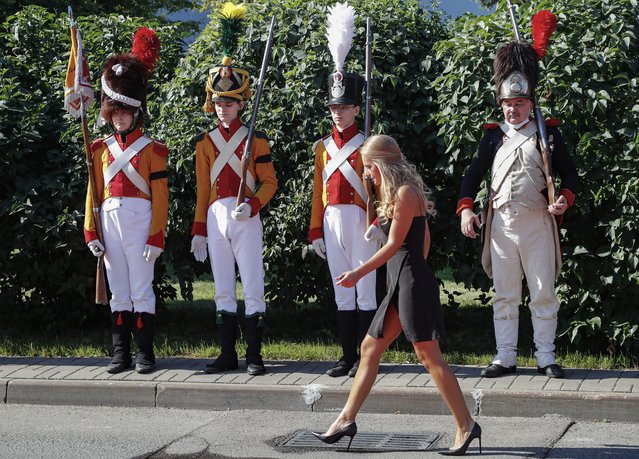
A woman passes Members of historical clubs dressed in the uniform of French soldiers during ceremony of repatriation of the remains of French General Charles-Etienne Gudin de la Sablonniere, participant in the French Revolutionary wars and Napoleonic wars, to France in Moscow airport Vnukovo-3, Russia, 13 July 2021. One of Napoleon Bonaparte's favourite military commanders died in the Battle of Smolensk during the Russian campaign of 1812. The search for his remains was one of the main goals of the joint archaeological expedition, which the historians of the two countries, led by Pierre Malinowski, President of the Foundation for the Development of Russian- French Historical Initiatives, began in the summer of 2019. A significant find was made during excavations at the Royal Bastion in the Lopatinsky Garden of Smolensk. (Photo by Sergei Ilnitsky/EPA/EFE)

A woman passes Members of historical clubs dressed in the uniform of French soldiers during ceremony of repatriation of the remains of French General Charles-Etienne Gudin de la Sablonniere, participant in the French Revolutionary wars and Napoleonic wars, to France in Moscow airport Vnukovo-3, Russia, 13 July 2021. (Photo by Sergei Ilnitsky/EPA/EFE)
Details
23 Jul 2021 09:07:00
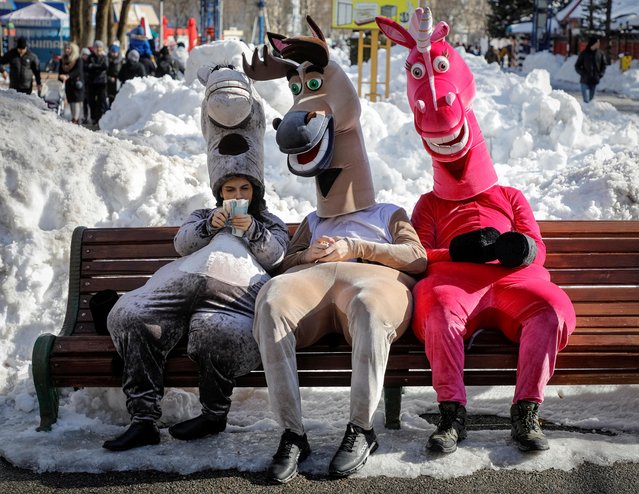
Street animators wearing fancy costumes take a break on a bench in a park in Stavropol, Russia on March 14, 2021. (Photo by Eduard Korniyenko/Reuters)

Street animators wearing fancy costumes take a break on a bench in a park in Stavropol, Russia on March 14, 2021. (Photo by Eduard Korniyenko/Reuters)
Details
21 Mar 2021 08:45:00
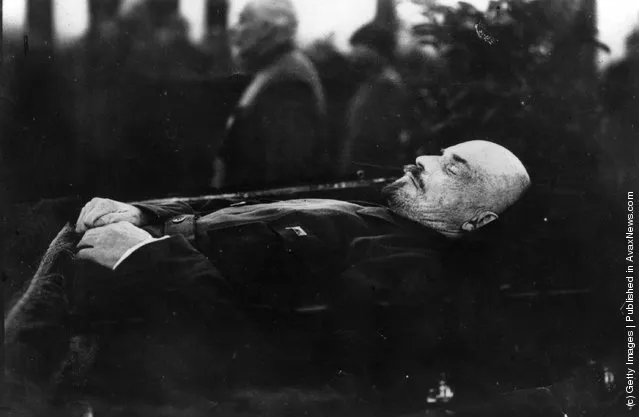
1924:  Vladimir Ilyich Lenin lying in state in the Kremlin

Photo: Vladimir Ilyich Lenin (1870 – 1924) lying in state in the Kremlin. (Photo by Hulton Archive/Getty Images). 1924

Important! For the same article in Russian language click here.

Something quite intriguing is happening within Russian-speaking internet during the last few – should you type a fully academic inquiry (at least, according to Russian academic requirements) in national search engines for "Lenin's mausoleum" – the first thing you get (even in top 10 searches) is website pages talking about black magic and occult. Website authors view this construction differently, but unconditionally agree on one thing: the mausoleum of the "leader of the world proletariat” – the essence of a magical artifact, a sort of “energy vampire”. It was built with a certain purpose: to drain the energy out of miserable Soviet citizens on one hand; and to poison the anthroposphere of one-sixth part of the earth with its vibes (the exact territory that was occupied by the former Soviet Union), depriving the Russian people of will to resist on the other hand. Complete nonsense? No doubt. Nevertheless, an intriguing one. Well, probably because some oddities do exist in mausoleum's history. These oddities are the thing we are going to discuss this time. First, let me refresh you memory on the subject.
Details
16 Oct 2011 11:27:00
Surma tribe at a blood drinking ritual

“Suri tribes boys are collecting the blood of a cow in a calabash the vein of the animal was opened with a bow and an arrow. Like most pastoralists the Surma people are drinking fresh blood which is from the cow vein. Only some minutes after the wound at the vein is closed again the animals are back with their herd”. (Photo and caption by Anthony Pappone)
Details
17 Nov 2013 11:12:00
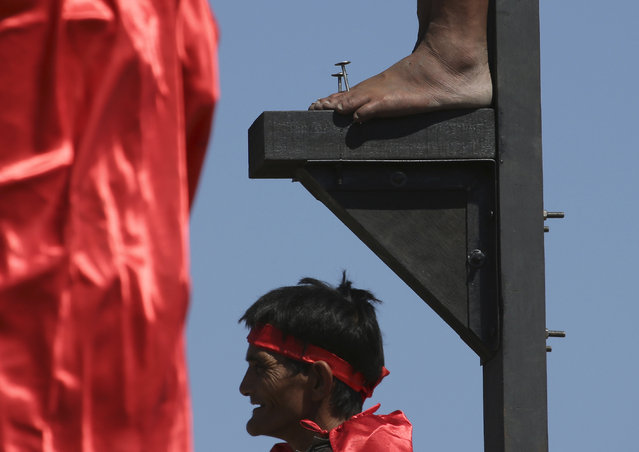
The feet of a Filipino penitent is nailed to a wooden cross during Good Friday rituals on April 3, 2015 at Cutud, Pampanga province, northern Philippines. Several Filipino devotees had themselves nailed to crosses Friday to remember Jesus Christ's suffering and death, an annual rite frowned upon by church leaders in this predominantly Roman Catholic country. (Photo by Aaron Favila/AP Photo)

The feet of a Filipino penitent is nailed to a wooden cross during Good Friday rituals on April 3, 2015 at Cutud, Pampanga province, northern Philippines. Several Filipino devotees had themselves nailed to crosses Friday to remember Jesus Christ's suffering and death, an annual rite frowned upon by church leaders in this predominantly Roman Catholic country. (Photo by Aaron Favila/AP Photo)
Details
05 Apr 2015 11:14:00
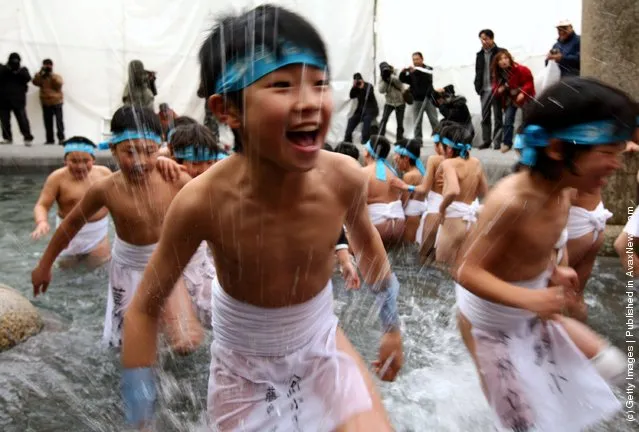
Japanese children wear loincloths as they splash about in freezing cold water during Saidaiji Naked Festival, at Saidaiji Temple

“A Hadaka Matsuri (“Naked Festival”) is a type of Japanese festival, or matsuri, in which participants wear a minimum amount of clothing; usually just a Japanese loincloth (called fundoshi), sometimes with a short happi coat, and rarely completely naked. Whatever the clothing, it is considered to be above vulgar, or everyday, undergarments, and on the level of holy Japanese shrine attire. Naked festivals are held in dozens of places throughout Japan every year, usually in the summer or winter. The most famous festival is held in Okayama, where the festival originated. Every year, over 9,000 men participate in this festival”. – Wikipedia

Photo: Japanese men wear loincloths as they splash about in freezing cold water during Saidaiji Naked Festival, at Saidaiji Temple on February 18, 2012 in Okayama, Japan. (Photo by Buddhika Weerasinghe/Getty Images)

Details
19 Feb 2012 12:18:00
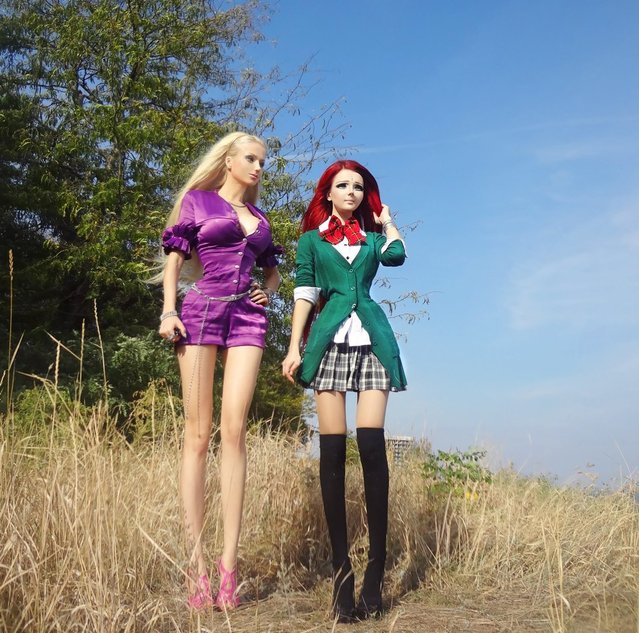
Human Dolls: Anastasiya Shpagina with Valeria Lukyanova. (Photo by Anastasiya Shpagina & Valeria Lukyanova)

“Anastasiya Shpagina is one of the famous women who have transformed themselves into looking like human dolls. Hailing from Ukraine, 19-year-old Anastasiya Shpagina always loved Japanese cartoon characters, and has dreamed of becoming a living doll that appears in animes. She transformed her look into something that can be seen in the pages of a manga book”.

Photo: “Human Anime Doll” Anastasiya Shpagina (R) with “Human Barbie Doll” Valeria Lukyanova. (Photo by Anastasiya Shpagina & Valeria Lukyanova)
Details
15 Dec 2012 10:46:00
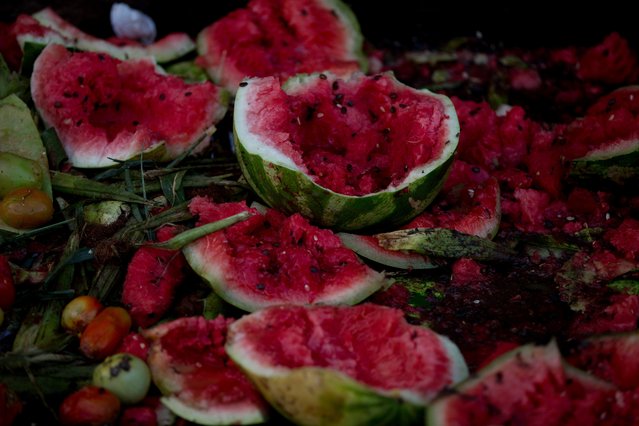
In this May 31, 2016 photo, pieces of watermelon litter the trash area of the Coche public market in Caracas, Venezuela. Staples such as corn flour and cooking oil are subsidized, costing pennies at the strongest of two official exchange rates. But fruit and vegetables have become an unaffordable luxury for many Venezuelan families. (Photo by Fernando Llano/AP Photo)

In this May 31, 2016 photo, pieces of watermelon litter the trash area of the Coche public market in Caracas, Venezuela. Staples such as corn flour and cooking oil are subsidized, costing pennies at the strongest of two official exchange rates. But fruit and vegetables have become an unaffordable luxury for many Venezuelan families. (Photo by Fernando Llano/AP Photo)
Details
08 Jun 2016 10:21:00