Loading...
Done
This picture taken on January 1, 2014 shows giant panda “Li Li” sleeping on a tree in Hangzhou Wild Animal World in Hangzhou, east China's Zhejiang province. Giant pandas, notorious for their low s*x drive, are among the world's most endangered animals. Fewer than 1,600 pandas remain in the wild, mainly in China's Sichuan province, with a further 300 in captivity around the world. (Photo by AFP Photo)

This picture taken on January 1, 2014 shows giant panda “Li Li” sleeping on a tree in Hangzhou Wild Animal World in Hangzhou, east China's Zhejiang province. Giant pandas, notorious for their low s*x drive, are among the world's most endangered animals. Fewer than 1,600 pandas remain in the wild, mainly in China's Sichuan province, with a further 300 in captivity around the world. (Photo by AFP Photo)
Details
04 Jan 2014 14:58:00
French army deminers secure a helicopter in a hangar at the Gao airport, on February 9, 2013. Two Malian soldiers and four civilians have already been killed by landmines, and French troops are still fighting off what Paris called “residual jihadists” in reclaimed territory. (Photo by Pascal Guyot/AFP Photo/The Atlantic)

French army deminers secure a helicopter in a hangar at the Gao airport, on February 9, 2013. Two Malian soldiers and four civilians have already been killed by landmines, and French troops are still fighting off what Paris called “residual jihadists” in reclaimed territory. (Photo by Pascal Guyot/AFP Photo via The Atlantic)
Details
28 Feb 2013 12:00:00
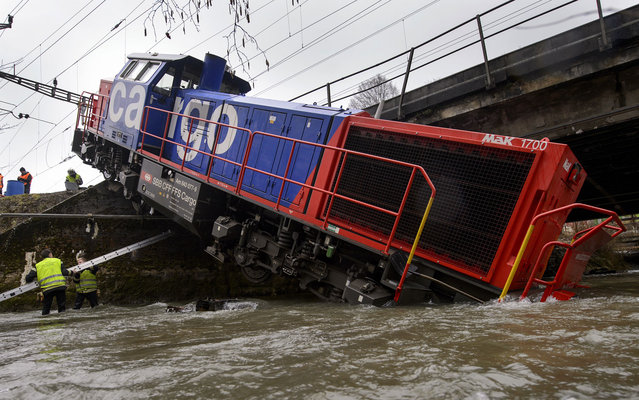
A diesel locomotive has ended up in the river Venoge on March 8, 2013 near Penthalaz, Western Switzerland. The freight locomotive derailed near Cossonez railway station with its driver slightly injured. (Photo by Fabrice Coffrini/AFP Photo)

A diesel locomotive has ended up in the river Venoge on March 8, 2013 near Penthalaz, Western Switzerland. The freight locomotive derailed near Cossonez railway station with its driver slightly injured. (Photo by Fabrice Coffrini/AFP Photo)
Details
09 Mar 2013 12:26:00
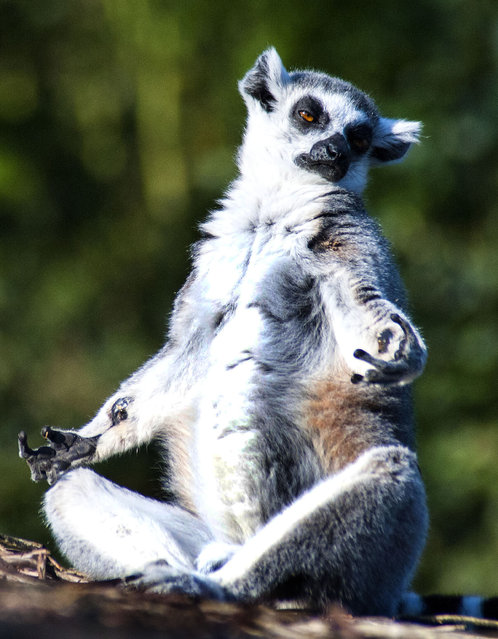
This lemur looks like he is channelling the spirit of Buddha – as he sits meditating. Sitting with his legs crossed, the lemur clasps his thumb and fore finger together with outstretched arms – just like the spiritual teacher. And amateur snapper Sebastien Degardin, 32, was on hand to capture the bizarre moment the animal searched for enlightenment on film. (Photo by Sebastien Degardin/Caters News)

This lemur looks like he is channelling the spirit of Buddha – as he sits meditating. Sitting with his legs crossed, the lemur clasps his thumb and fore finger together with outstretched arms – just like the spiritual teacher. And amateur snapper Sebastien Degardin, 32, was on hand to capture the bizarre moment the animal searched for enlightenment on film. Sebastien, who moved from his native Belgium to Finchley, North London, said: “I was gobsmacked when I saw this lemur meditating”. (Photo by Sebastien Degardin/Caters News)
Details
13 Apr 2014 10:18:00
Ocean voyage

Do you think that history is a science? Well, not exactly. First, and foremost, history is the state's “legend of wars”, it’s official regalia. Of course, public historians are not interested in scientific truth – quite the opposite. In this respect, any attempt to present a state’s history as altruistic and benevolent as possible is welcomed and encouraged – as opposed to any revisionism attempts that may be more accurate. In this matter, Chinese have surpassed us all – they revised in highly creative manner (but rather shamelessly) the technology already invented by Europeans, a process that resulted in oldest state on the planet. Here is an interesting paradox: ask any sinologist about the Middle Kingdom during second century B.C., and he will describe it to you in such a vivid manner as if he has been living there all his life – but as soon as you will ask him to describe Chinese history in the 19-20th centuries… let's say, his eagerness will be greatly diminished. However, we will discuss China in a different article, and in the meantime we will try to understand how exactly historic “legend of wars” is formed and functions – based on a specific and well-known example. A great example is Ferdinand Magellan's first voyage around the world.

Details
14 Nov 2011 09:11:00
Takeoka Chisaka, Hiroshima, Japan. “One morning in August 1945, I was walking home from the night shift at a factory in Hiroshima. As I reached my door, there was a huge explosion. When I came to, my head was bleeding and I had been blasted 30m away”. (Photo and caption by Sasha Maslov)

Takeoka Chisaka, Hiroshima, Japan. “One morning in August 1945, I was walking home from the night shift at a factory in Hiroshima. As I reached my door, there was a huge explosion. When I came to, my head was bleeding and I had been blasted 30m away. The atomic bomb had detonated. When I found my mother, her eyes were badly burned. A doctor said they had to come out, but he didn’t have the proper tools so used a knife instead. It was hellish. I became a peace-worker after the war. In the 1960s, at a meeting at the UN, I met one of the people who created the atomic bomb. He apologised”. (Photo and caption by Sasha Maslov)
Details
11 May 2015 11:56:00
People visit an art installation “Alley of Flying Umbrellas” in central St. Petersburg, Russia, May 15, 2015. Art installation inspired by “Umbrella Sky Project” of Portuguese town of Agueda and was made of 500 colored umbrellas. (Photo by Anatoly Maltsev/EPA)

People visit an art installation “Alley of Flying Umbrellas” in central St. Petersburg, Russia, May 15, 2015. Art installation inspired by “Umbrella Sky Project” of Portuguese town of Agueda and was made of 500 colored umbrellas. (Photo by Anatoly Maltsev/EPA)
Details
19 May 2015 12:13:00
An animal rights protester demonstrates for the abolition of bull runs and bullfights, three days before the start of the famous running of the bulls San Fermin festival in Pamplona, northern Spain, July 4, 2015. (Photo by Eloy Alonso/Reuters)

An animal rights protester demonstrates for the abolition of bull runs and bullfights, three days before the start of the famous running of the bulls San Fermin festival in Pamplona, northern Spain, July 4, 2015. (Photo by Eloy Alonso/Reuters)
Details
05 Jul 2015 10:45:00