Loading...
Done
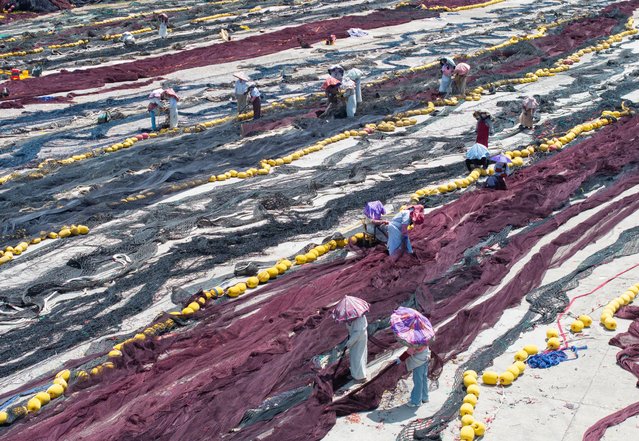
Aerial view of workers repairing fishing nets in preparation for a new round of fishing season on July 27, 2025 in Wenling, Taizhou City, Zhejiang Province of China. (Photo by Zhu Haiwei/Zhejiang Daily Press Group/VCG via Getty Images)

Aerial view of workers repairing fishing nets in preparation for a new round of fishing season on July 27, 2025 in Wenling, Taizhou City, Zhejiang Province of China. (Photo by Zhu Haiwei/Zhejiang Daily Press Group/VCG via Getty Images)
Details
08 Aug 2025 03:13:00
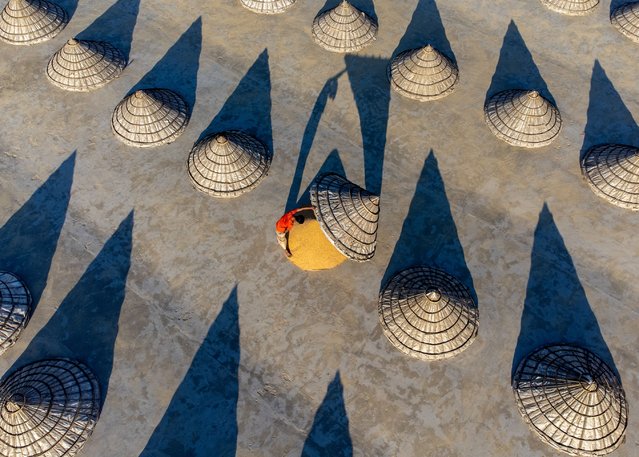
Giant bamboo cones, used to protect rice from overnight moisture during its drying process, in the Brahmanbaria district of Bangladesh in the second decade of April 2025. (Photo by Bipul Ahmed/Solent News & Photo Agency)

Giant bamboo cones, used to protect rice from overnight moisture during its drying process, in the Brahmanbaria district of Bangladesh in the second decade of April 2025. (Photo by Bipul Ahmed/Solent News & Photo Agency)
Details
09 Sep 2025 02:54:00


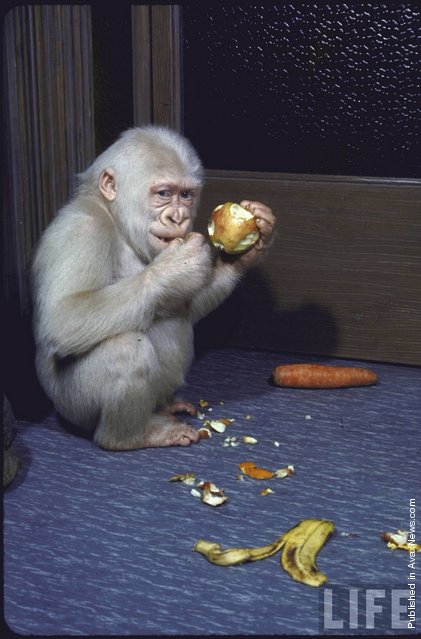
“Snowflake (c. 1964 – November 24, 2003) was an albino gorilla. He was the only known albino gorilla so far, and the most popular resident of the Barcelona Zoo in Catalonia, Spain. Originally named Nfumu Ngui in Fang language ("white gorilla") by his captor, he was then nicknamed Floquet de Neu (Catalan for little snowflake) by his keeper Jordi Sabater Pi. On his arrival to Barcelona where he was given an official reception by the then Mayor of Barcelona, Josep Maria de Porcioles, in November 1966, he was called Blancanieves (“Snow White”) in the newspaper Tele/Exprés. But he became famous with the name given to him by Sabater when National Geographic Magazine featured him on the main page in March 1967, with the English name Snowflake. This name spread among the press (Stern, Life, Paris-Match) and was later translated to Spanish as Copito de Nieve. Sabater himself called the gorilla Floquet or Copi, and in the later years Nfumu. The asteroid 95962 Copito, discovered by Catalan astronomer J. Manteca, is named in his honour”.

Details
07 Mar 2011 15:50:00
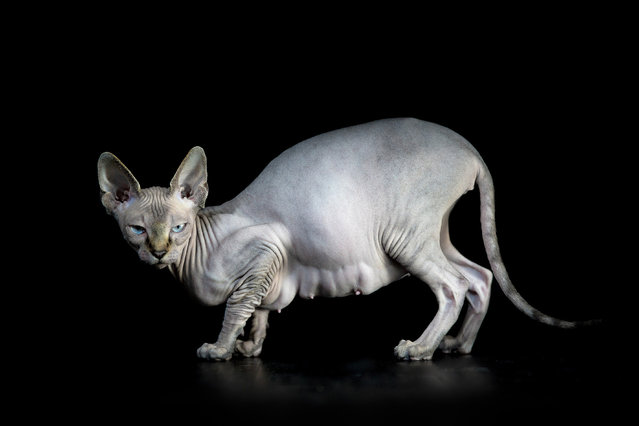
A photographer has captured the bizarre beauty of sphynx cats in a series of intriguing portraits. Creative Alicia Rius snapped them from different angles showing off their unusual flesh, colourings and bones. (Photo by Alicia Rius/Caters News)

A photographer has captured the bizarre beauty of sphynx cats in a series of intriguing portraits. Creative Alicia Rius snapped them from different angles showing off their unusual flesh, colourings and bones. In the images the cats can be seen curiously playing, observing their surroundings and even grooming themselves. (Photo by Alicia Rius/Caters News)
Details
16 Apr 2015 12:41:00
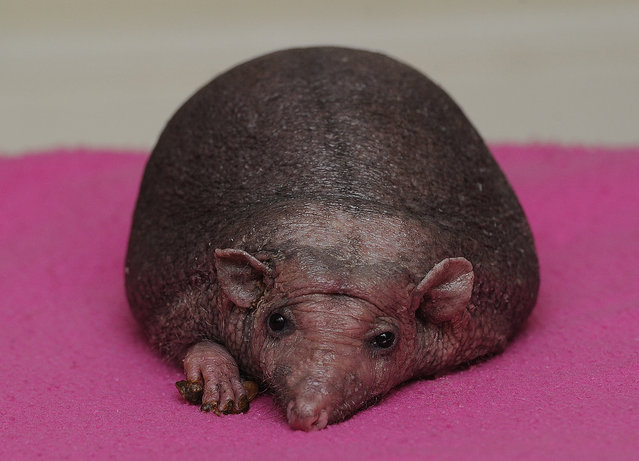
Meet the world's smoothest cuddliest hedgehog. Names after brave hero, but Nelson is completely bald so when curled up he looks like an egg. Doesn't have a single prickle or strand of hair. Thought to be suffering a stress related alopecia following a trauma in the wild. Volunteers have been massaging him for half an hour a day for the last year to encourage spikes to grow. Now given up but he still gets daily massages because he enjoys them so much and to keep his cuddle skin soft and smooth. Unlike his namesake Nelson could not defend himself so will live out his days at the Foxy Lodge Wildlife Rescue in Hemsby, England. (Photo by Jeremy Durkin)

Meet the world's smoothest cuddliest hedgehog. Names after brave hero, but Nelson is completely bald so when curled up he looks like an egg. Doesn't have a single prickle or strand of hair. Thought to be suffering a stress related alopecia following a trauma in the wild. Volunteers have been massaging him for half an hour a day for the last year to encourage spikes to grow. Now given up but he still gets daily massages because he enjoys them so much and to keep his cuddle skin soft and smooth. Unlike his namesake Nelson could not defend himself so will live out his days at the Foxy Lodge Wildlife Rescue in Hemsby, England. (Photo by Jeremy Durkin)
Details
23 Oct 2016 11:33:00
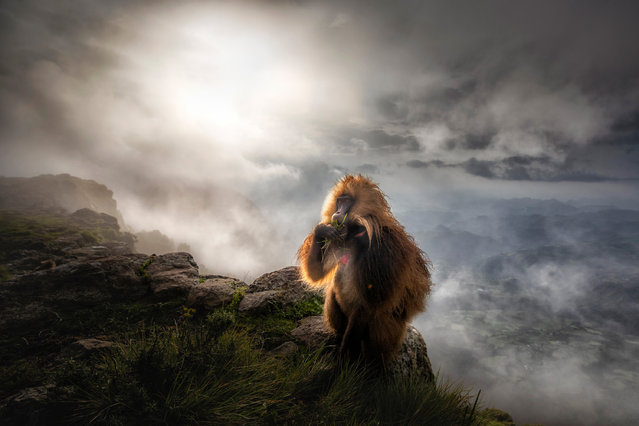
Highly commended, mammals: Gelada after the storm – Marco Gaiotti (Italy). “Gelada baboons are the only monkey species in the world that feed on grasses. They are native to the tableland of Ethiopia. Every morning large family groups wander from their sleeping places in the steep rock face, up to 1,000 metres high, to the feeding grounds at the tablelands. This image clearly depicts their feeding strategy: they pull out bunches of grass, sort the stalks and then lift them to their mouth. This shot was taken towards the end of the rainy season after a heavy storm”. (Photo by Marco Gaiotti/2019 GDT European Wildlife Photographer of the Year)

Highly commended, mammals: Gelada after the storm – Marco Gaiotti (Italy). “Gelada baboons are the only monkey species in the world that feed on grasses. They are native to the tableland of Ethiopia. Every morning large family groups wander from their sleeping places in the steep rock face, up to 1,000 metres high, to the feeding grounds at the tablelands. This image clearly depicts their feeding strategy: they pull out bunches of grass, sort the stalks and then lift them to their mouth. This shot was taken towards the end of the rainy season after a heavy storm”. (Photo by Marco Gaiotti/2019 GDT European Wildlife Photographer of the Year)
Details
31 Oct 2019 00:03:00
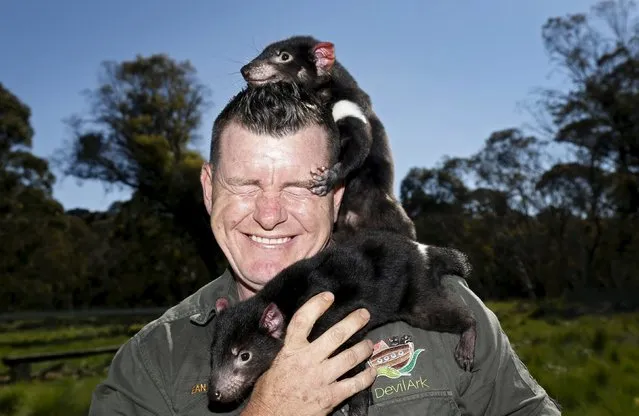
Devil Ark manager Dean Reid reacts as Tasmanian Devil joeys climb on him before the first shipment of healthy and genetically diverse devils to the island state of Tasmania leave the Devil Ark sanctuary in Barrington Tops on Australia's mainland, November 17, 2015. The largest group so far of disease-free Tasmanian devils has been released in the wild, as part of plans to save the carnivorous marsupials from a cancer threatening them with extinction. (Photo by Jason Reed/Reuters)

Devil Ark manager Dean Reid reacts as Tasmanian Devil joeys climb on him before the first shipment of healthy and genetically diverse devils to the island state of Tasmania leave the Devil Ark sanctuary in Barrington Tops on Australia's mainland, November 17, 2015. The largest group so far of disease-free Tasmanian devils has been released in the wild, as part of plans to save the carnivorous marsupials from a cancer threatening them with extinction. (Photo by Jason Reed/Reuters)
Details
21 Nov 2015 08:05:00
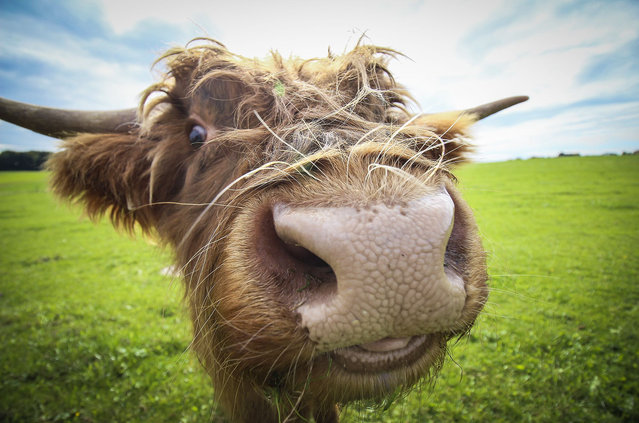
A hungry cow smiles for the camera in Salzburg, Austria. One of a series of funny animal mugshots taken by Chanel Cartell and Stevo Dirnberger during their travels around the globe. (Photo by Chanel Cartell/Stevo Dirnberger/Rex Features/Shutterstock)

A hungry cow smiles for the camera in Salzburg, Austria. One of a series of funny animal mugshots taken by Chanel Cartell and Stevo Dirnberger during their travels around the globe. (Photo by Chanel Cartell/Stevo Dirnberger/Rex Features/Shutterstock)
Details
13 Jun 2016 11:03:00