Loading...
Done
Afghanistan: Dogs of War Part 1

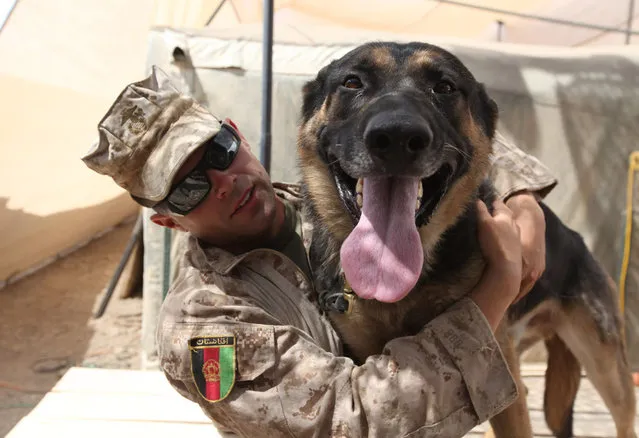
Throughout the course of the long war in Afghanistan, Coalition troops have relied on thousands of military working dogs to help keep them safe, and make their jobs easier. The dogs are trained to detect explosives, to find illegal drugs, to search for missing comrades, or target enemy combatants. Not only are they active on the front lines, but behind the lines they serve as therapy dogs, service dogs, and loyal companions. They also share the same risks as the ground troops, suffering injuries and sometimes death on the battlefields. Gathered here are images of these dogs and their handlers in Afghanistan and back home, from over the past several years, part of the ongoing series here on Afghanistan.
Details
03 Jun 2014 21:02:00
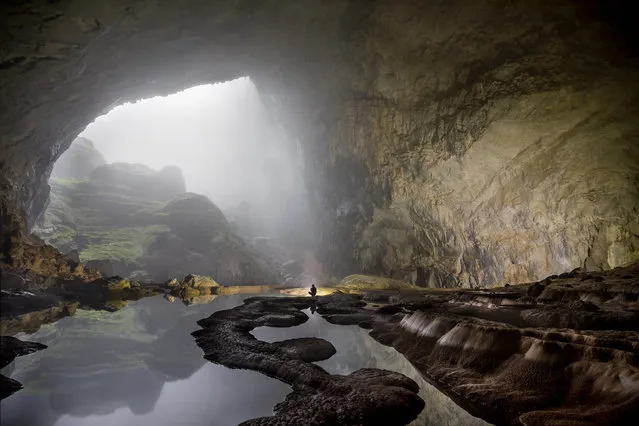
Vietnam’s Son Doong cave, the largest in the world, could hold a 40-story skyscraper inside. The pristine ecosystem has its own river and jungle. Despite its size, Son Doong wasn’t discovered until 1991. It was lost again for nearly two decades and was fully explored for the first time in 2009. (Photo by Jason Speth/HuffPost)

Vietnam’s Son Doong cave, the largest in the world, could hold a 40-story skyscraper inside. The pristine ecosystem has its own river and jungle. Despite its size, Son Doong wasn’t discovered until 1991. It was lost again for nearly two decades and was fully explored for the first time in 2009. (Photo by Jason Speth/HuffPost)
Details
27 Mar 2017 08:37:00
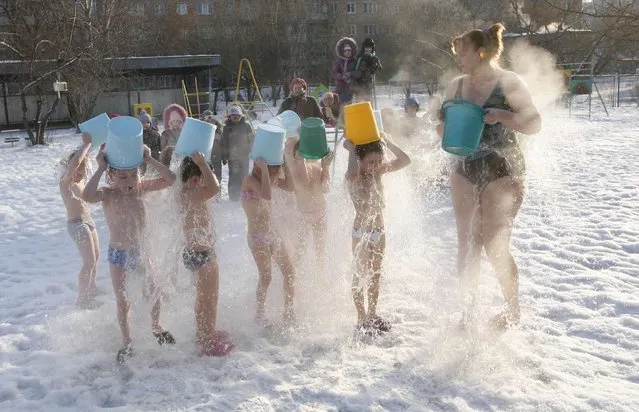
Children pour cold water on themselves under the control of fitness coach Margarita Filimonova (R) at local kindergarten number 317, with the air temperature at about minus 23 degrees Celsius (minus 9.4 degrees Fahrenheit), in Russia's Siberian city of Krasnoyarsk, February 5, 2013. (Photo by Ilya Naymushin/Reuters)

Children pour cold water on themselves under the control of fitness coach Margarita Filimonova (R) at local kindergarten number 317, with the air temperature at about minus 23 degrees Celsius (minus 9.4 degrees Fahrenheit), in Russia's Siberian city of Krasnoyarsk, February 5, 2013. (Photo by Ilya Naymushin/Reuters)

P.S. All pictures are presented in high resolution. To see Hi-Res images – just TWICE click on any picture. In other words, click small picture – opens the BIG picture. Click BIG picture – opens VERY BIG picture (if available; this principle works anywhere on the site AvaxNews).
Details
17 Feb 2013 15:40:00
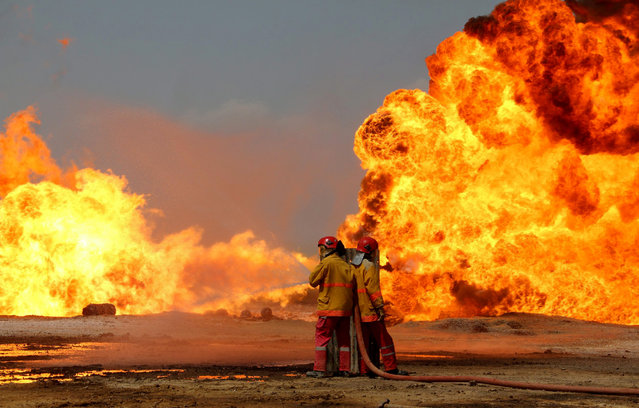
Iraqi firefighters try to stop the fire of burning oil wells in Kirkuk, northern Iraq, 02 June 2016. Two Khabbaz oil field wells in Kirkuk Province, northern Iraq, exploded by suspected insurgents, a security official said. (Photo by EPA/Stringer)

Iraqi firefighters try to stop the fire of burning oil wells in Kirkuk, northern Iraq, 02 June 2016. Two Khabbaz oil field wells in Kirkuk Province, northern Iraq, exploded by suspected insurgents, a security official said. (Photo by EPA/Stringer)
Details
12 Nov 2016 10:42:00
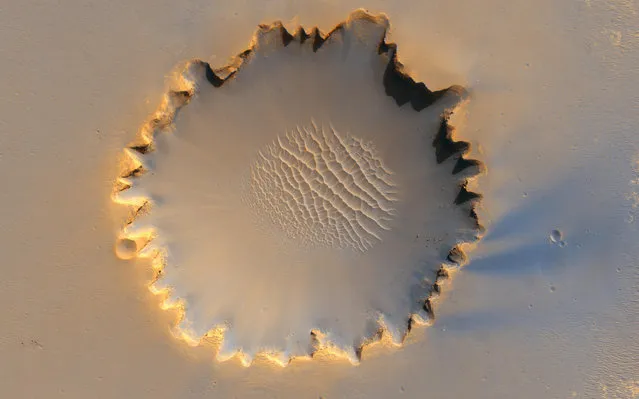
NASA's rover Opportunity visits Victoria Crater, viewed from orbit by the High Resolution Imaging Science Experiment on NASA's Mars Reconnaissance Orbiter in october of 2006. Opportunity is a small dot on the crater's lip, at top right. Opportunity first reached the crater's rim on September 27, 2006. (Photo by NASA/JPL-Caltech/University of Arizona/The Atlantic)

“NASA's Mars rover Opportunity just celebrated its ninth anniversary on Mars – a mission that was originally meant to last just 90 days...” – The Atlantic. Photo: NASA's rover Opportunity visits Victoria Crater, viewed from orbit by the High Resolution Imaging Science Experiment on NASA's Mars Reconnaissance Orbiter in october of 2006. Opportunity is a small dot on the crater's lip, at top right. Opportunity first reached the crater's rim on September 27, 2006. (Photo by NASA/JPL-Caltech/University of Arizona via The Atlantic)


Details
14 Feb 2013 10:58:00
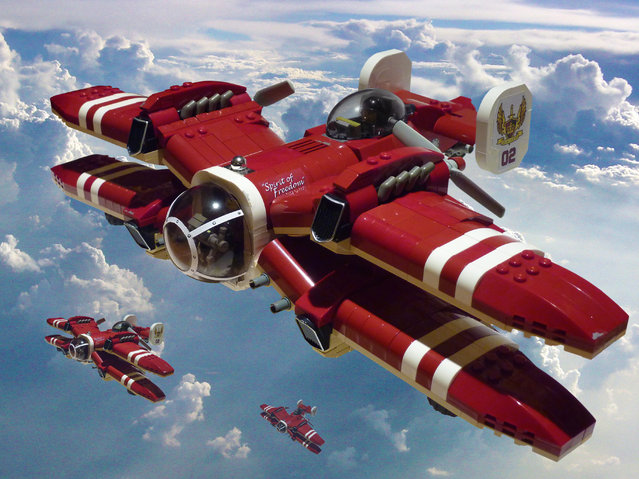
“The V-30 Warhawk was designed by Blackshaw Avionics as a long-range fighter and was primarily used by the Arcadian Air Force for escort duties. . (Jon Hall)

“The V-30 Warhawk was designed by Blackshaw Avionics as a long-range fighter and was primarily used by the Arcadian Air Force for escort duties. The plane pictured is the “Spirit of Freedom” and was one of the four planes that escorted the Arcadian Royal Airship during and after the Great War. The three other fighters were the “Spirit of Hope”, the “Spirit of Justice” and the “Spirit of Destiny”. All pilots were hand-picked by the Head of Airborne Forces and included some of the very finest pilots in the Kingdom. The crew consisted of one pilot and one gunner although both cabins were fitted so that if either crew member was killed the other could take over their duties. Each Warhawk was fitted with four Haverlock “Banshee” engines and four 24mm machine guns”. (Photo and comment by Jon Hall)


Details
11 Feb 2013 10:36:00
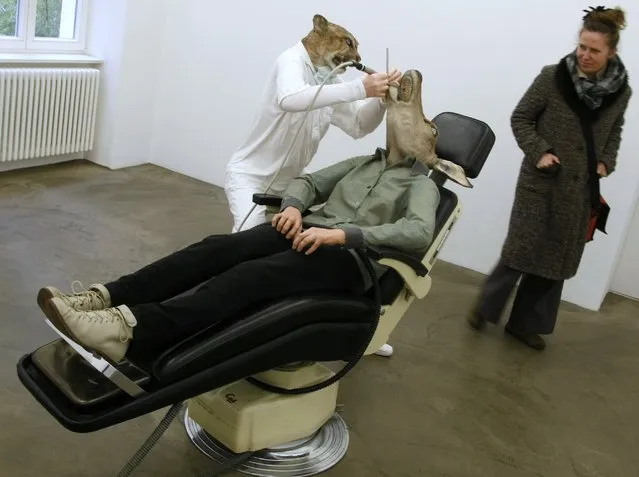
A visitor passes behind the sculpture “Puma-Dentist” made with plastic, wax and original heads of a puma and a hind by Austrian artist Deborah Sengl during an exhibition at the art gallery Deschler in Berlin April 15, 2008. (Photo by Fabrizio Bensch/Reuters)

A visitor passes behind the sculpture “Puma-Dentist” made with plastic, wax and original heads of a puma and a hind by Austrian artist Deborah Sengl during an exhibition at the art gallery Deschler in Berlin April 15, 2008. (Photo by Fabrizio Bensch/Reuters)
Details
11 Mar 2014 07:55:00
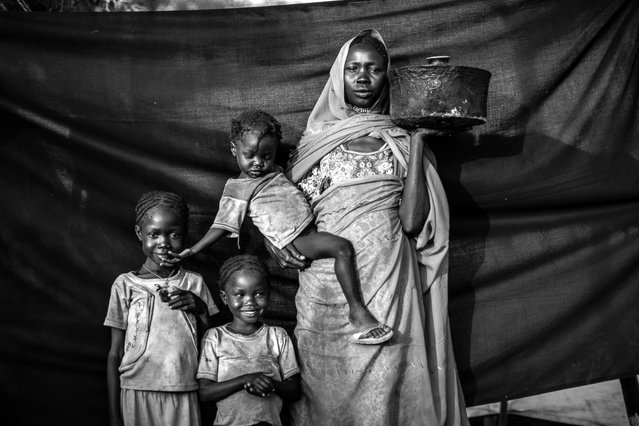
Magbola Alhadi, 20, and her three children pose for a portrait in Jamam refugee camp in Maban County, South Sudan on August 11th, 2012. Magboola and her family weathered aerial bombing raids for several months, but decided it was time to leave their village of Bofe the night that soldiers arrived and opened fire. (Photo by Brian Sokol/Panos Pictures)

Magbola Alhadi, 20, and her three children pose for a portrait in Jamam refugee camp in Maban County, South Sudan on August 11th, 2012. Magboola and her family weathered aerial bombing raids for several months, but decided it was time to leave their village of Bofe the night that soldiers arrived and opened fire. With her three children, she travelled for 12 days from Bofe to the town of El Fudj, on the South Sudanese border. The most important thing that Magboola was able to bring with her is the saucepan she holds in this photograph. It wasn't the largest pot that she had in Bofe, but it was small enough she could travel with it, yet big enough to cook sorghum for herself and her three daughters (from left: Aduna Omar, 6, Halima Omar, 4, and Arfa Omar, 2) during their journey. (Photo by Brian Sokol/Panos Pictures)
Details
18 Sep 2015 15:04:00