Loading...
Done
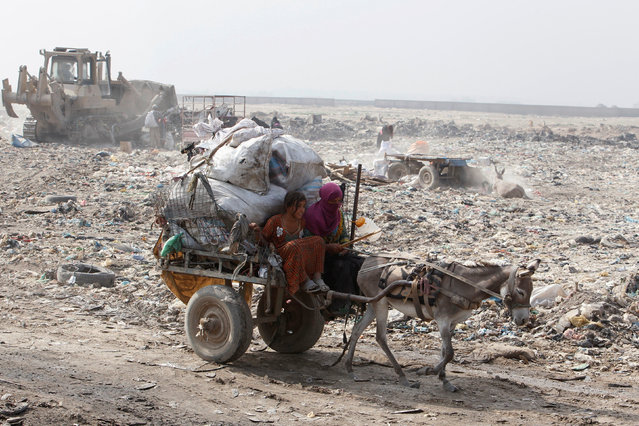
Garbage pickers collect ride on donkey cart while looking for recyclable materials at a rubbish dump in the outskirts of Baghdad, Iraq, August 23, 2016. Despite its huge untapped oil and gas reserves and steadily rising oil output and revenue, 23 percent of the population live below the poverty line, according to the Ministry of Planning. Eg, for 12-year-old Mohammed, life in Sadr City means long days during his school holidays scrabbling through the refuse in the scorching summer heat before selling his daily haul to a middleman. He sells each kilogram (2.2 lb) of plastic bottles or soda cans for 250 Iraqi dinars (around 20 U.S. cents), earning between 2,000 to 4,000 dinars ($1.50–$3) a day. A International Labor Organization report listing dangerous jobs in which children are engaged across the world mentioned collecting garbage as one of the activities in which minors risked suffering violence and injury. (Photo by Khalid al Mousily/Reuters)

Garbage pickers collect ride on donkey cart while looking for recyclable materials at a rubbish dump in the outskirts of Baghdad, Iraq, August 23, 2016. Despite its huge untapped oil and gas reserves and steadily rising oil output and revenue, 23 percent of the population live below the poverty line, according to the Ministry of Planning. (Photo by Khalid al Mousily/Reuters)
Details
24 Aug 2016 11:52:00
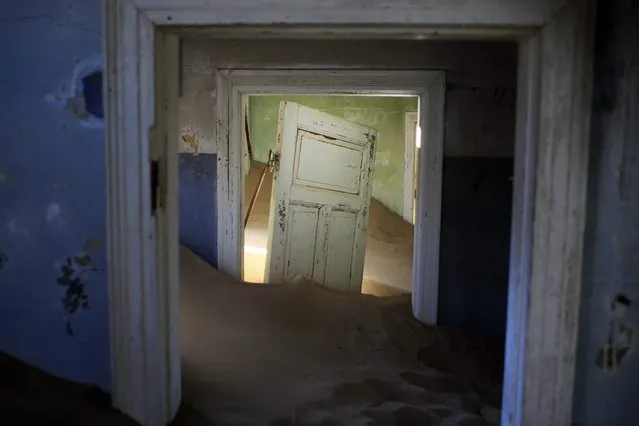
In this July 23, 2013 photo, sand fills an abandoned house in Kolmanskop, Namibia. Kolmanskop, was a diamond mining town south of Namibia, build in 1908 and deserted in 1956. SInce then, the desert slowly reclaims its territory, with sand invading the buildings where 350 German colonists and more than 800 local workers lived during its hay-days of the 1920s. (Photo by Jerome Delay/AP Photo)

In this July 23, 2013 photo, sand fills an abandoned house in Kolmanskop, Namibia. Kolmanskop, was a diamond mining town south of Namibia, build in 1908 and deserted in 1956. SInce then, the desert slowly reclaims its territory, with sand invading the buildings where 350 German colonists and more than 800 local workers lived during its hay-days of the 1920s. (Photo by Jerome Delay/AP Photo)
Details
14 Nov 2014 14:34:00
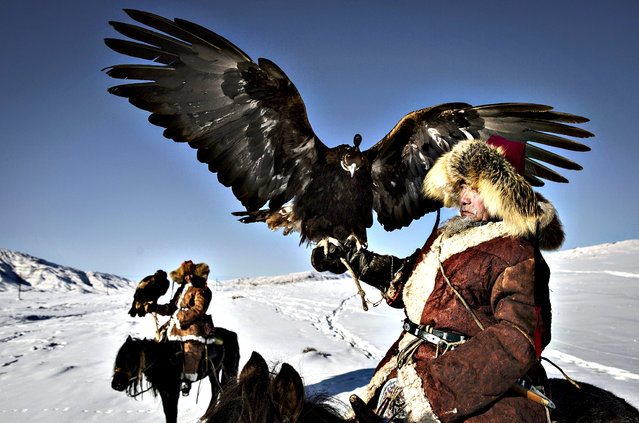
Chinese Kazakh eagle hunters sit on horseback as they travel to a local competition on January 29, 2015 in the mountains of Qinghe County, Xinjiang, northwestern China. The festival, organised by the local hunting community, is part of an effort to promote and grow traditional hunting practices for new generations in the mountainous region of western China that borders Kazakhstan, Russia and Mongolia. (Photo by Kevin Frayer/Getty Images)

Chinese Kazakh eagle hunters sit on horseback as they travel to a local competition on January 29, 2015 in the mountains of Qinghe County, Xinjiang, northwestern China. The festival, organised by the local hunting community, is part of an effort to promote and grow traditional hunting practices for new generations in the mountainous region of western China that borders Kazakhstan, Russia and Mongolia. The training and handling of the large birds of prey follows a strict set of ancient rules that Kazakh eagle hunters are preserving for future generations. (Photo by Kevin Frayer/Getty Images)
Details
07 Feb 2015 14:11:00
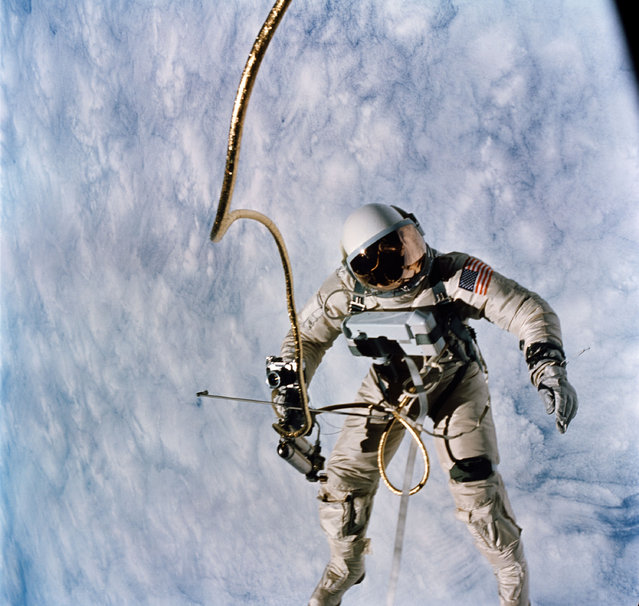
Astronaut Edward H. White II, pilot for the Gemini-Titan 4 (GT-4) spaceflight, floats in the zero-gravity of space during the third revolution of the GT-4 spacecraft on June 3, 1965. White wears a specially designed spacesuit. His face is shaded by a gold-plated visor to protect him from unfiltered rays of the sun. (Photo by NASA)

Astronaut Edward H. White II, pilot for the Gemini-Titan 4 (GT-4) spaceflight, floats in the zero-gravity of space during the third revolution of the GT-4 spacecraft on June 3, 1965. White wears a specially designed spacesuit. His face is shaded by a gold-plated visor to protect him from unfiltered rays of the sun. In his right hand he carries a Hand-Held Self-Maneuvering Unit (HHSMU) that gives him control over his movements in space. White also wears an emergency oxygen chest pack; and he carries a camera mounted on the HHSMU for taking pictures of the sky, Earth and the GT-4 spacecraft. He is secured to the spacecraft by a 25-feet umbilical line and a 23-feet tether line. Both lines are wrapped together in gold tape to form one cord. Astronaut James A. McDivitt, command pilot, remained inside the spacecraft during the extravehicular activity (EVA). Astronaut White died in the Apollo/Saturn 204 fire at Cape Kennedy on January 27, 1967. (Photo by NASA)
Details
22 Jul 2014 12:05:00
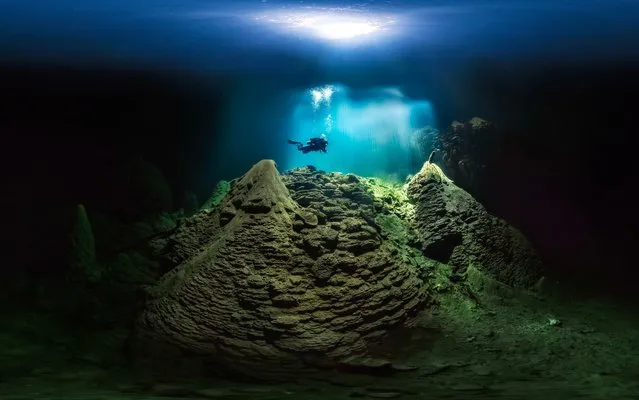
Cave Diver, Anhumas Abyss, Bonito, Brazil: The Anhumas Abyss is an underground cavern with a crystal-clear lake below, more than 260 feet (79 m) deep. A visitor must enter through a narrow opening at the top of the chamber and rappel into the cave. Snorkeling and scuba diving in the lake reveal amazing scenery. Distinctive, conical limestone stalagmites and stalactites occupy the lake and the surrounding area, some reaching 65 feet (20 m) high. “One must rappel about 235 feet (72 m) to get down into this deep lake. The photo was taken at a depth of 50 feet (15 m). It was a challenge to create the image because of the high contrast, plus the diver could not see into the darkness, making communication impossible”. (Photo by Marcio Cabral/Nature’s Best Photography Awards 2017)

Cave Diver, Anhumas Abyss, Bonito, Brazil: The Anhumas Abyss is an underground cavern with a crystal-clear lake below, more than 260 feet (79 m) deep. A visitor must enter through a narrow opening at the top of the chamber and rappel into the cave. Snorkeling and scuba diving in the lake reveal amazing scenery. Distinctive, conical limestone stalagmites and stalactites occupy the lake and the surrounding area, some reaching 65 feet (20 m) high. (Photo by Marcio Cabral/Nature’s Best Photography Awards 2017)
Details
26 Oct 2017 08:10:00


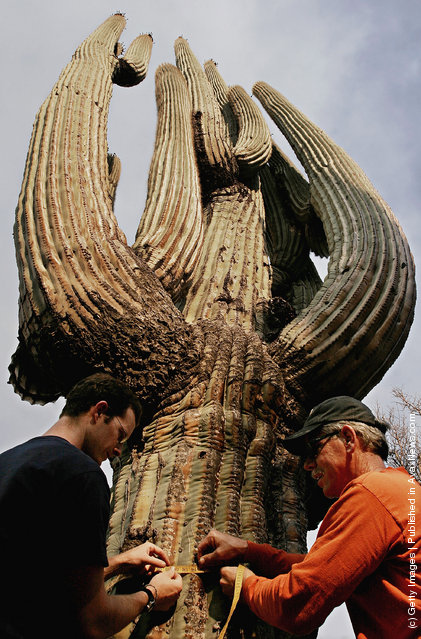
“The saguaro (scientific name Carnegiea gigantea) is a large, tree-sized cactus species in the monotypic genus Carnegiea. It is native to the Sonoran Desert in the U.S. state of Arizona, the Mexican state of Sonora, a small part of Baja California in the San Felipe Desert and an extremely small area of California, U.S. The saguaro blossom is the State Wildflower of Arizona”. – Wikipedia

Photo: Daniel Appel (L), a firefighter with Engine 84 from the Lassen National Forest in California and Mike Hallen, (R), Arizona representative of the National Register of Big Trees, measure the circumference of this Saguaro cactus called the "Grand One," in the Tonto National Forest on July 1, 2005 35 miles north of Phoenix, near Carefree, Arizona. The cactus, estimated to be more than 200 years old, measures a circumference of 7 feet, 10 inches (2.4 meters) and stands 46 feet high (14 meters). The cactus was burned in the Cave Creek Complex fire and may not survive. It was once the largest Saguaro in the world, two others have been found recently that have tied it's measurements. The fire has burned more than 214,000 acres of the Sonoran desert. (Photo by Jeff Topping/Getty Images)

Details
26 Jul 2011 12:27:00
Sport category, winner: Yuan Peng. Liu Bingqing and Liu Yujie are twin sisters who have studied and trained in gymnastics since their early childhood in Jining, China. (Photo by Yuan Peng/Sony World Photography Awards)

Sport category, winner: Yuan Peng. Liu Bingqing and Liu Yujie are twin sisters who have studied and trained in gymnastics since their early childhood in Jining, China. (Photo by Yuan Peng/Sony World Photography Awards)
Details
22 Apr 2017 09:14:00
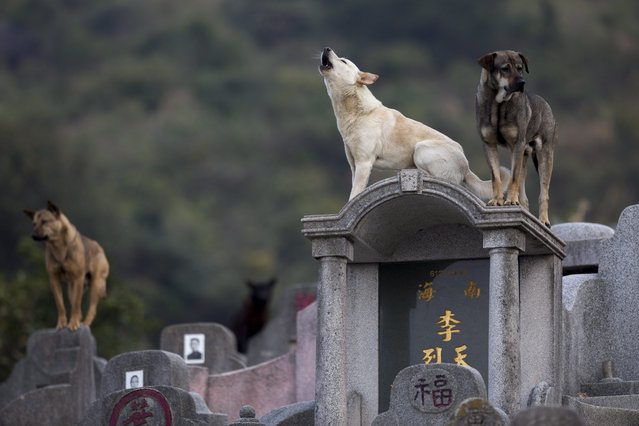
Stray dogs stand on tombs in Diamond Hill cemetery in Hong Kong, China, 04 April 2017. (Photo by Jerome Favre/EPA)

Stray dogs stand on tombs in Diamond Hill cemetery in Hong Kong, China, 04 April 2017. According to the lunar calendar, the Qingming Festival is observed on 04 April . The Qingming Festival, also known as Tomb-Sweeping Day, is marked by Chinese people by going to the cemetery to cleaning up tombs, bring flowers, and making offerings to their ancestors. (Photo by Jerome Favre/EPA)
Details
05 Apr 2017 09:30:00