Loading...
Done
Kha Tu Ngoc rests in her two- square- meter house in Ho Chi Minh City on May 2, 2018. (Photo by Thanh Nguyen/AFP Photo)

Kha Tu Ngoc rests in her two- square- meter house in Ho Chi Minh City on May 2, 2018. The “micro- house” dwellings are dotted throughout Vietnam' s bustling southern hub, occupied by families clinging to postage stamp- sized plots a city developing at breakneck pace. Tucked away in winding alleys, nestled under new condo developments or sandwiched between street food stalls and shops, the tiny houses are easily missed by the unattentive passerby. (Photo by Thanh Nguyen/AFP Photo)
Details
04 Jun 2018 00:01:00
A girl floats in a bucket in the village of Ologa in the western state of Zulia October 23, 2014. (Photo by Jorge Silva/Reuters)

A girl floats in a bucket in the village of Ologa in the western state of Zulia October 23, 2014. This year the Catatumbo Lightning was approved for inclusion in the 2015 edition of Guinness World Records, dethroning the Congolese town of Kifuka as the place with the world's most lightning bolts per square kilometer each year at 250. Scientists think the Catatumbo, named for a river that runs into the lake, is normal lightning that just happens to occur far more than anywhere else, due to local topography and wind patterns. (Photo by Jorge Silva/Reuters)
Details
09 Nov 2014 09:08:00
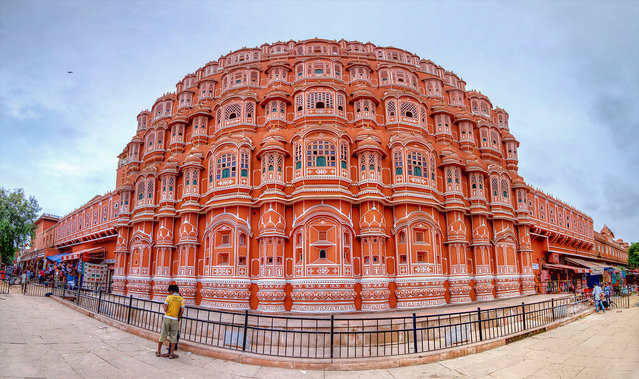
Hawa Mahal India

Hawa Mahal, which translates as the Palace of Winds, was built in 1799 by Maharaja Sawai Pratap Singh. The design of the palace was created by Shreyansh Jain to resemble the crown of Krishna. The design of this unique five-story building is akin to a honeycomb. The main purpose of this building was to allow royal ladies to watch the street below while remaining unseen, since during those times they had a strict code of dressing, which meant covering their faces. The palace was designed to produce the Venturi effect, which created natural air conditioning and kept the interior relatively cool during hot summers.
Details
22 Nov 2014 13:22:00
Women cover their heads with pans as they walk in a light rain brought by Hurricane Matthew in Port-au-Prince, Haiti, Tuesday, October 4, 2016. (Photo by Dieu Nalio Chery/AP Photo)

Women cover their heads with pans as they walk in a light rain brought by Hurricane Matthew in Port-au-Prince, Haiti, Tuesday, October 4, 2016. Matthew slammed into Haiti's southwestern tip with howling, 145 mph winds Tuesday, tearing off roofs in the poor and largely rural area, uprooting trees and leaving rivers bloated and choked with debris. (Photo by Dieu Nalio Chery/AP Photo)
Details
05 Oct 2016 09:14:00
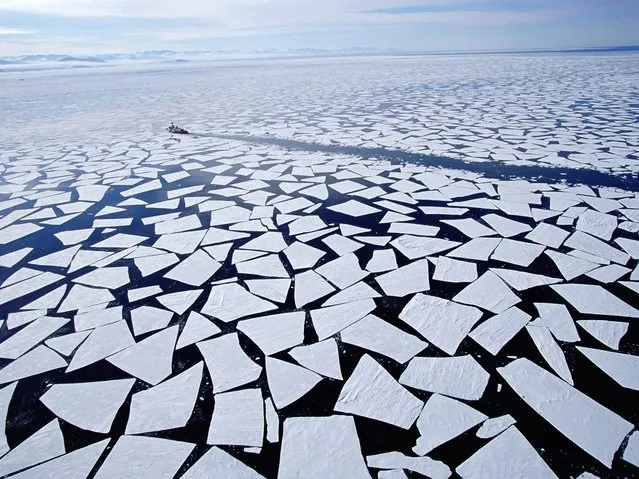
McMurdo Station Antarctic

McMurdo Station is a U.S. Antarctic research centre located on the southern tip of Ross Island, which is in the New Zealand-claimed Ross Dependency on the shore of McMurdo Sound in Antarctica. It is operated by the United States through the United States Antarctic Program, a branch of the National Science Foundation. The station is the largest community in Antarctica, capable of supporting up to 1,258 residents, and serves as the United States Antarctic science facility. All personnel and cargo going to or coming from Amundsen–Scott South Pole Station first pass through McMurdo.
Details
05 Sep 2013 10:18:00
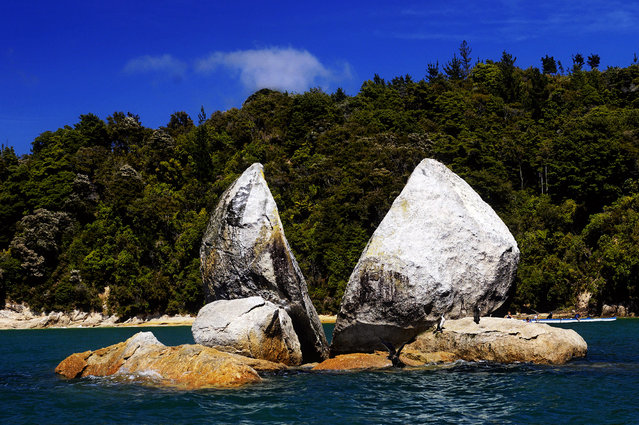
Split Apple Rock

Split Apple Rock is a geological rock formation in The Tasman Bay off the northern coast of the South Island of New Zealand. Made of granite, it is in the shape of an apple which has been cut in half. It is a popular tourist attraction in the waters of the Tasman Sea approximately 50 metres off the coast between Kaiteriteri and Marahau. The rock sits in shallow water at low tide and is accessible by wading. It is also a point of interest for the many tourist boats and pleasure craft which operate along the shores of the Abel Tasman National Park. The cleft to produce two sides of the 'apple' was a natural occurrence. It is unknown when this happened and therefore the cleaving of the rock has attracted mythological explanations.
Details
19 Oct 2013 10:58:00
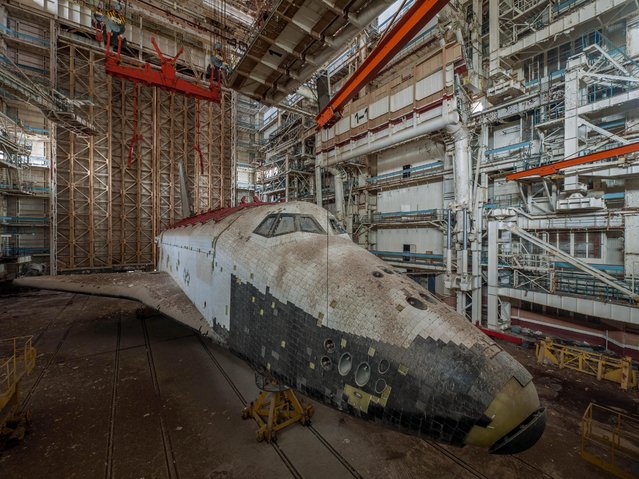
The shuttle never got its final coat of paint and was left unfinished. (Photo by Ralph Mirebs/Exclusivepix Media)

Ralph Mirebs, an urban explorer and photographer in Russia, has revealed extraordinary photos of Soviet space shuttle prototypes gathering dust in an abandoned hangar. The abandoned hangar is located at the Baikonur Cosmodrome in Kazakhstan, which is still in operation today (with the close of NASA’s shuttle program, Russian Soyuz shuttles are the only way for astronauts to reach the International Space Station). The Buran prototype shuttles found by Mirebs, however, are from an earlier era – they are the last remnants of a space program that began in 1974 and was finally shuttered in 1993. (Photo by Ralph Mirebs/Exclusivepix Media)
Details
12 Mar 2017 00:05:00
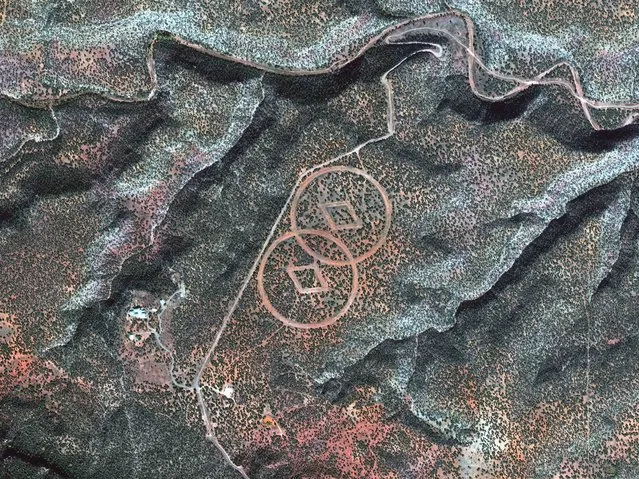
Trementina, New Mexico. (Photo by DigitalGlobe/Caters News)

These stunning photographs may look like alien planets, but they are actually satellite images of planet Earth. Commercial satellite company DigitalGlobe recently released the images as a way of highlighting the incredible detail of their imagery – the highest-resolution commercial satellite imagery in the world. Some of the images – taken above Afghanistan, Algeria, Peru, Russia and the United States – look more like abstract works by Mondrian than segments of the globe. DigitalGlobe, based in Westminster, Colo., launched its first satellite in 1999 and currently has four in operation. Here: Trementina, New Mexico. (Photo by DigitalGlobe/Caters News)
Details
02 Oct 2015 08:01:00