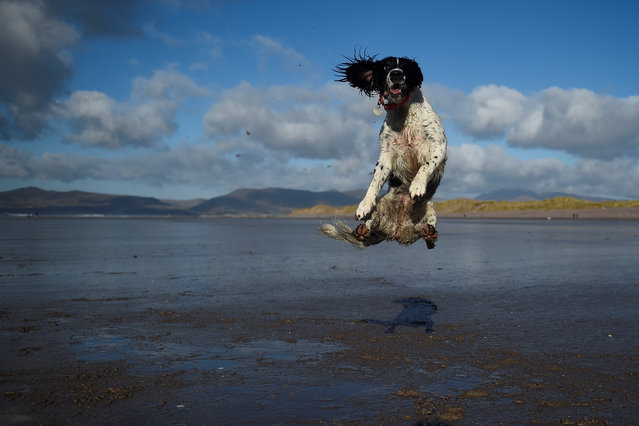
A dog jumps into the air to catch a ball along the beach near the County Kerry village of Rossbeigh, Ireland, February 4, 2018. (Photo by Clodagh Kilcoyne/Reuters)
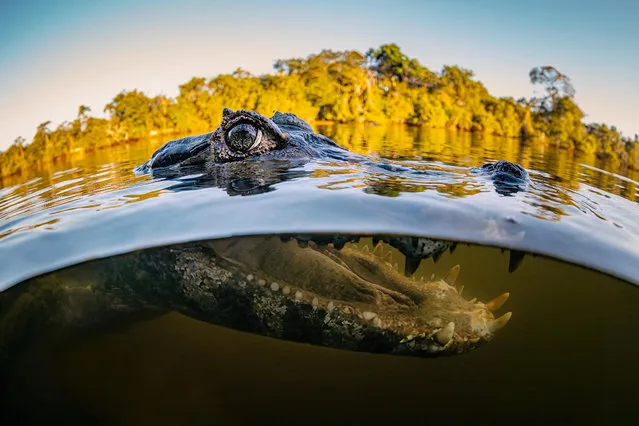
A caiman in the Pantanal region of Brazil in 2021. They are used to seeing humans, allowing the photographer, Leighton Lum, a close-up shot. (Photo by Leighton Lum/Caters News Agency)
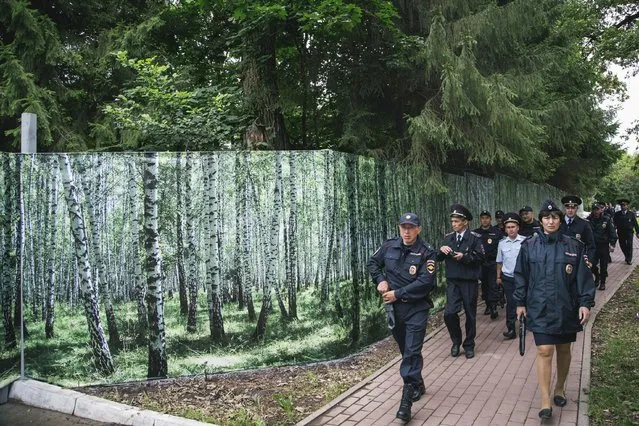
In this photo taken on Sunday, July 5, 2015, police officers walk along a giant poster to give an improved appearance, in downtown Ufa, Russia. Ufa will host SOC (Shanghai Cooperation Organization) and BRICS (Brazil, Russia, India, China and South Africa) summits July 7 to July 9, 2015. (Photo by Vadim Braydov/AP Photo)
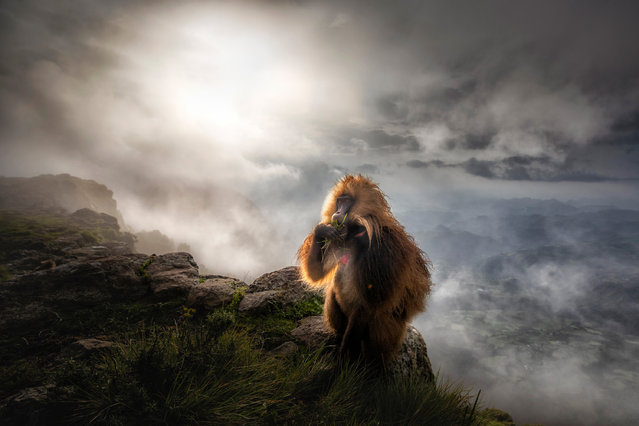
Highly commended, mammals: Gelada after the storm – Marco Gaiotti (Italy). “Gelada baboons are the only monkey species in the world that feed on grasses. They are native to the tableland of Ethiopia. Every morning large family groups wander from their sleeping places in the steep rock face, up to 1,000 metres high, to the feeding grounds at the tablelands. This image clearly depicts their feeding strategy: they pull out bunches of grass, sort the stalks and then lift them to their mouth. This shot was taken towards the end of the rainy season after a heavy storm”. (Photo by Marco Gaiotti/2019 GDT European Wildlife Photographer of the Year)
Feast your eyes on Europe’s most spectacular car graveyards as discovered by one auto-obsessed explorer who has dedicated over ten years to finding the best cars left to rot in the European wilderness. The beautiful set of images were taken in Germany, Sweden and Belgium by German Civil Servant Robert Kahl (30) using a Nikon D7100. He describes his photographs as showcasing “the beauty of transience and decayed charm”. Here: 1941 Chevrolet 1.5 tonnes are left to rot in a field. (Photo by Robert Kahl/Mediadrumworld)
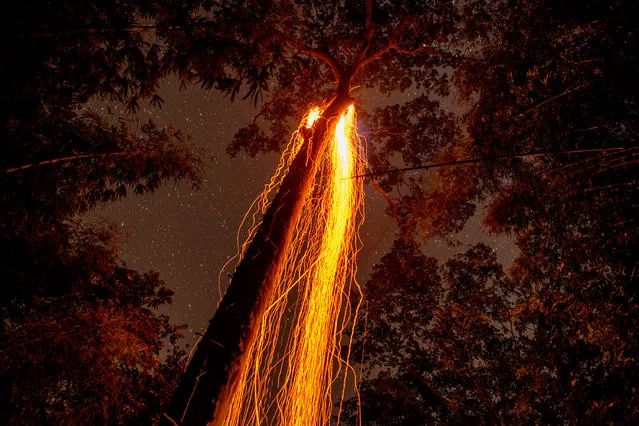
During the spring harvest season, a group of traditional Malaysian honey hunters travel to the rainforest near the Thai border to collect honeycombs from giant bees – and risk their lives climbing 200ft trees. Here: Bees are sensitive to light, which makes them follow the glowing embers down to the ground. (Photo by Hasnoor Hussain/The Guardian)