Loading...
Done
Negative Space - Mungo Thomson

Mungo Thomson is a contemporary visual concept artist from Los Angeles. His work can be described as simple but fascinating. His interest in what he calls ‘the dumb idea’, something simple but interesting, makes his art so special.
Details
10 Jun 2013 09:53:00
Photographers: Darrell Eager

“When you think of Darrell Eager, you think of a journeyman photographer with taste and a talent for conceptual thinking. Darrell's great at working with vague ideas and concepting back and forth until they become real and concrete, appropriate for each project”.
Details
20 Mar 2012 11:03:00
Mutants

The STRP mutants were designed by Bart Hess together with Heyheyhey for the 2011 STRP Art & Technology Festival campaign. The mutants evolved around the idea of transformation. They visualize movement and the ever changing boundaries between the different disciplines: art, music and technology.
Details
08 Jun 2012 11:03:00
 Menswear Dog By  David Fung

Here is a dog named Bodhi. By the will of fate, and he became bored hosts the star of the Internet. The story begins with the moment when the head designer David Fung and his girlfriend Yena Kim came a strange idea – to put their pet in human clothes. The dog was very photogenic.
Details
05 Mar 2013 09:28:00
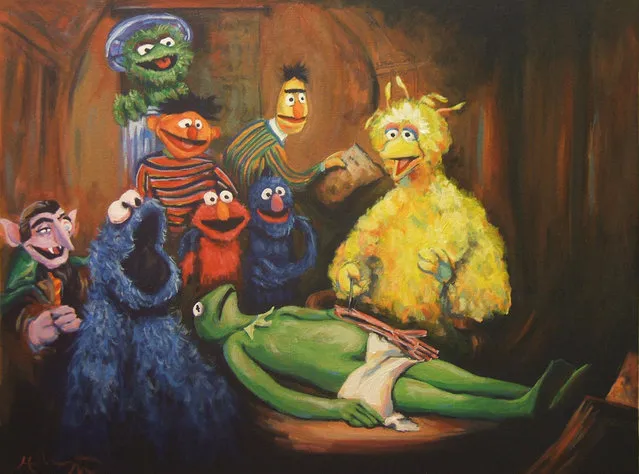
The Anatomy Lesson of Dr. Bird

The Anatomy Lesson of Dr. Bird

Pop culture is the inspiration for many great artists. From music to movies, all of it provide great amount of ideas for people to do great, even witty pieces, like these, by American painter Hillary White.
Details
17 May 2012 10:13:00


Is it worth eating live beings? This is a philosophical question: the history of our species and the ontology of being are saying that it's more likely yes, and on the other hand your mind and empathy are more likely to be against this idea. Or at least like in this Korean clip – eat, but with tears in your eyes.
Details
05 Jan 2019 13:13:00
In this March 31, 2019 photo, an Egyptian student borrows a Bedouin wedding dress to pose for a photograph with Bedouin men from the Hamada tribe, in Wadi Sahw, Abu Zenima, in South Sinai, Egypt. Four Bedouin women are for the first time leading tours in Egypt’s Sinai Peninsula, breaking new ground in their deeply conservative community, where women almost never work outside the home or interact with outsiders.  The tourists can only be women, and the tours can’t go overnight. Each day before the sun sets, the group returns to the Hamada’s home village in Wadi Sahu, a narrow desert valley. (Photo by Nariman El-Mofty/AP Photo)


In this March 31, 2019 photo, an Egyptian student borrows a Bedouin wedding dress to pose for a photograph with Bedouin men from the Hamada tribe, in Wadi Sahw, Abu Zenima, in South Sinai, Egypt. Four Bedouin women are for the first time leading tours in Egypt’s Sinai Peninsula, breaking new ground in their deeply conservative community, where women almost never work outside the home or interact with outsiders. The tourists can only be women, and the tours can’t go overnight. Each day before the sun sets, the group returns to the Hamada’s home village in Wadi Sahu, a narrow desert valley. (Photo by Nariman El-Mofty/AP Photo)

Details
11 Apr 2019 00:01:00
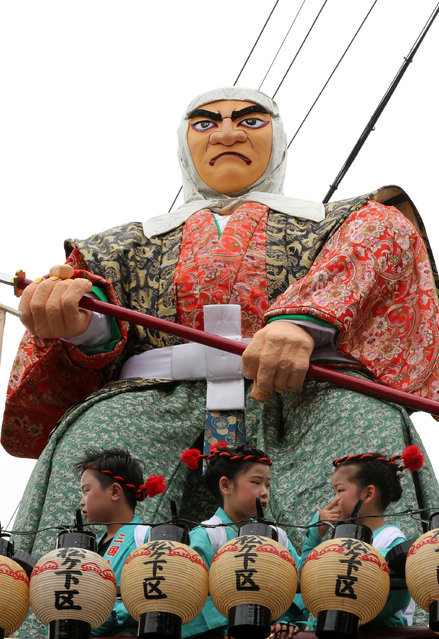
Children dressed in festival costume sit on the huge paper doll of historical Japanese figure named Hashi-Benkeii on the carts during the Mikuini annual festival on May 20, 2014 in Sakai, Japan. The annual festival takes place from May 19-21 and is attended by thousands of visitors. During the festival people dressed in traditional Japanese costumes pull carts carrying 6 meter high dolls of Japanese historical figures through the narrow streets. The origins of the festival are unclear but its history can be traced back more than 250 years. (Photo by Buddhika Weerasinghe/Getty Images)

Children dressed in festival costume sit on the huge paper doll of historical Japanese figure named Hashi-Benkeii on the carts during the Mikuini annual festival on May 20, 2014 in Sakai, Japan. The annual festival takes place from May 19-21 and is attended by thousands of visitors. During the festival people dressed in traditional Japanese costumes pull carts carrying 6 meter high dolls of Japanese historical figures through the narrow streets. The origins of the festival are unclear but its history can be traced back more than 250 years. (Photo by Buddhika Weerasinghe/Getty Images)
Details
21 May 2014 08:49:00