Loading...
Done
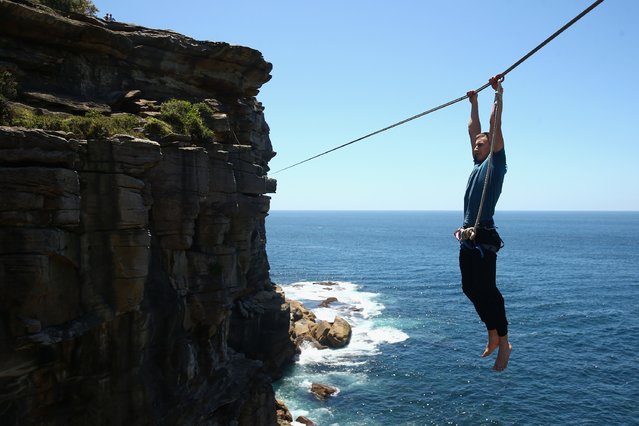
Antek Marciniec holds onto a slackline after falling off as he highlines between two cliffs at Diamond Bay on December 21, 2014 in Sydney, Australia. Slacklining is a balance sport in which participants walk on a flat nylon webbing anchored between two points with the tension adjusted to allow for slack, providing an experience similiar to that of walking on a trapmoline. Highlining is a style of slacklining where the two anchor points are set up with significant elevation from the ground or water. (Photo by Cameron Spencer/Getty Images)

Antek Marciniec holds onto a slackline after falling off as he highlines between two cliffs at Diamond Bay on December 21, 2014 in Sydney, Australia. Slacklining is a balance sport in which participants walk on a flat nylon webbing anchored between two points with the tension adjusted to allow for slack, providing an experience similiar to that of walking on a trapmoline. Highlining is a style of slacklining where the two anchor points are set up with significant elevation from the ground or water. (Photo by Cameron Spencer/Getty Images)
Details
28 Dec 2014 11:50:00
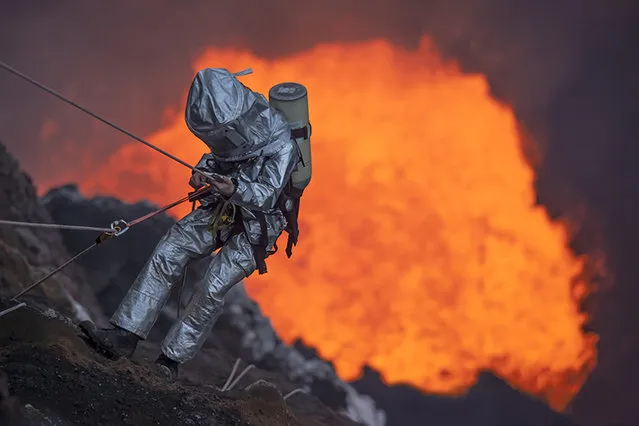
Descending into the Marum Volcano in Vanuatu, Intrepid explorers found an unusual way of staying warm this winter by spending Christmas day on an active volcano. British climber Chris Horsley, 22, and his friends Gareth Hawken, 30, Geoff Mackley, 50, and Bradley Ambrose, 36, from Auckland, New Zealand, hiked up the Marum Volcano, Vanuatu, on the morning of the 25th. Instead of passing the day with their families, the team climbed down a 1200ft cliff to get close to a flowing lake of lava. (Photo by Bradley Ambrose/Caters News)

Descending into the Marum Volcano in Vanuatu, Intrepid explorers found an unusual way of staying warm this winter by spending Christmas day on an active volcano. British climber Chris Horsley, 22, and his friends Gareth Hawken, 30, Geoff Mackley, 50, and Bradley Ambrose, 36, from Auckland, New Zealand, hiked up the Marum Volcano, Vanuatu, on the morning of the 25th. Instead of passing the day with their families, the team climbed down a 1200ft cliff to get close to a flowing lake of lava. (Photo by Bradley Ambrose/Caters News)
Details
31 Dec 2014 14:04:00
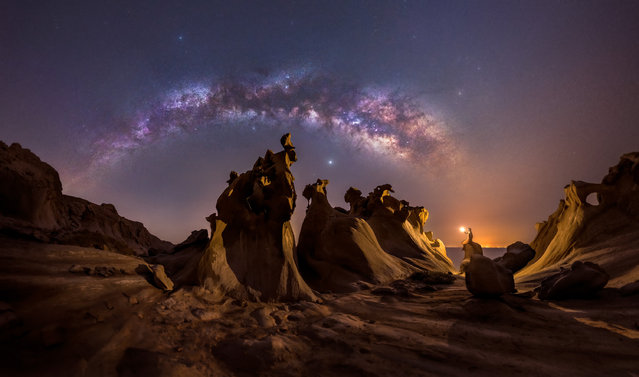
Night lovers; Hormozgan province, Iran. “In this picture, you can see the Milky Way rising on a fascinating spring night on the Persian Gulf coast. The stunning cliffs of this area make every viewer imagine and even talk to them! The light pollution from a faraway city was quite strong, so it was a challenging post-processing process. I’m a nightscaper who tries to achieve an artistic look in my images, and in this image, I tried to convey and capture the magic of this location”. (Photo by Mohammad Hayati/Milky Way Photographer of the Year)

Night lovers; Hormozgan province, Iran. “In this picture, you can see the Milky Way rising on a fascinating spring night on the Persian Gulf coast. The stunning cliffs of this area make every viewer imagine and even talk to them! The light pollution from a faraway city was quite strong, so it was a challenging post-processing process. I’m a nightscaper who tries to achieve an artistic look in my images, and in this image, I tried to convey and capture the magic of this location”. (Photo by Mohammad Hayati/Milky Way Photographer of the Year)
Details
01 Jun 2021 09:42:00
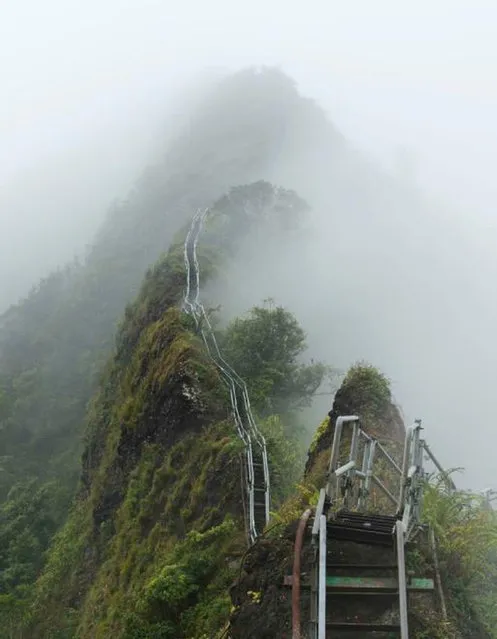
Stairway To Heaven In Hawaii

The Haʻikū Stairs, also known as the Stairway to Heaven or Haʻikū Ladder, is a steep hiking trail on the island of Oʻahu. The trail began as a wooden ladder spiked to the cliff on the south side of the Haʻikū Valley. It was installed in 1942 to enable antenna cables to be strung from one side of the cliffs above Haʻikū Valley to the other. A building to provide a continuous communication link between Wahiawā and Haʻikū Valley Naval Radio Station was constructed at the peak of Puʻukeahiakahoe, elevation about 2,800 feet (850 m). The antennae transmitted very low frequency radio signals from a 200,000-watt Alexanderson alternator in the center of Haʻikū valley. The signals could reach US Navy submarines as far away as Tokyo Bay while the submarines were submerged.
Details
30 Nov 2013 12:47:00
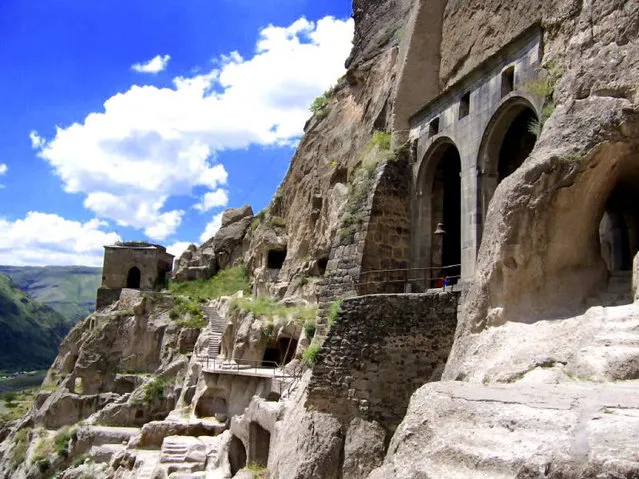
Vardzia Cave Monastery

Vardzia is a cave monastery site in southern Georgia, excavated from the slopes of the Erusheti Mountain on the left bank of the Mtkvari River, thirty kilometres from Aspindza. The main period of construction was the second half of the twelfth century. The caves stretch along the cliff for some five hundred metres and in up to nineteen tiers. The Church of the Dormition, dating to the 1180s during the golden age of Tamar and Rustaveli, has an important series of wall paintings. The site was largely abandoned after the Ottoman takeover in the sixteenth century. Now part of a state heritage reserve, the extended area of Vardzia-Khertvisi has been submitted for future inscription on the UNESCO World Heritage List
Details
04 Sep 2013 10:53:00
Chinese Villagers Zip Line

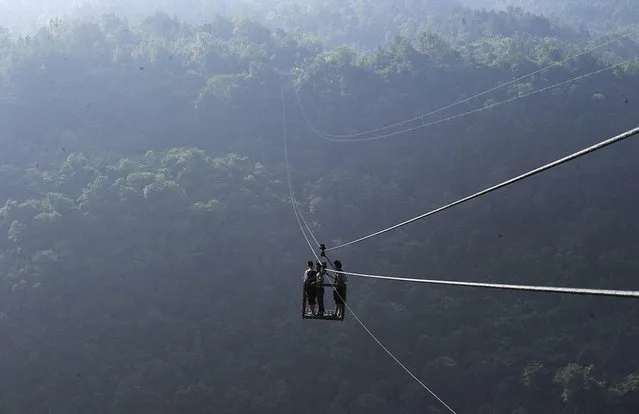
This cable ropeway suspended between cliffs is the only access to Yushan village in Hubei Province, Chin, which has a population of just over 200 people. The ropeway was built in 1997; before that villagers faced a walk of several days to get to the next nearest village. The ropeway, which is powered by a diesel engine, is 1,000 metres long and 400 metres above the valley floor.
Details
14 Mar 2014 15:22:00
Buddha

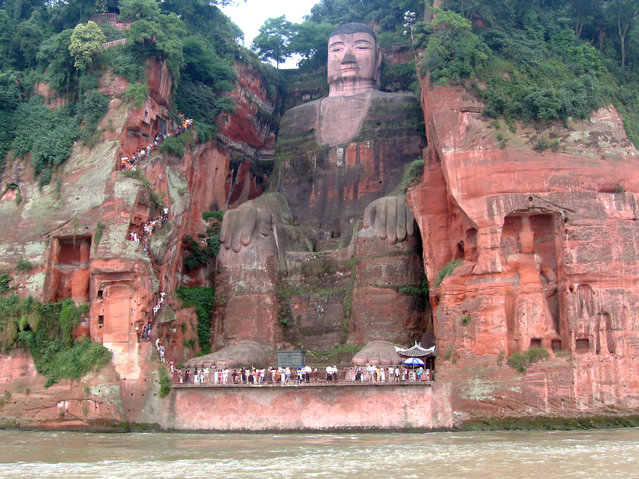
The Leshan Giant Buddha was built during the Tang Dynasty (618–907AD). It is carved out of a cliff face that lies at the confluence of the Minjiang, Dadu and Qingyi rivers in the southern part of Sichuan province in China, near the city of Leshan. The stone sculpture faces Mount Emei, with the rivers flowing below his feet. It is the largest carved stone Buddha in the world[1] and it is by far the tallest pre-modern statue in the world.
Details
14 Jul 2012 04:50:00
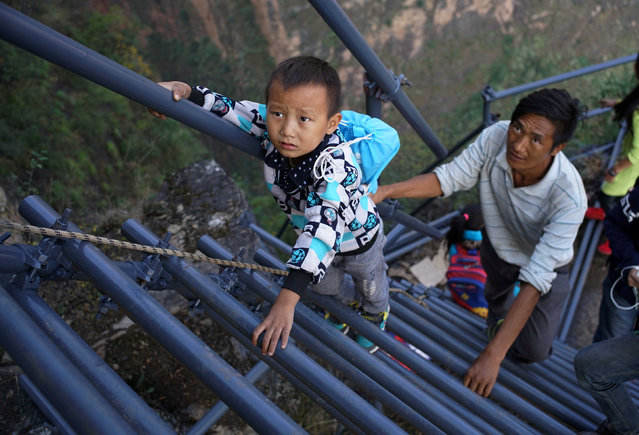
A student from “the cliff village” in Atule'er climbs newly-constructed steel ladders after school to go home for holidays, in Liangshan Sichuan province, China, November 19, 2016. The steel ladders which replaced the unsafe vine ladders shortened the time taken for the children to go home, from three hours to two. (Photo by Reuters/Stringer)

A student from “the cliff village” in Atule'er climbs newly-constructed steel ladders after school to go home for holidays, in Liangshan Sichuan province, China, November 19, 2016. The steel ladders which replaced the unsafe vine ladders shortened the time taken for the children to go home, from three hours to two. (Photo by Reuters/Stringer)
Details
07 Dec 2016 11:57:00