Loading...
Done
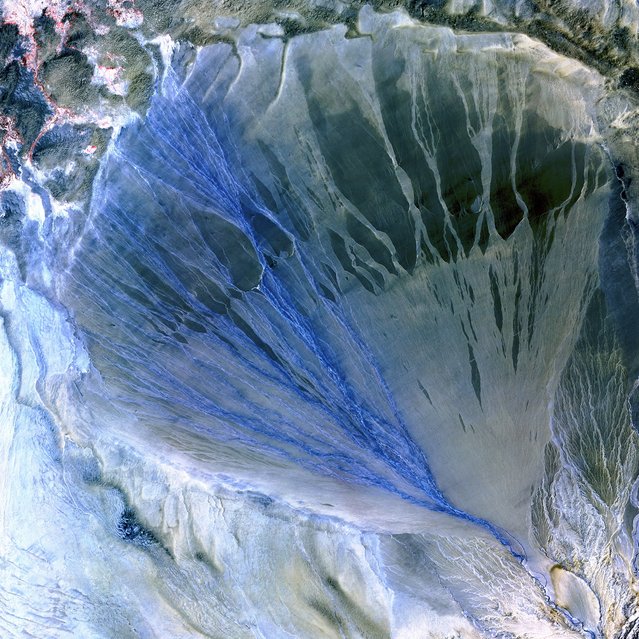
Alluvial Fan, China. A vast alluvial fan blossoms across the desolate landscape between the Kunlun and Altun mountain ranges that form the southern border of the Taklimakan Desert in China’s XinJiang Province. Image taken by the ASTER instrument on NASA’s Terra satellite on May 2nd, 2002. (Photo by NASA/GSFC/USGS EROS Data Center)

Alluvial Fan, China. A vast alluvial fan blossoms across the desolate landscape between the Kunlun and Altun mountain ranges that form the southern border of the Taklimakan Desert in China’s XinJiang Province. Image taken by the ASTER instrument on NASA’s Terra satellite on May 2nd, 2002. (Photo by NASA/GSFC/USGS EROS Data Center)
Details
07 Jan 2013 09:27:00
A model presents a creation by Japanese designer Yoshikazu Yamagata for his label writtenafterwards during the Mercedes-Benz Fashion Week in Tokyo, Japan, 16 March 2016. The presentation of the Autumn/Winter 2016 collections runs from 14 to 19 March. (Photo by Kiyoshi Ota/EPA)

A model presents a creation by Japanese designer Yoshikazu Yamagata for his label writtenafterwards during the Mercedes-Benz Fashion Week in Tokyo, Japan, 16 March 2016. The presentation of the Autumn/Winter 2016 collections runs from 14 to 19 March. (Photo by Kiyoshi Ota/EPA)
Details
17 Mar 2016 15:45:00
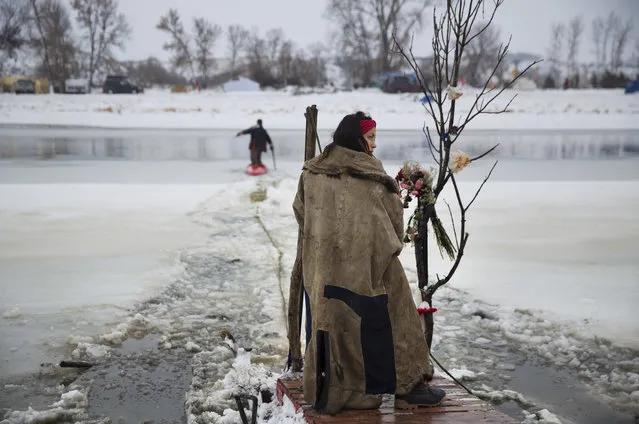
In this Thursday, December 1, 2016 photo, Cat Bigney, part of the Oglala Native American tribe, waits on the shore of the Cannonball river for travelers to arrive by canoe at the Oceti Sakowin camp where people have gathered to protest the Dakota Access oil pipeline in Cannon Ball, N.D. So far, those at the camp have shrugged off the heavy snow, icy winds and frigid temperatures. But if they defy next week's government deadline to abandon the camp, demonstrators know the real deep freeze lies ahead. Life-threatening wind chills and towering snow drifts could mean the greatest challenge is simple survival. (Photo by David Goldman/AP Photo)

In this Thursday, December 1, 2016 photo, Cat Bigney, part of the Oglala Native American tribe, waits on the shore of the Cannonball river for travelers to arrive by canoe at the Oceti Sakowin camp where people have gathered to protest the Dakota Access oil pipeline in Cannon Ball, N.D. So far, those at the camp have shrugged off the heavy snow, icy winds and frigid temperatures. But if they defy next week's government deadline to abandon the camp, demonstrators know the real deep freeze lies ahead. Life-threatening wind chills and towering snow drifts could mean the greatest challenge is simple survival. (Photo by David Goldman/AP Photo)
Details
06 Dec 2016 10:22:00
An officer wipes sweat off the face of a Chinese People's Liberation Army (PLA) honor guard soldier as they rehearse for a welcoming ceremony for New Zealand's Governor-General Sir Jerry Mateparae at the Great Hall of the People in Beijing, Tuesday, July 21, 2015. (Photo by Mark Schiefelbein/AP Photo)

An officer wipes sweat off the face of a Chinese People's Liberation Army (PLA) honor guard soldier as they rehearse for a welcoming ceremony for New Zealand's Governor-General Sir Jerry Mateparae at the Great Hall of the People in Beijing, Tuesday, July 21, 2015. (Photo by Mark Schiefelbein/AP Photo)
Details
22 Jul 2015 11:52:00
A donkey savors warming temperatures after a long winter at the zoo in Warsaw, Poland, on Wednesday, April 8, 2015. (Photo by Czarek Sokolowski/AP Photo)

A donkey savors warming temperatures after a long winter at the zoo in Warsaw, Poland, on Wednesday, April 8, 2015. (Photo by Czarek Sokolowski/AP Photo)
Details
11 Apr 2015 11:12:00
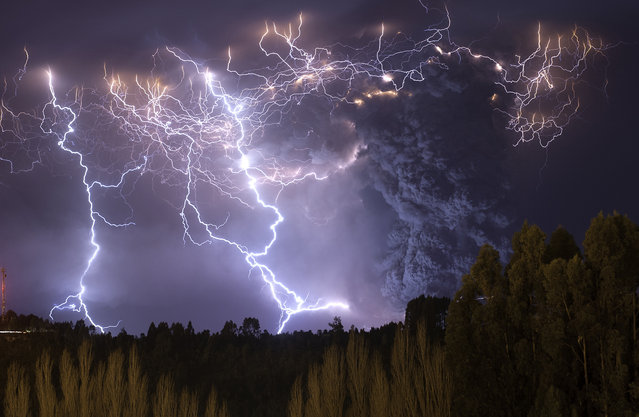
The eruption of Cordon Caulle began on June 4, 2011, located in the Region of Los Rios in Chile. For about 12 months, people and animals became accustomed to living with the daily fall of ash, which also caused problems in the air traffic in South America. The explosions and lightning during first days of the eruption could be seen from hundreds of miles around. This photograph was taken on the second night of eruption from the town of Lago Ranco. (Photo and caption by Francisco Negroni/National Geographic Traveler Photo Contest)

The eruption of Cordon Caulle began on June 4, 2011, located in the Region of Los Rios in Chile. For about 12 months, people and animals became accustomed to living with the daily fall of ash, which also caused problems in the air traffic in South America. The explosions and lightning during first days of the eruption could be seen from hundreds of miles around. This photograph was taken on the second night of eruption from the town of Lago Ranco. (Photo and caption by Francisco Negroni/National Geographic Traveler Photo Contest)

ATTENTION! All pictures are presented in high resolution. To see Hi-Res images – just TWICE click on any picture. In other words, click small picture – opens the BIG picture. Click BIG picture – opens VERY BIG picture.
Details
23 Jun 2013 11:24:00
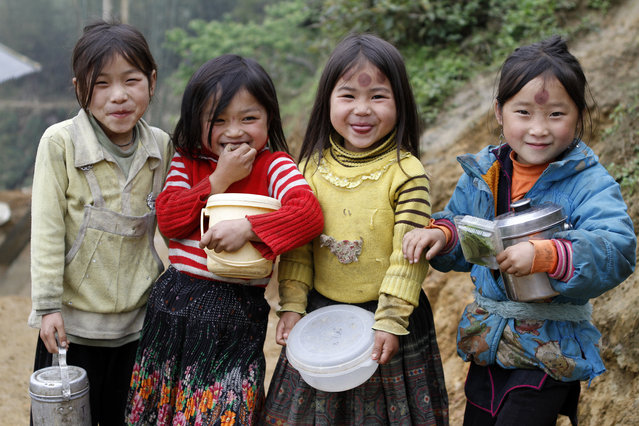
“Kids of Sapa”. Four little beautiful Hmong girls from Lao Chai Village, near Sapa, Vietnam. (Photo and caption by Felipe Hanower/National Geographic Traveler Photo Contest)

“Kids of Sapa”. Four little beautiful Hmong girls from Lao Chai Village, near Sapa, Vietnam. (Photo and caption by Felipe Hanower/National Geographic Traveler Photo Contest)
Details
15 Jul 2013 09:14:00
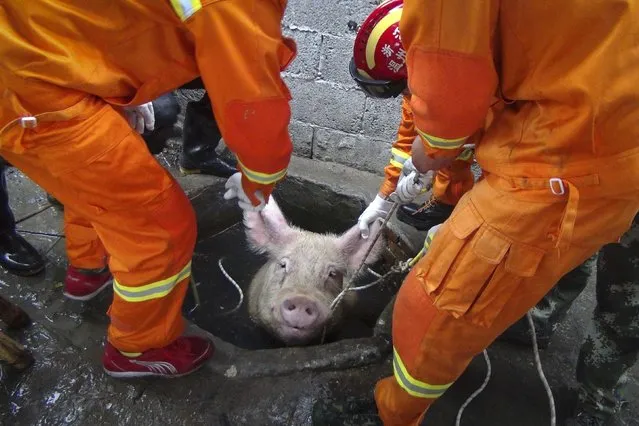
Firefighters pull a pig as they try to rescue it from a well at a pig farm in Huanghua township of Leqing, Zhejiang province, April 25, 2014. Seven local firefighters successfully rescued a 300 kg (661 lbs) pig which fell down a well on Friday morning, local media reported. (Photo by Reuters/China Daily)

Firefighters pull a pig as they try to rescue it from a well at a pig farm in Huanghua township of Leqing, Zhejiang province, April 25, 2014. Seven local firefighters successfully rescued a 300 kg (661 lbs) pig which fell down a well on Friday morning, local media reported. (Photo by Reuters/China Daily)
Details
26 Apr 2014 12:44:00