Loading...
Done
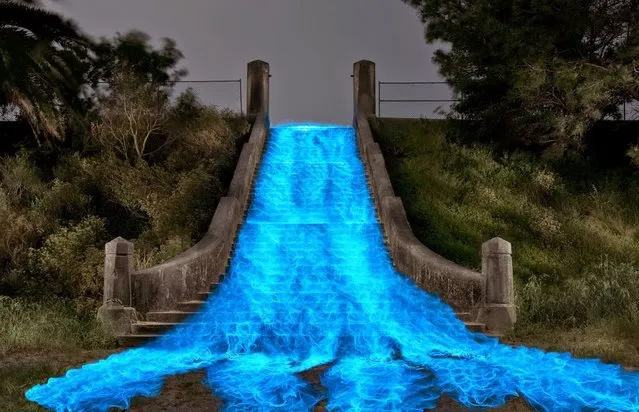
Winner of the NSW (New South Wales) prize: Peter Solness said: “I wanted to re-imagine the lost waterways, so I got my light-painting tools to work. In this image, water is being released from the top of the historic Centennial Park No. 2 Reservoir, which was built in 1925 and holds 90 megalitres of water. After 89 years of incarceration these waters now run free!”. (Photo by Peter Solness/Head On)

Touching and dramatic portraits and landscape shots have won prizes at Australia's prestigious photography prize. Photo: Winner of the NSW (New South Wales) prize: Peter Solness said: “I wanted to re-imagine the lost waterways, so I got my light-painting tools to work. In this image, water is being released from the top of the historic Centennial Park No. 2 Reservoir, which was built in 1925 and holds 90 megalitres of water. After 89 years of incarceration these waters now run free!”. (Photo by Peter Solness/Head On)
Details
21 May 2014 11:11:00
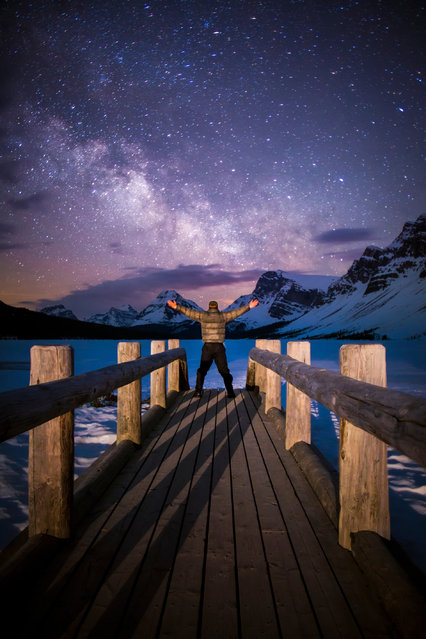
Paul Zizka in “Galactic Gateway”, Bow Lake, Banff National Park, May 11, 2013. (Photo by Paul Zizka/Caters News)

“These are the stunning shots of one photographer who is putting everyday “selfies” to shame. Paul Zizka, 34, began experimenting with night photography just two years ago and immediately became fascinated with the spectacular scenes he discovered. To create something more unique he started adding himself into the shot – as well as showing others the beautiful surroundings he had been exploring. Using lengthy exposure, the photographer felt that featuring himself in some of his shots – the night sky illuminating the mountains around him – created a relationship between the central figure in the image and the nature around him”. – Caters News. Photo: Paul Zizka in “Galactic Gateway”, Bow Lake, Banff National Park, May 11, 2013. (Photo by Paul Zizka/Caters News)
Details
22 May 2014 04:38:00
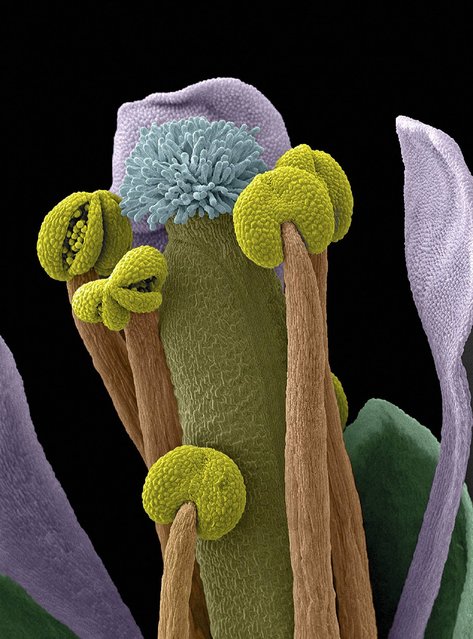
Scanning electron micrograph (SEM) of an Arabidopsis thaliana flower, also commonly known as thale cress. Some of the anthers are open, revealing pollen grains ready for dispersal. Arabidopsis was the first plant to have its entire genome sequenced and is widely used as a model organism in molecular and plant biology. Horizontal width of image is 1200 microns. Magnification 100x. (Photo by Stefan Eberhard/Wellcome Images)

Beautiful, strange and occasionally alarming pictures from the shortlist for this year’s Wellcome image awards – which celebrate the very best in science photography and imaging – from an x-ray of a bat to a micrograph of a kidney stone. The exhibition opens on 12 March at three science centres and the Museum of Science and Industry in Manchester. Photo: Scanning electron micrograph (SEM) of an Arabidopsis thaliana flower, also commonly known as thale cress. Some of the anthers are open, revealing pollen grains ready for dispersal. Arabidopsis was the first plant to have its entire genome sequenced and is widely used as a model organism in molecular and plant biology. Horizontal width of image is 1200 microns. Magnification 100x. (Photo by Stefan Eberhard/Wellcome Images)
Details
11 Mar 2014 05:58:00
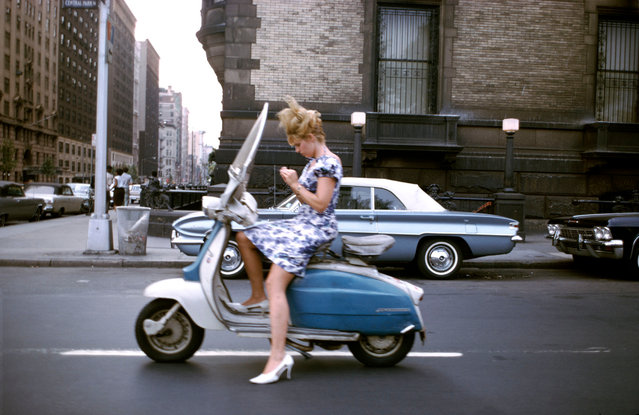
New York City, 1965, by Joel Meyerowitz. “A girl on a Vespa on her way to who knows where, when the light stopped her at the 72nd street crossing near the Dakota, where John Lennon would one day cross paths with his fate. She takes this moment to finesse a fingernail before she resumes her downtown journey, while I, stopping at the same crossing, but on foot, leap into the street to capture this vision of a dream girl before time takes her on her way”. (Photo by Joel Meyerowitz/Courtesy Aperture)

The November 2018 Square Print Sale, presented by Magnum Photos and Aperture, brings together over 100 images to explore perspectives on transition and transformation in photography. Here: New York City, 1965, by Joel Meyerowitz. “A girl on a Vespa on her way to who knows where, when the light stopped her at the 72nd street crossing near the Dakota, where John Lennon would one day cross paths with his fate. She takes this moment to finesse a fingernail before she resumes her downtown journey, while I, stopping at the same crossing, but on foot, leap into the street to capture this vision of a dream girl before time takes her on her way”. (Photo by Joel Meyerowitz/Courtesy Aperture)
Details
31 Oct 2018 00:05:00
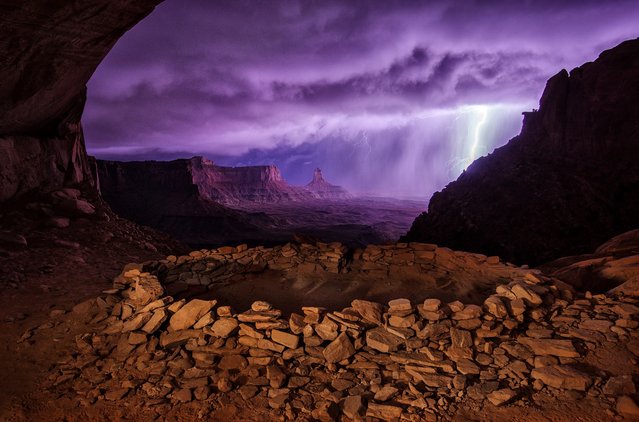
Second Place Winner: “Thunderstorm at False Kiva”. I hiked out to these ruins at night hoping to photograph them with the Milky Way, but instead a thunderstorm rolled through, creating this dramatic image. – Max Seigal. (Photo and caption by Max Seigal/National Geographic Traveler Photo Contest)

Second Place Winner: “Thunderstorm at False Kiva”. I hiked out to these ruins at night hoping to photograph them with the Milky Way, but instead a thunderstorm rolled through, creating this dramatic image. – Max Seigal. National Geographic Traveler Director of Photography Dan Westergren, one of this year's judges, shares his thoughts on the second place winner: “This photo combines two different scenes into one: the small kiva in a cliff dwelling and the grand vista of Canyonlands National Park across the valley. I really like the two different color palettes – warm inside and purple outside. This two-for-one scene was caused by the lightning storm outside the dwelling, which lit up the landscape like it was a huge electronic flash. Looking at this picture I can imagine what a wonderful sight it must have been for the ancient people who lived here. It doesn't seem too amazing now in our modern world, but might have been mind-blowing for the prehistoric residents”. Location: Utah. (Photo and caption by Max Seigal/National Geographic Traveler Photo Contest)
Details
02 Aug 2013 06:16:00
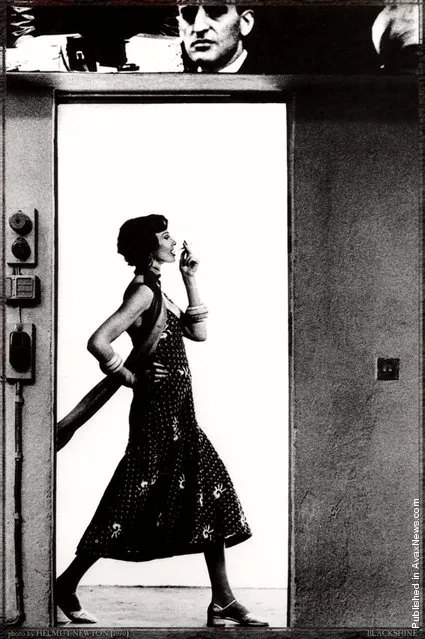
Photographers: Helmut Newton

“Newton was born in Berlin, the son of Klara “Claire” (Marquis) and Max Neustädter, a button factory owner. His family was Jewish. Newton attended the Heinrich-von-Treitschke-Realgymnasium and the American School in Berlin. Interested in photography from the age of 12 when he purchased his first camera, he worked for the German photographer Yva (Elsie Neulander Simon) from 1936. The increasingly oppressive restrictions placed on Jews by the Nuremberg laws meant that his father lost control of the factory in which he manufactured buttons and buckles; he was briefly interned in a concentration camp on “Kristallnacht”, November 9, 1938, which finally compelled the family to leave Germany. Newton's parents fled to South America. He was issued with a passport just after turning 18, and left Germany on December 5, 1938. At Trieste he boarded the “Conte Rosso” (along with about 200 others escaping the Nazis) intending to journey to China. After arriving in Singapore he found he was able to remain there, first and briefly as a photographer for the Straits Times and then as a portrait photographer”. – Wikipedia

Photo: Sigourney Weaver by Helmut Newton, 1995.
Details
08 Apr 2012 13:49:00
In this third of seven sequential photos, Elian Gonzalez is held in a closet by Donato Dalrymple, one of the two men who rescued the boy from the ocean, right, as government officials search the home of Lazaro Gonzalez for the young boy, early morning, April 22, 2000, in Miami, Florida. Armed federal agents seized Elian Gonzalez from the home of his Miami relatives before dawn, firing tear gas into an angry crowd as they left the scene with the weeping 6-year-old boy. This photo won the Prize in 2001. (Photo by Alan Diaz/AP Photo)

In this third of seven sequential photos, Elian Gonzalez is held in a closet by Donato Dalrymple, one of the two men who rescued the boy from the ocean, right, as government officials search the home of Lazaro Gonzalez for the young boy, early morning, April 22, 2000, in Miami, Florida. Armed federal agents seized Elian Gonzalez from the home of his Miami relatives before dawn, firing tear gas into an angry crowd as they left the scene with the weeping 6-year-old boy. This photo won the Prize in 2001. (Photo by Alan Diaz/AP Photo)
Details
22 Aug 2014 12:18:00
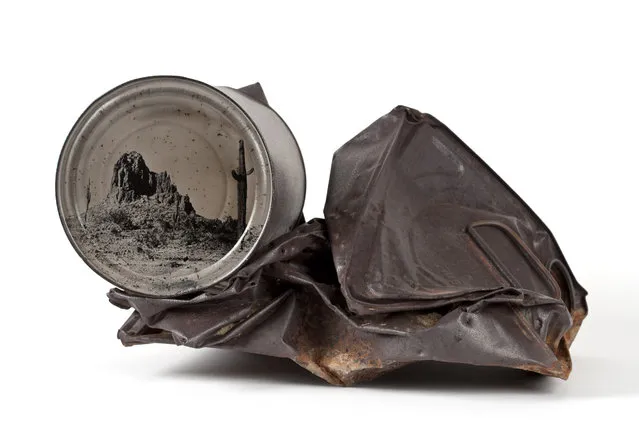
Conversations with History by Photographer David Emitt Adams

Photographer David Emitt Adams creates tintypes on discarded cans he collects from the Sonoran Desert. In his artist statement, Adams says that some are more than four decades old, which have earned a deep reddish-brown, rusty coloration. (Photo by David Emitt Adams)
Details
19 Mar 2014 05:24:00