Loading...
Done
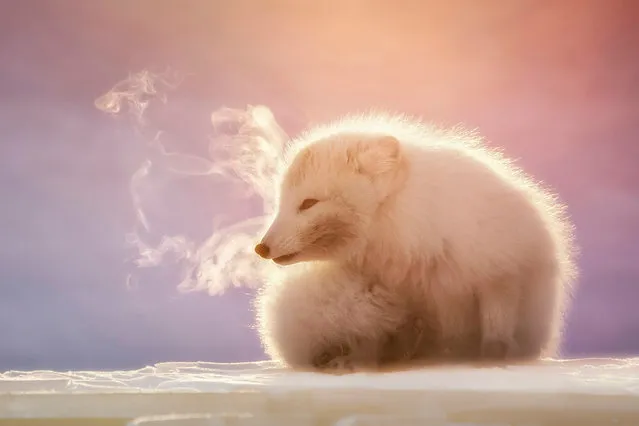
Breath of an Arctic fox by Marco Gaiotti, Italy. Marco was watching this little Arctic fox as it incessantly called another nearby. Gradually he noticed the fox’s wet breath was quickly freezing in the air after each call. It was late winter in Spitsbergen, Svalbard, and the air was -35C (-31F). Photographing Arctic foxes is often frustrating, as they are normally running around fast in search of food, but this one was very relaxed and let Marco get close enough to focus on it, with the light glowing perfectly in the background. (Photo by Marco Gaiotti/Wildlife Photographer of the Year 2021)

Breath of an Arctic fox by Marco Gaiotti, Italy. Marco was watching this little Arctic fox as it incessantly called another nearby. Gradually he noticed the fox’s wet breath was quickly freezing in the air after each call. It was late winter in Spitsbergen, Svalbard, and the air was -35C (-31F). Photographing Arctic foxes is often frustrating, as they are normally running around fast in search of food, but this one was very relaxed and let Marco get close enough to focus on it, with the light glowing perfectly in the background. (Photo by Marco Gaiotti/Wildlife Photographer of the Year 2021)
Details
05 Dec 2021 06:36:00
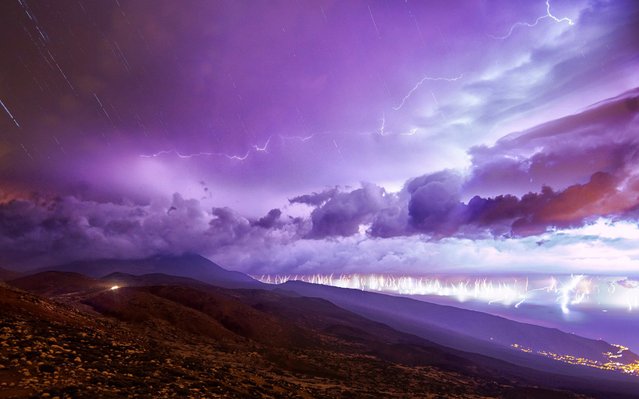
A handout photo made available by TeideLab shows an image composed of 200 pictures that shows the lightning activity between 3 am and 7am during a storm in Izana, Tenerife, Canary Islands, Spain, 27 October 2019. Over 2,000 lighting strikes fell mostly over Tenerife island last 26 October during a strong storm. (Photo by Daniel López/EPA/EFE/TeideLab)

A handout photo made available by TeideLab shows an image composed of 200 pictures that shows the lightning activity between 3 am and 7am during a storm in Izana, Tenerife, Canary Islands, Spain, 27 October 2019. Over 2,000 lighting strikes fell mostly over Tenerife island last 26 October during a strong storm. (Photo by Daniel López/EPA/EFE/TeideLab)
Details
29 Aug 2020 00:03:00
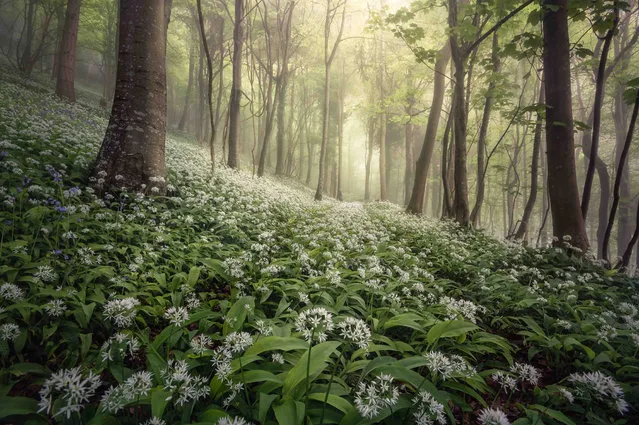
Woolland Woods, Dorset. Landscape photographer of the year 2020. “Taken in spring of 2018 in a wooded area close to Milborne St Andrew in Dorset, this was the third visit to the area in a matter of days. On the previous days, both devoid of morning mists, the light had been harsh and unappealing but the third day delivered stunning conditions with mist swirling through the trees. The low shooting position allowed more emphasis to be placed on the wild garlic and pathway”. (Photo by Chris Frost/UK Landscape Photographer of the Year 2020)

Woolland Woods, Dorset. Landscape photographer of the year 2020. “Taken in spring of 2018 in a wooded area close to Milborne St Andrew in Dorset, this was the third visit to the area in a matter of days. On the previous days, both devoid of morning mists, the light had been harsh and unappealing but the third day delivered stunning conditions with mist swirling through the trees. The low shooting position allowed more emphasis to be placed on the wild garlic and pathway”. (Photo by Chris Frost/UK Landscape Photographer of the Year 2020)
Details
22 Oct 2020 00:03:00
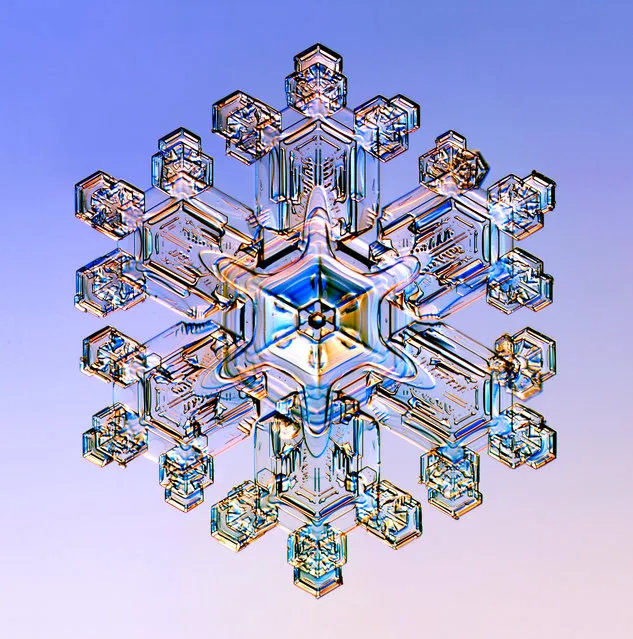
Nikon Small World Photomicrography Competition 2012. Honorable Mention. “Snow crystal, illuminated with colored lights (5x)”. (Photo by Dr. Kenneth Libbrecht, California Institute of Technology (Caltech), Department of Physics, Pasadena, California, USA)

Most people know Nikon as a purveyor of pro and consumer-grade digital cameras. But the company's expertise with optics bleeds over into related markets – it's one of the science community's major suppliers of microscopes. And each year the company asks the community to send it some of their favorite images of tiny objects. A panel of scientists and journalists have chosen the best of this past year's submissions, which Nikon has placed on its Small World site.

Photo: Honorable Mention. “Snow crystal, illuminated with colored lights (5x)”. (Photo by Dr. Kenneth Libbrecht, California Institute of Technology (Caltech), Department of Physics, Pasadena, California, USA)
Details
25 Oct 2012 13:49:00
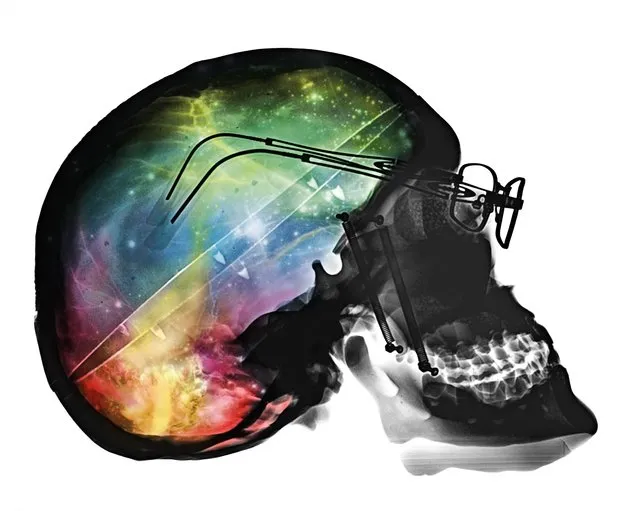
These stunning coloured images show detailed x-ray images of everything from skulls to light bulbs. Artist Paula Fontaine, from Westminster Massachusetts, created the images using a process called digital map painting. Here: Brain storm, conceptual composite X-ray. (Photo by Paula Fontaine/Barcroft Media)

These stunning coloured images show detailed x-ray images of everything from skulls to light bulbs. Artist Paula Fontaine, from Westminster Massachusetts, created the images using a process called digital map painting. To create the images the x-ray emission source – the head of the machine on an arm which focuses the beam – is placed over the object. Paula then retreats behind a shielded screen before activating the x-ray exposure. Here: Brain storm, conceptual composite X-ray. (Photo by Paula Fontaine/Barcroft Media)
Details
27 Mar 2015 13:34:00
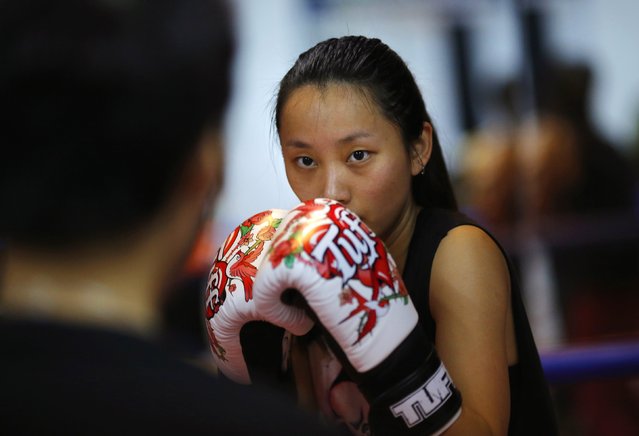
A woman attends a boxing class at Princess Women's Boxing Club in Shanghai December 3, 2014. Women have boxed as long as the sport has existed but for years they were relegated out of national and international competitions in many countries around the world. Female boxers entered the ring in an exhibition match at the 1904 Olympic Games, but it was more than a century later when they were given the green light to make their Olympic debut in London in 2012. (Photo by Carlos Barria/Reuters)

A woman attends a boxing class at Princess Women's Boxing Club in Shanghai December 3, 2014. Women have boxed as long as the sport has existed but for years they were relegated out of national and international competitions in many countries around the world. Female boxers entered the ring in an exhibition match at the 1904 Olympic Games, but it was more than a century later when they were given the green light to make their Olympic debut in London in 2012. (Photo by Carlos Barria/Reuters)
Details
10 Dec 2014 12:46:00
French twins Thomas and Vincent (L) Seris take the tram in Bordeaux, November 12, 2014. Born with Xeroderma Pigmentosum (XP), the twins cannot be exposed to the sun and its ultraviolet (UV) light, which could provoke precocious cancers due to an autosomal recessive genetic disorder of DNA repair. (Photo by Regis Duvignau/Reuters)

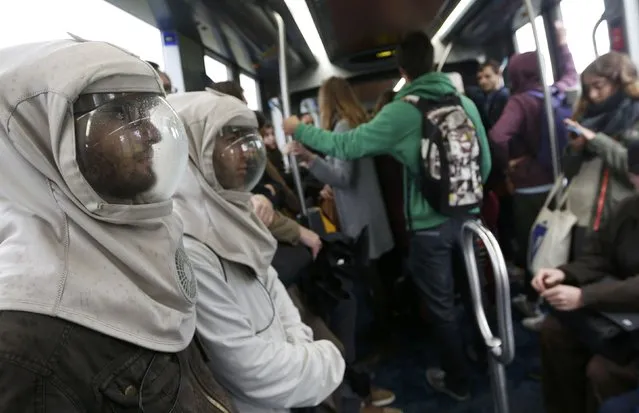
French twins Thomas and Vincent (L) Seris take the tram in Bordeaux, November 12, 2014. Born with Xeroderma Pigmentosum (XP), the twins cannot be exposed to the sun and its ultraviolet (UV) light, which could provoke precocious cancers due to an autosomal recessive genetic disorder of DNA repair. Colloquially referred to as Children of the Night (Les Enfants de la Lune) the Seris twins are among 70 to 80 people in France who suffer from the genetic defect. The French association “Les Enfants de la Lune” reports that there are between five and ten thousand such cases in the world. Thomas and Vincent have been testing a new protective mask for the last year which is transparent and ventilated and developed by several hospitals in France. (Photo by Regis Duvignau/Reuters)
Details
01 Feb 2015 10:27:00
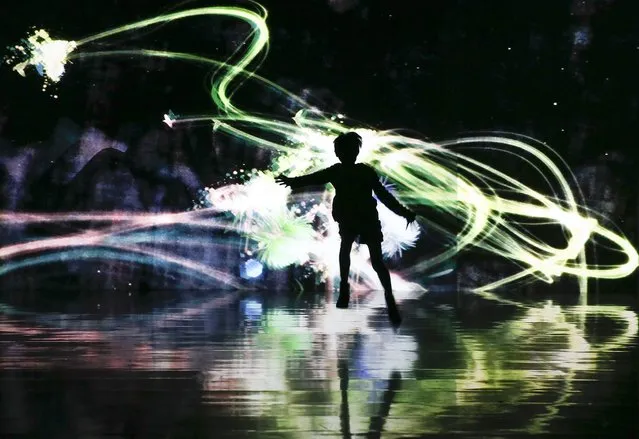
A girl dances in front of the digital art installation “Light in Dark” created by teamLab, a collaborative of Japanese digital artists, during a special exhibition of “Shake! Art Exhibition! and Learn and Play! teamLab Future Park” at National Museum of Emerging Science and Innovation (or Miraikan) in Tokyo, Japan, 19 January 2015. The exhibition is held through 01 March 2015. (Photo by Kimimasa Mayama/EPA)

A girl dances in front of the digital art installation “Light in Dark” created by teamLab, a collaborative of Japanese digital artists, during a special exhibition of “Shake! Art Exhibition! and Learn and Play! teamLab Future Park” at National Museum of Emerging Science and Innovation (or Miraikan) in Tokyo, Japan, 19 January 2015. The exhibition is held through 01 March 2015. (Photo by Kimimasa Mayama/EPA)
Details
06 Feb 2015 12:51:00