Loading...
Done
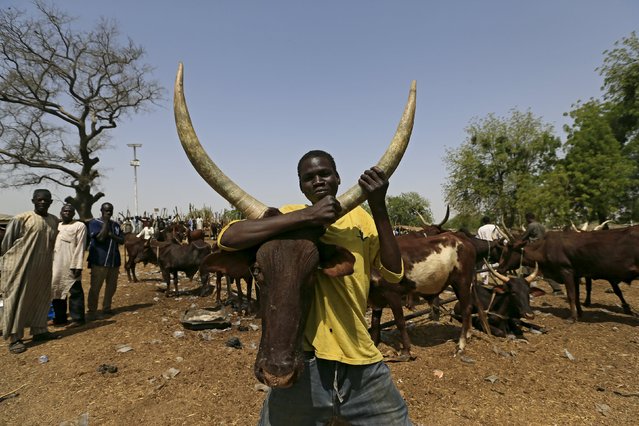
A man holds a cow at the cattle market in Maiduguri, Nigeria, March 9, 2016. (Photo by Afolabi Sotunde/Reuters)

A man holds a cow at the cattle market in Maiduguri, Nigeria, March 9, 2016. A Nigerian government push to strangle the Boko Haram insurgency has shut down the cattle trade that sustained the city of Maiduguri, leaving many residents with no livelihood, including many of the two million people displaced by the war. In recent months the army has taken back much of the territory lost to the jihadists during the five-year insurgency. (Photo by Afolabi Sotunde/Reuters)
Details
16 Mar 2016 14:06:00
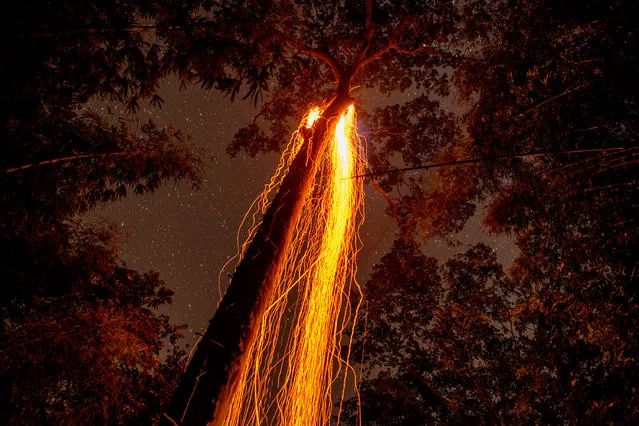
Bees are sensitive to light, which makes them follow the glowing embers down to the ground. (Photo by Hasnoor Hussain/The Guardian)

During the spring harvest season, a group of traditional Malaysian honey hunters travel to the rainforest near the Thai border to collect honeycombs from giant bees – and risk their lives climbing 200ft trees. Here: Bees are sensitive to light, which makes them follow the glowing embers down to the ground. (Photo by Hasnoor Hussain/The Guardian)
Details
22 Oct 2016 10:26:00
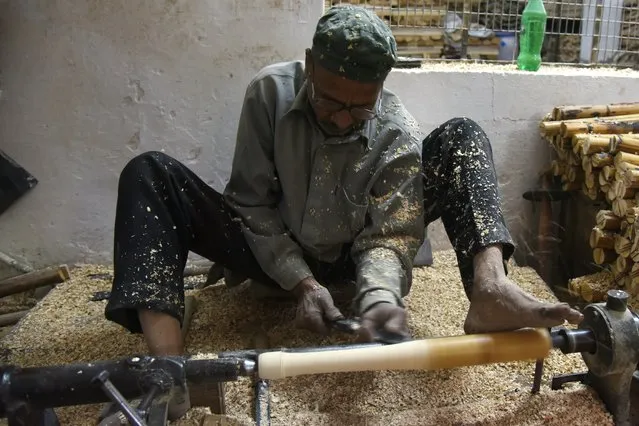
In this photograph taken on December 14, 2016, an Indian craftsman works on unfinished cricket bats in a factory in Meerut, some 70 kms north- east of New Delhi. As Indian factory worker Jitender Singh carves out another big- hitting slab of thick willow he insists MCC proposals to limit the size of cricket bats won' t tame Twenty20 marauders. “I don' t think the thickness matters. It' s more about the balance of the bat and the talent of the batsman”, says Singh, who has made bats for many stars, including South Africa's AB de Villiers. The World Cricket committee of the MCC, the guardians of the game, recommended in December 2016 that limitations be placed on the width and depth of bats because it had become too easy to smash fours and sixes. (Photo by Dominique Faget/AFP Photo)

In this photograph taken on December 14, 2016, an Indian craftsman works on unfinished cricket bats in a factory in Meerut, some 70 kms north- east of New Delhi. (Photo by Dominique Faget/AFP Photo)
Details
11 Jan 2017 14:32:00
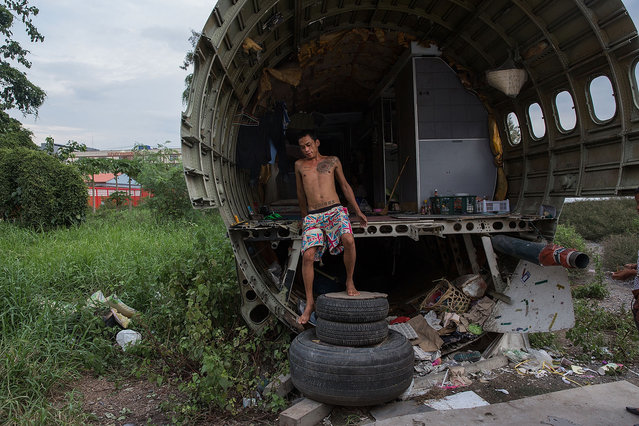
A Thai man climbs down from his home in a disused airplane on September 12, 2015 in Bangkok, Thailand. 3 impoverished Thai families have begun living in disused airplanes on a private field. The families, who collect and recycle garbage earning a few dollars a day, can't afford to rent and prefer to stay in the planes. (Photo by Taylor Weidman/Getty Images)

A Thai man climbs down from his home in a disused airplane on September 12, 2015 in Bangkok, Thailand. 3 impoverished Thai families have begun living in disused airplanes on a private field. The families, who collect and recycle garbage earning a few dollars a day, can't afford to rent and prefer to stay in the planes. (Photo by Taylor Weidman/Getty Images)
Details
05 Oct 2015 08:04:00
s*xy women kissing in bed. (Photo by Sakkmesterke/Getty Images)

Sеxy women kissing in bed. (Photo by Sakkmesterke/Getty Images)
Details
27 Dec 2017 07:13:00
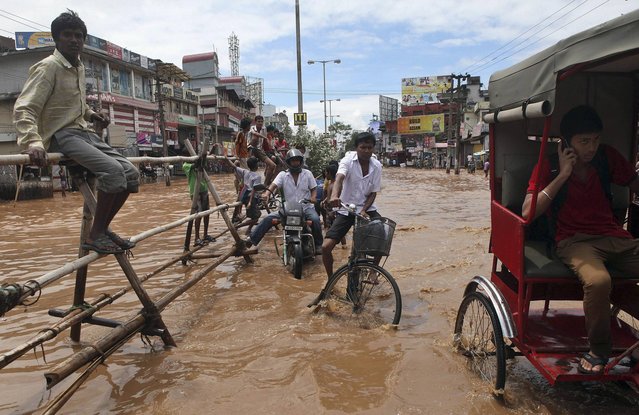
People move through a waterlogged street in Gauhati, India, Tuesday, July 16, 2013.  Heavy showers flooded some areas in the city on Tuesday. (Photo by Anupam Nath/AP Photo)

People move through a waterlogged street in Gauhati, India, Tuesday, July 16, 2013. Heavy showers flooded some areas in the city on Tuesday. (Photo by Anupam Nath/AP Photo)
Details
17 Jul 2013 10:16:00


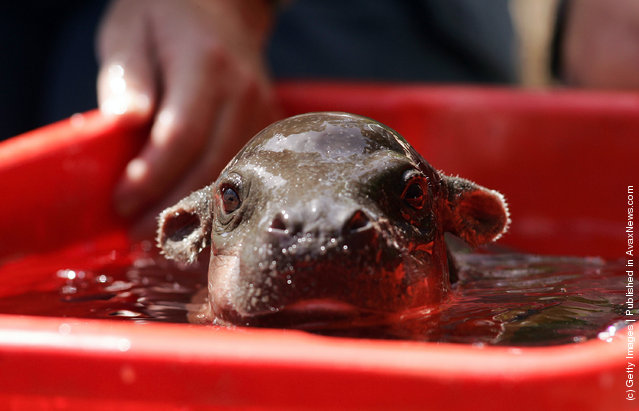
“The pygmy hippopotamus (Choeropsis liberiensis or Hexaprotodon liberiensis) is a large mammal native to the forests and swamps of western Africa (the specific name liberiensis means “of Liberia”, as this is where the vast majority live). The pygmy hippo is reclusive and nocturnal. It is one of only two extant species in the Hippopotamidae family, the other being its much larger cousin the common hippopotamus”. – Wikipedia

Photo: Monifa, a one month old baby Pygmy Hippopotamus takes a morning bath at Taronga Zoo on November 7, 2008 in Sydney, Australia. Monifa is the first Pygmy Hippopotamus to be born at Taronga Zoo in the past twenty three years. (Photo by Sergio Dionisio/Getty Images)
Details
11 Apr 2011 08:11:00


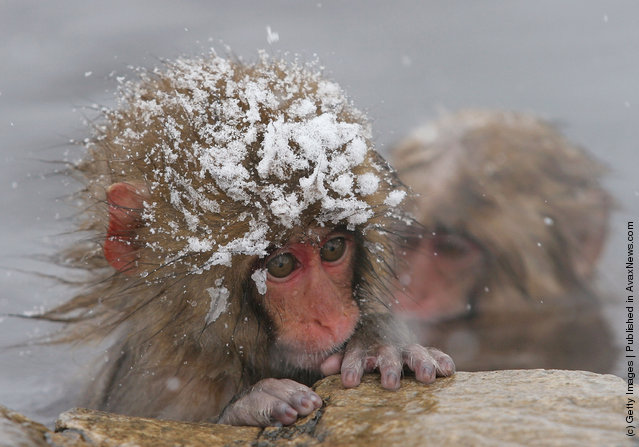
Japanese macaque monkeys enjoy sitting in the hot springs at Jigokudani-Onsen (Hell Valley) on January 23, 2005 in Jigokudani, Nagano-Prefecture, Japan. Japanese Macaques, also known as snow monkeys are the most northerly nonhuman primate in the world. In 1963 a female Macaque ventured into the hot springs to retrieve some soybeans. This behaviour was adopted by other monkeys, and eventually by the entire troop. This Macaque troop regularly visits the Jigokudani-Onsen springs to escape the cold. The hot springs are said to help relieve nerve pain and fatigue. (Photo by Koichi Kamoshida/Getty Images)
Details
20 May 2011 08:04:00