Loading...
Done
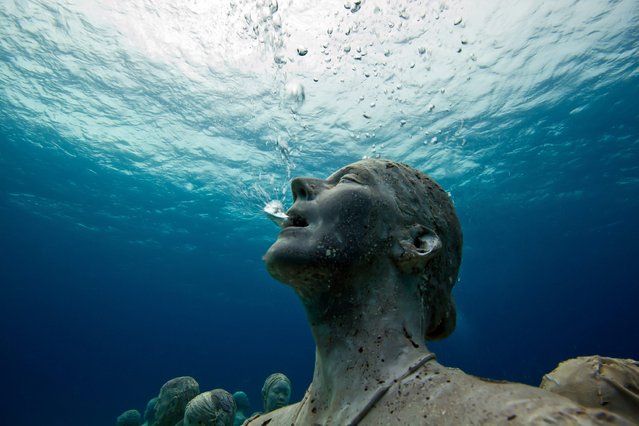
Monumental Underwater Museum MUSA; Jason deCaires Taylor; Silent Evolution

“In 2009 a monumental underwater museum called “MUSA” (Museo Subacuático de Arte) was formed in the waters surrounding Cancun, Isla Mujeres and Punta Nizuc. The project founded by Jaime Gonzalez Cano of The National Marine Park, Roberto Diaz of The Cancun Nautical Association and Jason deCaires Taylor consists of over 450 permanent life-size sculptures and is one of the largest and most ambitious underwater artificial art attractions in the world”. – UnderwaterSculpture (Photos by Jason deCaires Taylor/Intrepidacious/Kozy and Dan Kitchens)

Details
05 Oct 2012 07:26:00


“Snowflake (c. 1964 – November 24, 2003) was an albino gorilla. He was the only known albino gorilla so far, and the most popular resident of the Barcelona Zoo in Catalonia, Spain. Originally named Nfumu Ngui in Fang language ("white gorilla") by his captor, he was then nicknamed Floquet de Neu (Catalan for little snowflake) by his keeper Jordi Sabater Pi. On his arrival to Barcelona where he was given an official reception by the then Mayor of Barcelona, Josep Maria de Porcioles, in November 1966, he was called Blancanieves (“Snow White”) in the newspaper Tele/Exprés. But he became famous with the name given to him by Sabater when National Geographic Magazine featured him on the main page in March 1967, with the English name Snowflake. This name spread among the press (Stern, Life, Paris-Match) and was later translated to Spanish as Copito de Nieve. Sabater himself called the gorilla Floquet or Copi, and in the later years Nfumu. The asteroid 95962 Copito, discovered by Catalan astronomer J. Manteca, is named in his honour”.
Details
07 Mar 2011 15:50:00
An empty camp is shown beneath a colourful sky in Siberia, December 2016. (Photo by Timothy Allen/Barcroft Productions)

A British photographer has captured life at the “edge of the world”. Timothy Allen, best known for his work on BBC's Human Planet, trekked through the freezing Siberian wilderness for 16 days as he joined part of an 800km migration of reindeer in the Yamal-Nenets region – a name that roughly translates to “edge of the world”. The stunning pictures feature the nomadic Nenets tribe, who drink blood to survive in -45°C temperatures. Timothy's epic journey, which will be revealed in an eight-minute documentary on Animal Planet USA, saw him travel across the bleak terrain of the frozen Ob River with the Nenets people in December last year. Here: An empty camp is shown beneath a colourful sky in Siberia, December 2016. (Photo by Timothy Allen/Barcroft Productions)
Details
19 Sep 2017 07:48:00
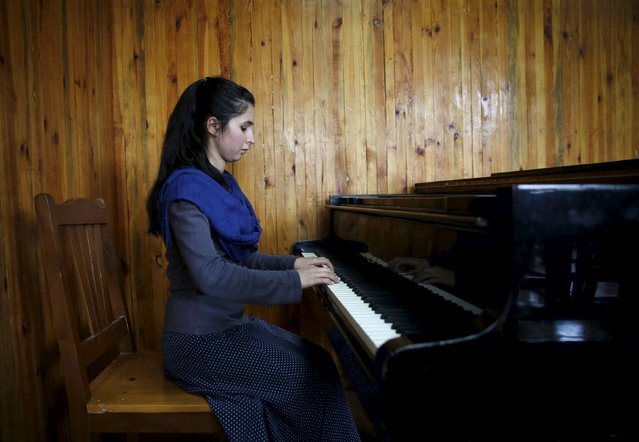
Negin Ekhpulwak, leader of the Zohra orchestra, an ensemble of 35 women, practises on a piano at Afghanistan's National Institute of Music, in Kabul, Afghanistan April 9, 2016. (Photo by Ahmad Masood/Reuters)

Negin Ekhpulwak, leader of the Zohra orchestra, an ensemble of 35 women, practises on a piano at Afghanistan's National Institute of Music, in Kabul, Afghanistan April 9, 2016. Playing instruments was banned under Taliban rule in Afghanistan, and even today, many conservative Muslims frown on most forms of music. Living in an orphanage in the capital, Kabul, 19-year-old Negin Ikhpolwak leads an ensemble of 35 women that plays both Western and Afghan musical instruments. In a country notorious internationally for harsh restrictions on women in most areas of life, Negin's story highlights a double challenge. (Photo by Ahmad Masood/Reuters)
Details
19 Apr 2016 13:47:00
Crystal, 15, a part-time boutique sales assistant, poses on Nathan Road in Mongkok shopping district in Hong Kong October 7, 2014. Holding a walkie talkie for fast communication with other supporters, Crystal said, “I am not demanding Chief Executive Leung Chun-ying to quit, but (want) to protect protesters from being threatened badly by opponents and the police”. (Photo by Bobby Yip/Reuters)

Reuters photographers Carlos Barria and Bobby Yip photographed protestors and details of life on the barricades, asking demonstrators what their role was in the movement, and what they wanted to happen. Here: Crystal, 15, a part-time boutique sales assistant, poses on Nathan Road in Mongkok shopping district in Hong Kong October 7, 2014. Holding a walkie talkie for fast communication with other supporters, Crystal said, “I am not demanding Chief Executive Leung Chun-ying to quit, but (want) to protect protesters from being threatened badly by opponents and the police”. (Photo by Bobby Yip/Reuters)
Details
09 Oct 2014 12:53:00


“The Southern Tamandua, Collared Anteater or Lesser Anteater (Tamandua tetradactyla) is a species of anteater from South America. It is a solitary animal, found in many habitats from mature to highly disturbed secondary forests and arid savannas. It feeds on ants, termites and bees. It has very strong foreclaws that can be used to break insect nests or to defend itself”. – Wikipedia

Photo: A three-month-old baby Southern Tamandua “Konbu” lies on its mother Tae's back at Sunshine International Aquarium on July 7, 2009 in Tokyo, Japan. Baby Southern Tamandua feels safe and comfortable holding onto something and normally stays on the mother's back until around 3 months old. (Photo by Junko Kimura/Getty Images)
Details
19 May 2011 10:31:00
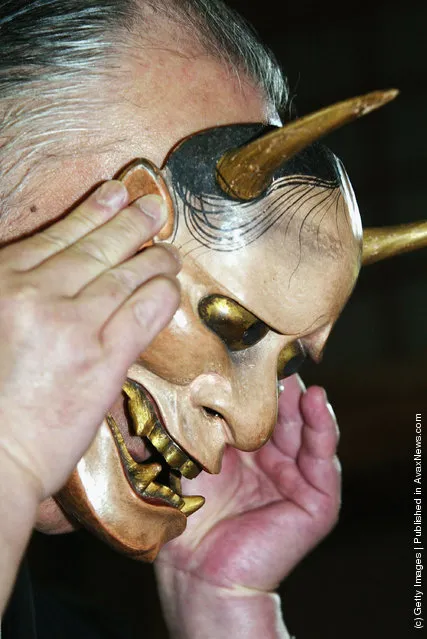
A renowned Noh actor, Otoshige Sakai, demostrates how to put on a Noh mask

“Noh, or Nogaku – derived from the Japanese word for “skill” or “talent” – is a major form of classical Japanese musical drama that has been performed since the 14th century. Many characters are masked, with men playing male and female roles. Traditionally, a Noh “performance day” lasts all day and consists of five Noh plays interspersed with shorter, humorous kyōgen pieces. However, present-day Noh performances often consist of two Noh plays with one Kyōgen play in between”. – Wikipedia

Photo: A renowned Noh actor, Otoshige Sakai, demostrates how to put on a Noh mask, on May 17, 2004 in Tokyo, Japan. (Photo by Koichi Kamoshida/Getty Images)
Details
02 Aug 2011 14:09:00
Baby Fennec Fox

“The fennec fox is a small nocturnal fox found in the Sahara of North Africa. Its most distinctive feature is unusually large ears. The name “fennec” comes from the Arabic word for fox, and the species name zerda has a Greek origin that refers to its habitat. The fennec is the smallest species of canid in the world; coat, ears and kidney functions have adapted to a high-temperature, low-water, desert environment. In addition, its hearing is sensitive enough to hear prey moving underground”. – Wikipedia

Photo: A Baby Fennec is seen at Sunshine International Aquarium on June 24, 2009 in Tokyo, Japan. The small nocturnal fox babies were born on May 17 2009. (Photo by Junko Kimura/Getty Images)
Details
16 Sep 2011 12:02:00