Loading...
Done
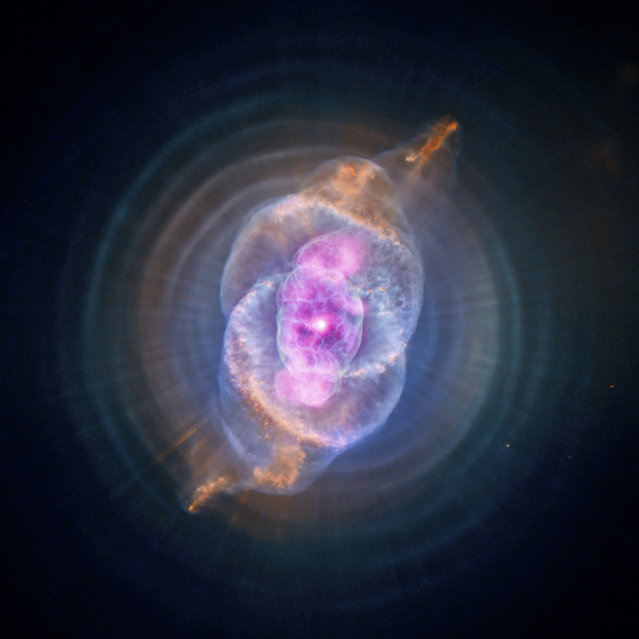
This image is NGC 6543 known as the Cat's Eye Nebula as it appears to the Chandra X-Ray Observatory and Hubble Telescope. A planetary nebula is a phase of stellar evolution that the sun should experience several billion years from now, when it expands to become a red giant and then sheds most of its outer layers, leaving behind a hot core that contracts to form a dense white dwarf star. This image was released October 10, 2012. (Photo by J. Kastner/NASA/CXC/RIT)

This image is NGC 6543 known as the Cat's Eye Nebula as it appears to the Chandra X-Ray Observatory and Hubble Telescope. A planetary nebula is a phase of stellar evolution that the sun should experience several billion years from now, when it expands to become a red giant and then sheds most of its outer layers, leaving behind a hot core that contracts to form a dense white dwarf star. This image was released October 10, 2012. (Photo by J. Kastner/NASA/CXC/RIT)
Details
15 Apr 2013 10:09:00
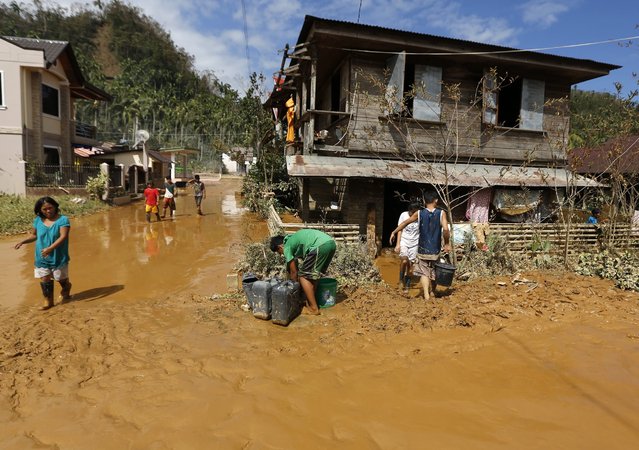
Filipino typhoon victims walk through heavy mud in the typhoon hit town of Taft, Samar island, Philippines, 08 December 2014. Typhoon Hagupit weakened into a tropical storm as it moved towards the Philippine capital after killing at least 27 people and displacing more than one million people in the eastern and central provinces. (Photo by Francis R. Malasig/EPA)

Filipino typhoon victims walk through heavy mud in the typhoon hit town of Taft, Samar island, Philippines, 08 December 2014. Typhoon Hagupit weakened into a tropical storm as it moved towards the Philippine capital after killing at least 27 people and displacing more than one million people in the eastern and central provinces. Hagupit slammed into the country's eastern coast on 06 December evening, bringing heavy rains and gale-force winds that flattened homes, ripped off roofs, and knocked out power and communications. (Photo by Francis R. Malasig/EPA)
Details
10 Dec 2014 11:37:00
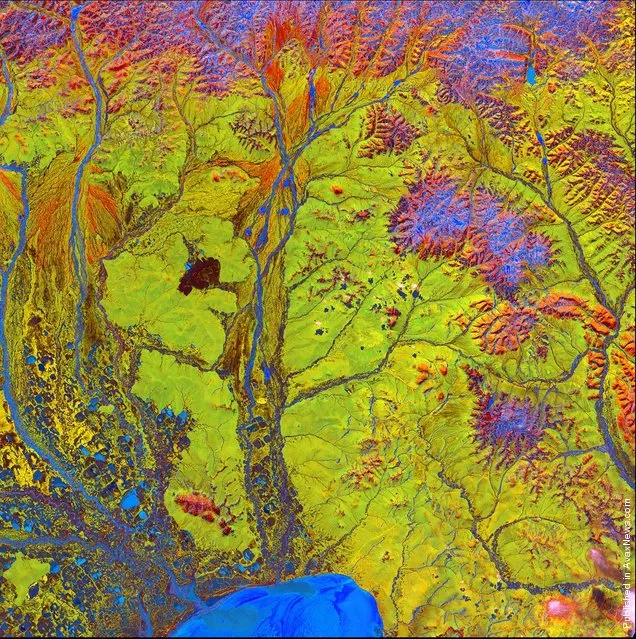
Vivid colors and bizarre shapes come together in a false-color image that could be an illustration for a fantasy story

Vivid colors and bizarre shapes come together in a false-color image that could be an illustration for a fantasy story. This labyrinth of exotic features winds its way along the edge of Russia’s Chaunskaya Bay in northeastern Siberia, seen as a vivid blue half-circle at the bottom of the image Two major rivers, the Chaun and Palyavaam, flow into the bay, which in turn opens into the Arctic Ocean. Ribbon lakes and bogs are present throughout the area, created by depressions left by receding glaciers. (Photo by USGS/NASA)
Details
14 Apr 2012 11:02:00
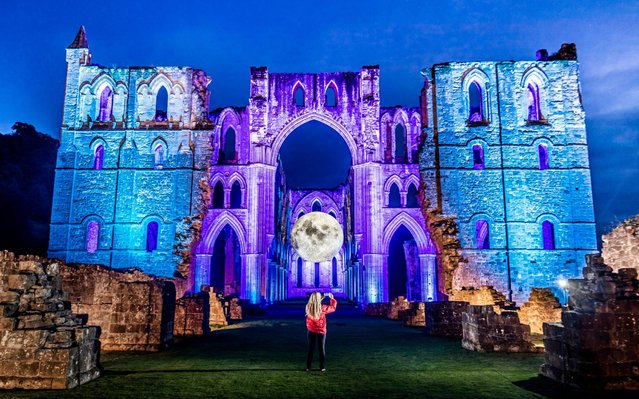
Luke Jerram's “Museum of the Moon” at English Heritage's Illuminating Rievaulx installation at Rievaulx Abbey, near Helmsley, North Yorkshire, England on September 18, 2019. (Photo by Danny Lawson/PA Images via Getty Images)

Luke Jerram's “Museum of the Moon” at English Heritage's Illuminating Rievaulx installation at Rievaulx Abbey, near Helmsley, North Yorkshire, England on September 18, 2019. (Photo by Danny Lawson/PA Images via Getty Images)
Details
21 Sep 2019 00:07:00
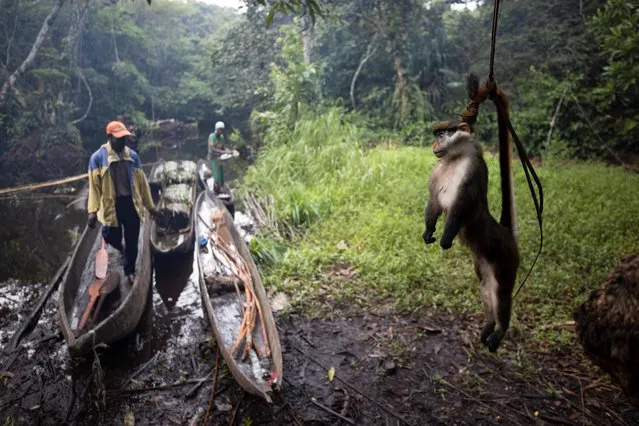
A dead red-tailed monkey hangs by its tail above the ground, in order to keep it away from ants, in the forest near the city of Mbandaka, Democratic Republic of the Congo, April 5, 2019. Bushmeat hunters are emptying Central Africa's forests at a high rate, researchers say. A growing appetite for wild meat in cities has ramped up the scale of hunting. Research shows around 6 million tonnes of bushmeat are sourced annually from the Congo Basin, whose forest spans across six countries and is second in size only to the Amazon. (Photo by Thomas Nicolon/Reuters)

A dead red-tailed monkey hangs by its tail above the ground, in order to keep it away from ants, in the forest near the city of Mbandaka, Democratic Republic of the Congo, April 5, 2019. Bushmeat hunters are emptying Central Africa's forests at a high rate, researchers say. A growing appetite for wild meat in cities has ramped up the scale of hunting. Research shows around 6 million tonnes of bushmeat are sourced annually from the Congo Basin, whose forest spans across six countries and is second in size only to the Amazon. (Photo by Thomas Nicolon/Reuters)
Details
14 Oct 2019 00:03:00
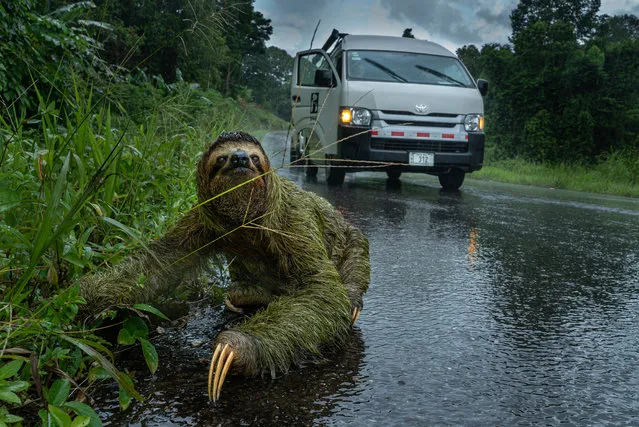
People and Nature category winner: Why did the sloth cross the road? by Andrew Whitworth (Osa Conservation and University of Glasgow), taken in Osa Peninsula, Costa Rica. “I was driving out from the Osa Peninsula, located on the southern Pacific coast of Costa Rica on a dark, stormy day. This female three-toed sloth (Bradypus variegatus) had luckily just about made it across the road, and the drivers of the Toyota on this occasion had spotted her in good time”. (Photo by Andrew Whitworth/2019 British Ecological Society Photography Competition)

People and Nature category winner: Why did the sloth cross the road? by Andrew Whitworth (Osa Conservation and University of Glasgow), taken in Osa Peninsula, Costa Rica. “I was driving out from the Osa Peninsula, located on the southern Pacific coast of Costa Rica on a dark, stormy day. This female three-toed sloth (Bradypus variegatus) had luckily just about made it across the road, and the drivers of the Toyota on this occasion had spotted her in good time”. (Photo by Andrew Whitworth/2019 British Ecological Society Photography Competition)
Details
30 Nov 2019 00:05:00
Sumo wrestler Kaiho eats a “chanko” meal in Nagoya, Japan on July 18, 2017. After ending practice at 10:30 a.m., the wrestlers mingle with fans, sign autographs and pose for photos before the first of their two daily meals. (Photo by Issei Kato/Reuters)

Sumo wrestler Kaiho eats a “chanko” meal in Nagoya, Japan on July 18, 2017. After ending practice at 10:30 a.m., the wrestlers mingle with fans, sign autographs and pose for photos before the first of their two daily meals. (Photo by Issei Kato/Reuters)
Details
20 Jul 2017 07:49:00
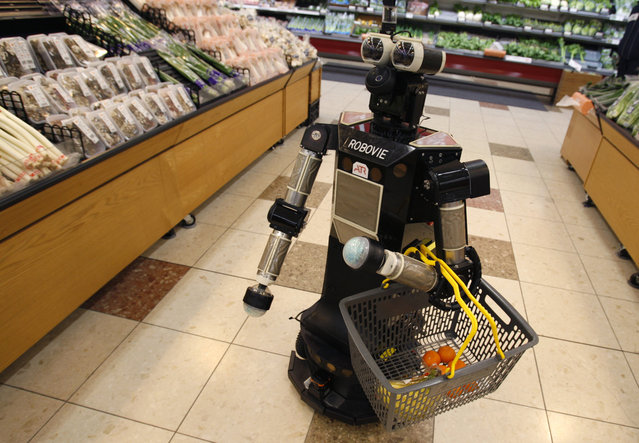
A robot named “Robovie-II”, developed by Japanese robotics research institution ATR, moves around at a grocery store during a shopping assisting experiment by utilizing the robot in an ubiquitous network technology platform in Kyoto, western Japan January 6, 2010. The robot greets the shopper at the entrance of the store, follows him to the shelves while holding a grocery basket and reminds him of the items on a shopping list, which the shopper would have entered beforehand in a specialized mobile device. The experiment is aimed to gather data in order to provide livelihood support for the elderly by using robots and network technologies, ATR's researcher Satoshi Koizumi said. (Photo by Yuriko Nakao/Reuters)

A robot named “Robovie-II”, developed by Japanese robotics research institution ATR, moves around at a grocery store during a shopping assisting experiment by utilizing the robot in an ubiquitous network technology platform in Kyoto, western Japan January 6, 2010. (Photo by Yuriko Nakao/Reuters)
Details
02 Feb 2018 06:54:00