Loading...
Done
NYC no pants subway ride. Thousands of straphangers took their pants off for the 15th annual "No Pants Subway Ride" hosted by Improv Everywhere. People gathered at seven meeting points throughout the five boroughs at 3PM. All participants met up at Union Square around 5PM to and had a pant-less celebration and the afterparty at Webster Hall. (Photo by Paul Martinka/The New York Post)

NYC no pants subway ride. Thousands of straphangers took their pants off for the 15th annual "No Pants Subway Ride" hosted by Improv Everywhere. People gathered at seven meeting points throughout the five boroughs at 3PM. All participants met up at Union Square around 5PM to and had a pant-less celebration and the afterparty at Webster Hall. (Photo by Paul Martinka/The New York Post)
Details
14 Jan 2016 08:04:00
Justin Nelzen, in red vest, joins others as they work to rescue up to 70 horses along Cypresswood Drive near Humble along Cypress Creek, Monday, April 18, 2016, in Houston. (Photo by Mark Mulligan/Houston Chronicle via AP Photo)

Justin Nelzen, in red vest, joins others as they work to rescue up to 70 horses along Cypresswood Drive near Humble along Cypress Creek, Monday, April 18, 2016, in Houston. More than a foot of rain fell Monday in parts of Houston, submerging scores of subdivisions and several major interstate highways, forcing the closure of schools and knocking out power to thousands of residents who were urged to shelter in place. (Photo by Mark Mulligan/Houston Chronicle via AP Photo)
Details
19 Apr 2016 13:21:00
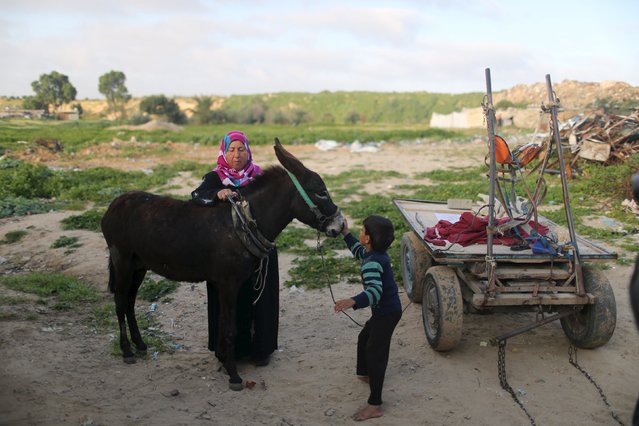
Palestinian woman Jihan Abu Muhsen prepares her donkey with her son Kareem before going work collecting bricks for sale from sites of demolished buildings, at her dwelling in Khan Younis in the southern Gaza Strip March 8, 2016. Abu Muhsen gathers bricks from the sites of demolished buildings and sells them to recycling factories. She earns around 20 shekels ($5) a day and her 10-year-old son Mohammad helps her when he is not at school. (Photo by Ibraheem Abu Mustafa/Reuters)

Palestinian woman Jihan Abu Muhsen prepares her donkey with her son Kareem before going work collecting bricks for sale from sites of demolished buildings, at her dwelling in Khan Younis in the southern Gaza Strip March 8, 2016. Abu Muhsen gathers bricks from the sites of demolished buildings and sells them to recycling factories. She earns around 20 shekels ($5) a day and her 10-year-old son Mohammad helps her when he is not at school. (Photo by Ibraheem Abu Mustafa/Reuters)
Details
19 Apr 2016 13:32:00
An activist with a painted face symbolizing the count of days spent in captivity attends the Free Azov rally in support of the captured defenders of Mariupol on April 21, 2024 in Kyiv, Ukraine. The participants came out to remind about the Ukrainian soldiers who have been held in Russian captivity for more than two years. (Photo by Yan Dobronosov/Global Images Ukraine via Getty Images)

An activist with a painted face symbolizing the count of days spent in captivity attends the Free Azov rally in support of the captured defenders of Mariupol on April 21, 2024 in Kyiv, Ukraine. The participants came out to remind about the Ukrainian soldiers who have been held in Russian captivity for more than two years. (Photo by Yan Dobronosov/Global Images Ukraine via Getty Images)
Details
05 May 2024 04:35:00
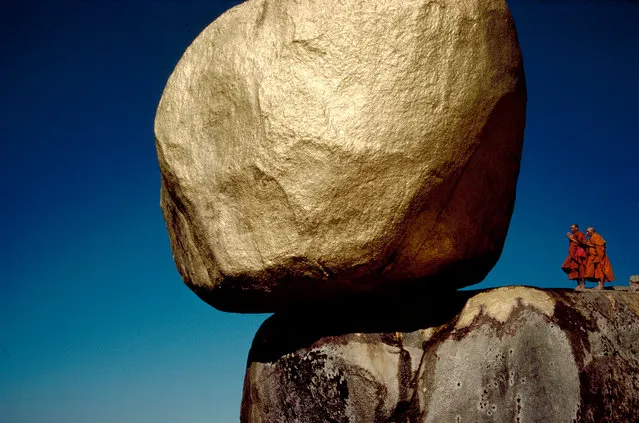
Kyaiktiyo, Burma, 1978. The Golden Rock at Shwe Pyi Daw (the Golden Country), the Buddhist holy place. Hiroji Kubota writes: “I was desperate to keep a distance from America for a while; luckily, I found Burma and its gentle and compassionate people. In the spring of 1978, on the top of the hill where I took this photo, I had two Leica bodies: the one with Tri-X and the other with Kodachrome 64. Soon after, I realised that the colour one looked very colourful and was more powerful. That was my decisive moment, to become a colour photographer”. (Photo by Hiroji Kubota/Magnum Photos)

Kyaiktiyo, Burma, 1978. The Golden Rock at Shwe Pyi Daw (the Golden Country), the Buddhist holy place. Hiroji Kubota writes: “I was desperate to keep a distance from America for a while; luckily, I found Burma and its gentle and compassionate people. In the spring of 1978, on the top of the hill where I took this photo, I had two Leica bodies: the one with Tri-X and the other with Kodachrome 64. Soon after, I realised that the colour one looked very colourful and was more powerful. That was my decisive moment, to become a colour photographer”. (Photo by Hiroji Kubota/Magnum Photos)
Details
10 Jun 2016 13:30:00
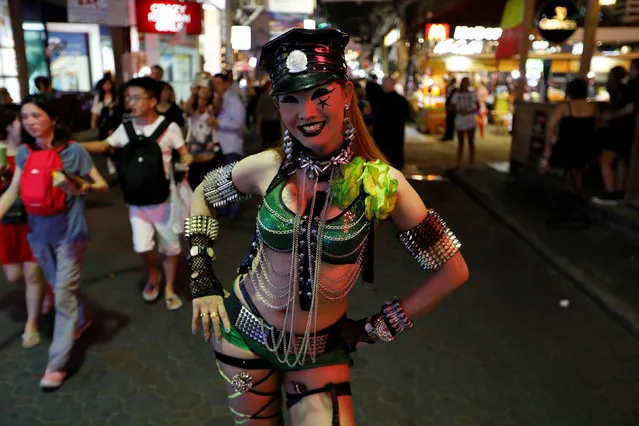
A woman promotes a go-go dance bar in Pattaya, Thailand March 25, 2017. With mascots dressed as smiling fish and a police rock band, Thai authorities launched a “Happy Zone” at the weekend to improve the image of a city notorious for sеx tourism. Stung by foreign headlines portraying the seaside resort of Pattaya as “Sin City” and “The World’s Sеx Capital”, Thailand’s junta has begun a new effort to re-brand it. Businesses in the Happy Zone are asked to make the area feel safer, there are increased security patrols, police launched a mobile phone app for visitors to summon them if an emergency occurs. (Photo by Jorge Silva/Reuters)

A woman promotes a go-go dance bar in Pattaya, Thailand March 25, 2017. With mascots dressed as smiling fish and a police rock band, Thai authorities launched a “Happy Zone” at the weekend to improve the image of a city notorious for sеx tourism. Stung by foreign headlines portraying the seaside resort of Pattaya as “Sin City” and “The World’s Sеx Capital”, Thailand’s junta has begun a new effort to re-brand it. Businesses in the Happy Zone are asked to make the area feel safer, there are increased security patrols, police launched a mobile phone app for visitors to summon them if an emergency occurs. (Photo by Jorge Silva/Reuters)
Details
28 Mar 2017 09:20:00
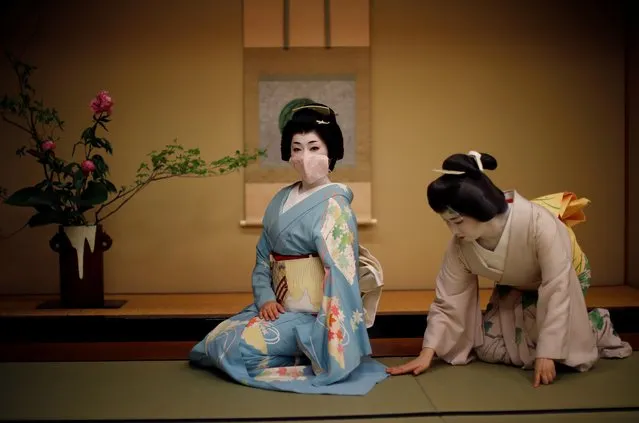
Mayu adjusts Koiku’s kimono, as Koiku wears a protective face mask while posing for a photograph, before they work at a party where they will entertain with other geisha at Japanese luxury restaurant Asada in Tokyo, Japan, June 23, 2020. The coronavirus pandemic has made Tokyo's geisha fear for their centuries-old profession as never before. Though the number of geisha - famed for their witty conversation, beauty and skill at traditional arts - has been falling for years, they were without work for months due to Japan's state of emergency and now operate under awkward social distancing rules. Engagements are down 95 percent, and come with new rules: no pouring drinks for customers or touching them even to shake hands, and sitting 2 meters apart. Masks are hard to wear with their elaborate wigs, so they mostly don't. “I was just full of anxiety”, said Mayu, 47. “I went through my photos, sorted my kimonos ... The thought of a second wave is terrifying”. (Photo by Kim Kyung-Hoon/Reuters)

Mayu adjusts Koiku’s kimono, as Koiku wears a protective face mask while posing for a photograph, before they work at a party where they will entertain with other geisha at Japanese luxury restaurant Asada in Tokyo, Japan, June 23, 2020. (Photo by Kim Kyung-Hoon/Reuters)
Details
23 Jul 2020 00:03:00
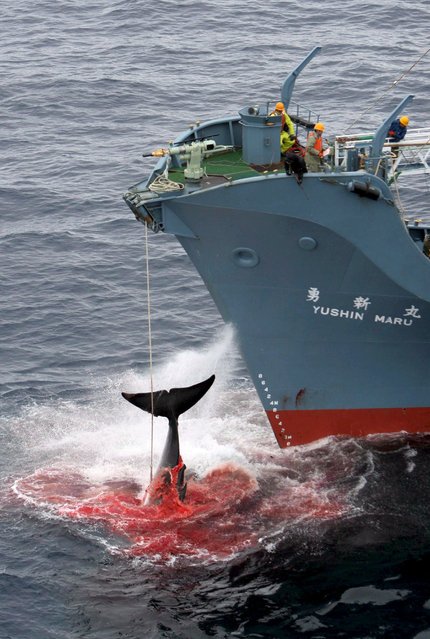
A file photograph dated 07 January 2006 and released by Greenpeace, showing the Yushin Maru, a factory ship in a Japanese whaling fleet, injuring a whale with it's first harpoon attempt. A UN court in The Hague on 31 March 2014 halted Japan's much-criticized whaling programme, ruling that it contravenes a 1986 moratorium on whale hunting. Japan must end its 'research whaling' programme, the International Court of Justice (ICJ) said. (Photo by Kate Davison/EPA)

A file photograph dated 07 January 2006 and released by Greenpeace, showing the Yushin Maru, a factory ship in a Japanese whaling fleet, injuring a whale with it's first harpoon attempt. A UN court in The Hague on 31 March 2014 halted Japan's much-criticized whaling programme, ruling that it contravenes a 1986 moratorium on whale hunting. Japan must end its 'research whaling' programme, the International Court of Justice (ICJ) said. Japan said the programme was for scientific research and permitted under international conventions. Australia had brought the case to the ICJ in 2010, charging that Japan was breaching international law by killing hundreds of whales every year for commercial purposes. Japan was “deeply disappointed” by the ruling, an unnamed government official was quoted by the Kyodo News agency as saying. But the official said Japan would stand by the ruling. (Photo by Kate Davison/EPA)
Details
01 Apr 2014 08:38:00