Loading...
Done
A stunt rider jumps over spectators after the final stage of the annual ABSA Cape Epic mountain bike stage race, Cape Town, South Africa, 30 March 2014. (Photo by Kim Ludbrook/EPA)

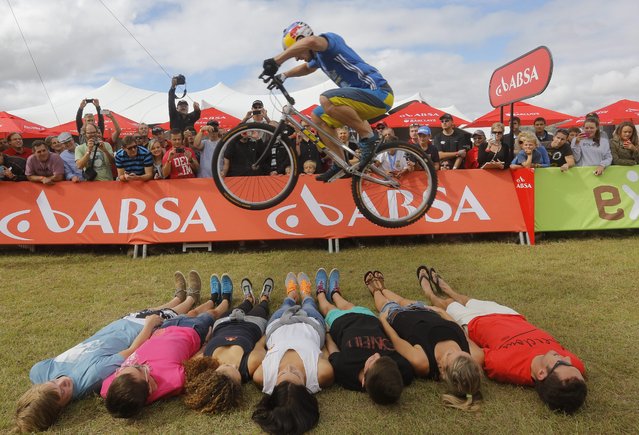
A stunt rider jumps over spectators after the final stage of the annual ABSA Cape Epic mountain bike stage race, Cape Town, South Africa, 30 March 2014. The multi day stage race is know as the “Tour de France” of mountain biking and sees 1,200 riders riding 720km in seven days. The race includes the worlds leading professional racers along with amateur cyclists. (Photo by Kim Ludbrook/EPA)
Details
31 Mar 2014 09:12:00
Fun Laws In America By Olivia Locher

Many laws still in existence throughout the united states are wildly outdated, rendering them completely ridiculous, useless and bizarre. The absurdity is illustrated by new York-based photographer Olivia Locher, who catalogs the crazy rules and regulations of each state in a playful photographic series ‘I fought the law’. Readers might be surprised to learn that in Rhode island, it is illegal to wear transparent clothing, nobody is allowed to ride a bicycle in a swimming pool in California and Arizona residents may not have more than two dildos in a house. Take a look at the ongoing series below to find out more about the peculiar oddities present in the American legal system.
Details
09 Jun 2014 11:36:00


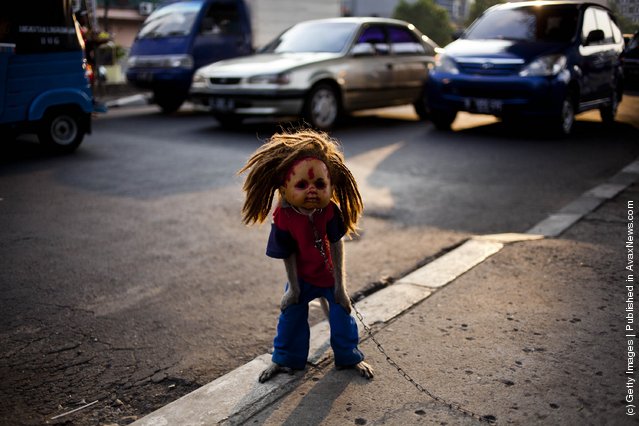
Ucil, a trained monkey, takes part in a street performance on June 1, 2011 in Jakarta, Indonesia. The street performances usually involve the monkeys wearing masks, such as dolls' heads or attire to mimic humans, with the monkeys trained to act out human activities such as shopping, riding bicycles or other simulations of human behaviour. Poverty drives the handlers to exploit the monkeys in the hope of earning small change, but the effect and cruelty to the monkeys is a cause that charities such as the Jakarta Animal Aid Network are increasingly taking up. (Photo by Ulet Ifansasti/Getty Images)
Details
02 Jun 2011 12:14:00


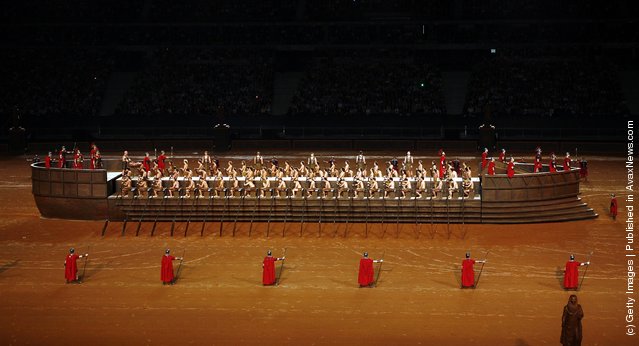
PARIS - SEPTEMBER 22: French actor Christophe Heraut plays Ben-Hur and rides in a Roman chariot during the stage production premiere of 'Ben-Hur' September 22, 2006 in Saint-Denis, Paris, France. After Charlton Heston played the lead in this sword and sandal epic, written by Civil War Union Gen. Lew Wallace, on the big screen, the play is set to return in a live version staged at France's biggest sports stadium. Behind the 13-million-euro (16.5-million-dollar) show is a veteran Paris-born director Robert Hossein, who involved a large crew of hundreds of actors for the show. (Photo by Francois Durand/Getty Images)
Details
16 Nov 2011 12:17:00
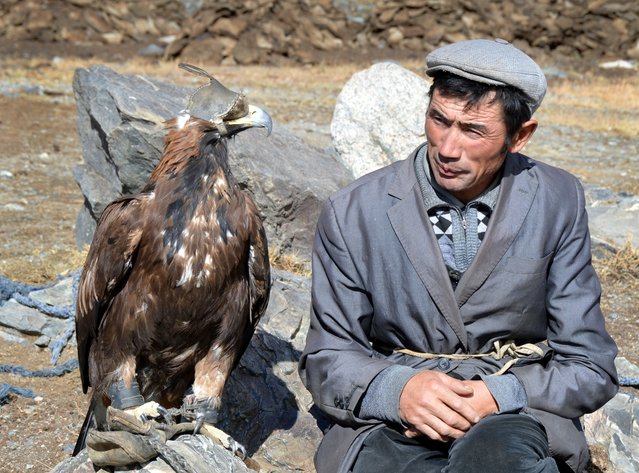
Hunter Berek and his eagle outside his home. (Photo by Brad Ruoho/The Star Tribune)

“I’d come to the Altai Mountains on an Adventure Sherpas tour. Our group of 12 was made up mostly of Minnesotans who’d left warm weather and falling leaves for frosty Mongolia. We’d come to sleep in cozy ger tents, the traditional yurt abode of the Mongolian steppe; sip mare’s milk tea; climb mountain glaciers; ride horses to an ancient battle site, and attend the annual Eagle Hunting Festival in Ölgiy...”. – Kathryn Kysar via The Star Tribune. Here: hunter Berek and his eagle outside his home. (Photo by Brad Ruoho/The Star Tribune)
Details
11 Jan 2015 12:57:00
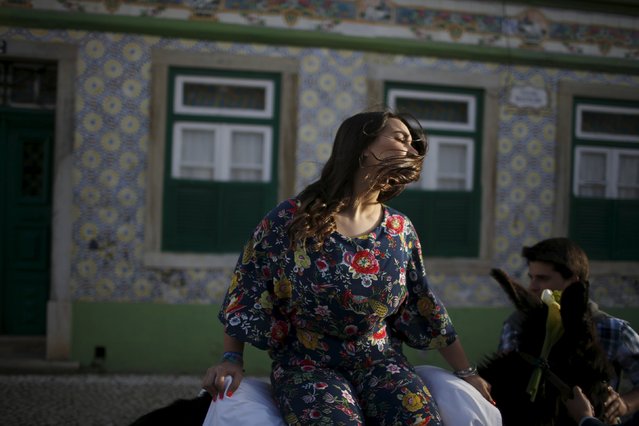
A woman takes part in the procession of the “Virgem da Atalaia” procession during Holy Week at Alcochete, near Lisbon, Portugal March 27, 2016. (Photo by Rafael Marchante/Reuters)

A woman takes part in the procession of the “Virgem da Atalaia” procession during Holy Week at Alcochete, near Lisbon, Portugal March 27, 2016. Women ride on donkeys during the “Virgem da Atalaia” procession, that has been held annually for about 400 years. In the past, only single women rode the donkeys to ask for help from the Virgin to find a husband. (Photo by Rafael Marchante/Reuters)
Details
28 Mar 2016 10:30:00
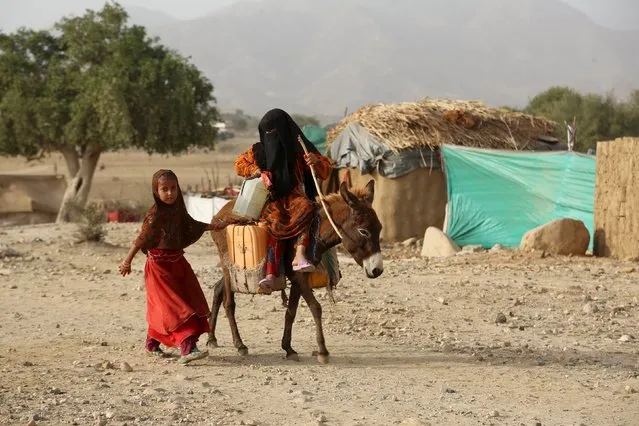
A girl rides a donkey as another walks by at the Shawqaba camp for internally displaced people who were forced to leave their villages by the war in Yemen's northwestern province of Hajjah March 12, 2016. In northwest Yemen, one of the poorest countries in the Middle East, about 400 families uprooted by the war have been stuck in the Shawqaba camp in Hajjah province for the past year. Residents live in poorly built huts that protect them neither from summer heat nor winter cold in a camp that lacks the most basic services. (Photo by Abduljabbar Zeyad/Reuters)

A girl rides a donkey as another walks by at the Shawqaba camp for internally displaced people who were forced to leave their villages by the war in Yemen's northwestern province of Hajjah March 12, 2016. In northwest Yemen, one of the poorest countries in the Middle East, about 400 families uprooted by the war have been stuck in the Shawqaba camp in Hajjah province for the past year. Residents live in poorly built huts that protect them neither from summer heat nor winter cold in a camp that lacks the most basic services. (Photo by Abduljabbar Zeyad/Reuters)
Details
09 Apr 2016 13:16:00
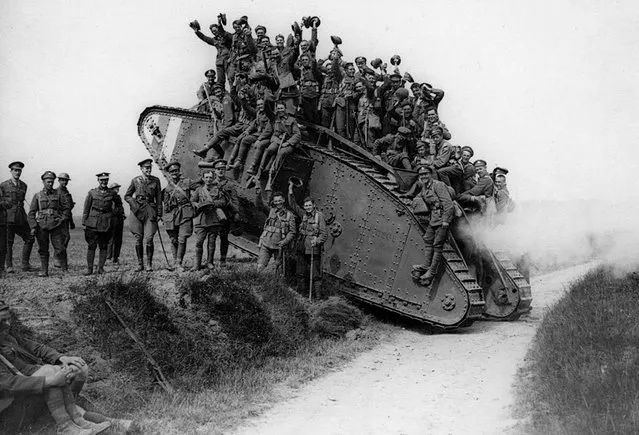
These black-and-white photos are taken from the new book “Armoured Warfare in the First World War 1916 – 1918” by Anthony Tucker-Jones and published by Pen & Sword Military. “Interestingly the British, French and Germans took completely different approaches with varying results”. The British military produced “Little Willie” in Autumn 1915 weighing 18 tonnes, which had a crew of two plus four gunners. “Inspired by a tracked artillery tractor “Little Willie” was referred to as a water tank – hence the name tank – to ensure secrecy”, said Anthony. “This led to the strange looking Mark I with its peculiar rhomboid shape, designed to cross trenches with guns in sponsons on either side. The Germans saw the tank as unchivalrous and were slow to grasp its utility. They favoured the Stormtrooper (specialist soldiers used to infiltrate enemy trenches) and artillery, not the tank”, said Anthony. “However, they didn’t hesitate to make use of captured British tanks. Although the tank helped secure victory and German soldiers dubbed it “Germany’s Downfall” the country was ultimately brought to its knees by the Allies blockade”. Here: British troops hitch a ride on a Mark IV after the massed tank fleet spearheading attack at Cambrai on November 20, 1917. (Photo by Anthony Tucker-Jones/Mediadrumworld.com)

These black-and-white photos are taken from the new book “Armoured Warfare in the First World War 1916 – 1918” by Anthony Tucker-Jones and published by Pen & Sword Military. Here: British troops hitch a ride on a Mark IV after the massed tank fleet spearheading attack at Cambrai on November 20, 1917. (Photo by Anthony Tucker-Jones/Mediadrumworld.com)
Details
23 Feb 2017 00:02:00