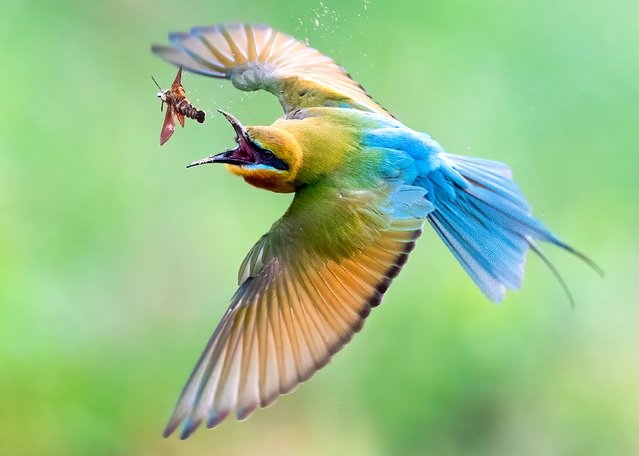
A blue-tailed bee-eater chases down its prey along the banks of the Kaveri River on the outskirts of the city of Mysore, India in the last decade of June 2025. (Photo by Nitin Jain/Solent News)
A Hindu devotee performs a stunt with fire during a rehearsal for the annual Rath Yatra, or chariot procession, which commemorates a journey by Hindu god Jagannath, his brother Balabhadra and sister Subhadra, in specially made chariots, in Ahmedabad, India, June 26, 2016. (Photo by Amit Dave/Reuters)
Emma the Maltese's fur blows in the wind as she rides in her owner's purse on 5th Avenue at Central Park in New York December 2, 2014. (Photo by Carlo Allegri/Reuters)
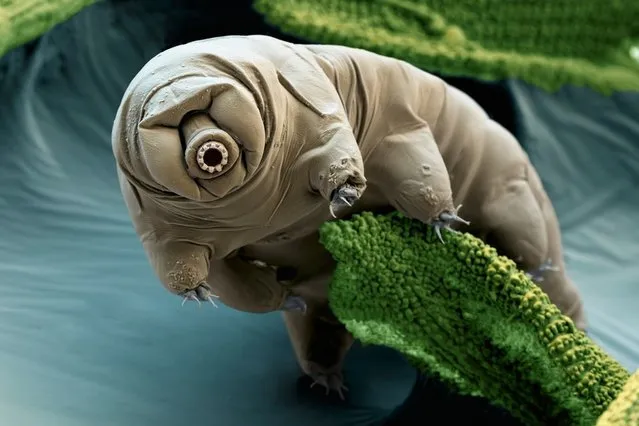
“Tardigrades (commonly known as waterbears or moss piglets) are small, water-dwelling, segmented animals with eight legs. Tardigrades were first discovered in 1773 by Johann August Ephraim Goeze, who called them kleiner Wasserbär, meaning “little water bear” in German. The name Tardigrada means “slow walker” and was given by Lazzaro Spallanzani in 1777. The name water bear comes from the way they walk, reminiscent of a bear's gait. The biggest adults may reach a body length of 1.5 millimetres (0.059 in), the smallest below 0.1 mm. Freshly hatched tardigrades may be smaller than 0.05 mm”. – Wikipedia. Photo: Tardigrades. (Photo by SPL/East News)
The “Rabid Transit” Burning Man art car erupts with flames from it's onboard propane poofers during the 4th day of the annual Burning Man arts and music festival in the Black Rock Desert of Nevada, U.S., August 31, 2017. (Photo by Jim Bourg/Reuters)