Loading...
Done
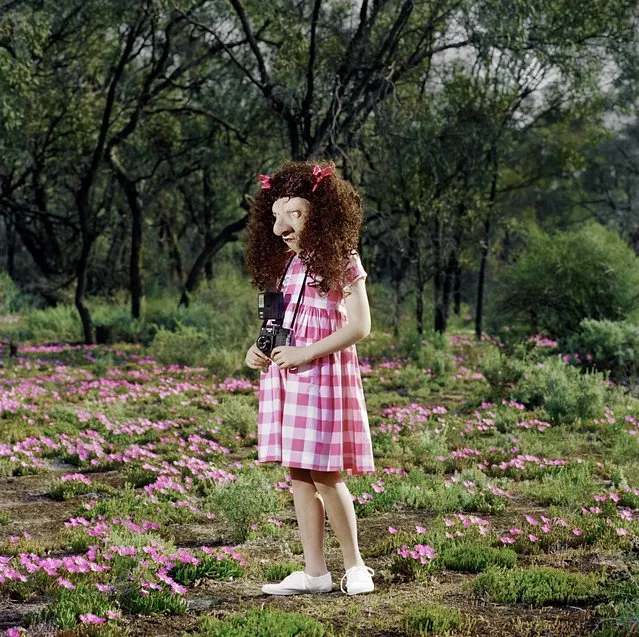
Photo by Polixeni Papapetrou

Australian artist Polixeni Papapetrou trends the line between fantasy/theatre, mythology/reality, archetype/play, male/female, child/adult and animal/human. As with all her work the series The Dreamkeepers tells a story that includes her autobiographical relationship with her children, but it also says a lot more about the condition of childhood - its place in our culture and how we react to images of children in photography.

Details
06 Aug 2012 08:09:00
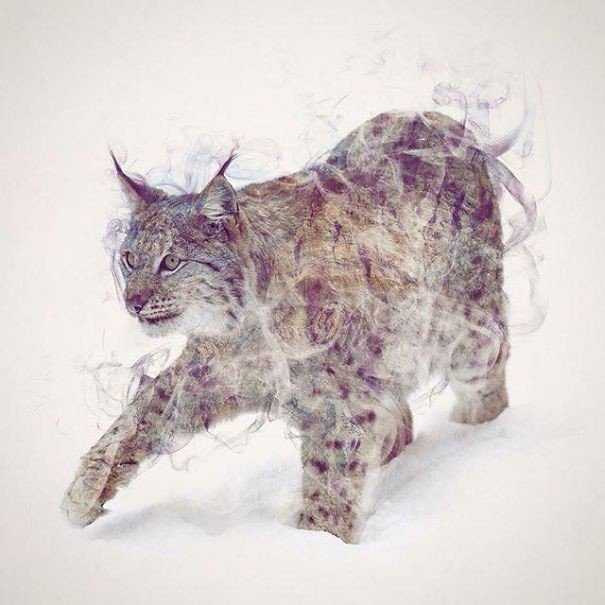
Double-Exposure Animal Portraits By Dániel Taylor

I wanted to create the smoke effects on animals I used on some few of my female subjects.
The hardest part was that while there were only faces, here there was the whole body that needed to be “smokeified”.


Dániel Taylor.
Details
10 Oct 2015 11:15:00
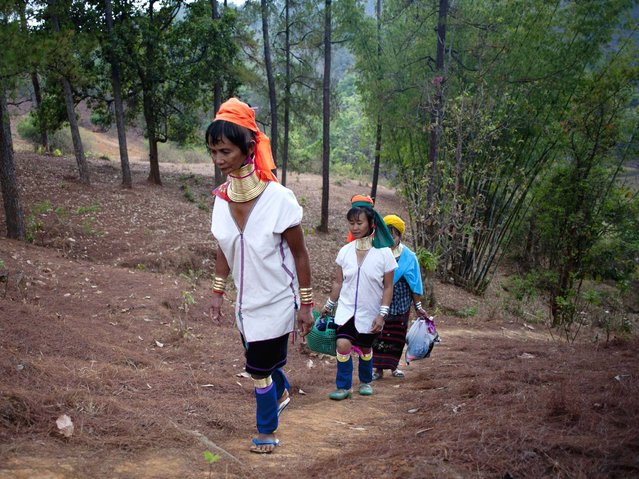
One of the theories says that the coils originate from the desire to look more attractive by exaggerating sexual dimorphism, as women have more slender necks than men. (Photo by Ye Aung Thu/AFP Photo)

This photo taken on April 16, 2014 shows ethnic Kayan women wearing traditional clothes and bronze rings around tbeir neck in Panpet village, Demoso township in Kayah state, eastern Myanmar. Some ethnic Kayan women, also known as Padaung, begin wearing the bronze rings on their neck and legs from a young age. Usually they start wearing six to ten rings when they are five to ten-years-old and then they put on one more ring a year for years after then. (Photo by Ye Aung Thu/AFP Photo)
Details
23 Apr 2014 08:56:00
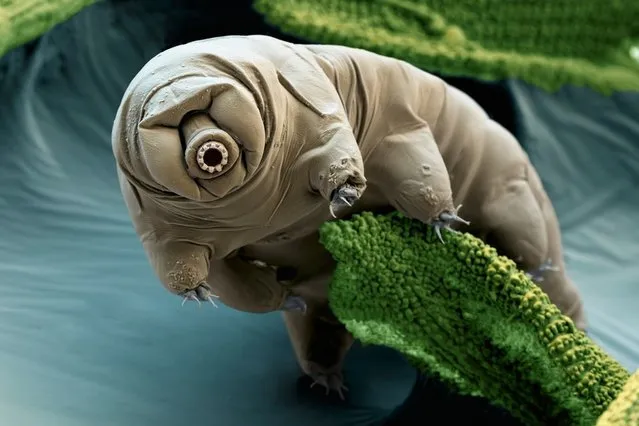
Tardigrades (commonly known as waterbears or moss piglets). (Photo by SPL/East News)

“Tardigrades (commonly known as waterbears or moss piglets) are small, water-dwelling, segmented animals with eight legs. Tardigrades were first discovered in 1773 by Johann August Ephraim Goeze, who called them kleiner Wasserbär, meaning “little water bear” in German. The name Tardigrada means “slow walker” and was given by Lazzaro Spallanzani in 1777. The name water bear comes from the way they walk, reminiscent of a bear's gait. The biggest adults may reach a body length of 1.5 millimetres (0.059 in), the smallest below 0.1 mm. Freshly hatched tardigrades may be smaller than 0.05 mm”. – Wikipedia. Photo: Tardigrades. (Photo by SPL/East News)
Details
26 Sep 2012 09:55:00
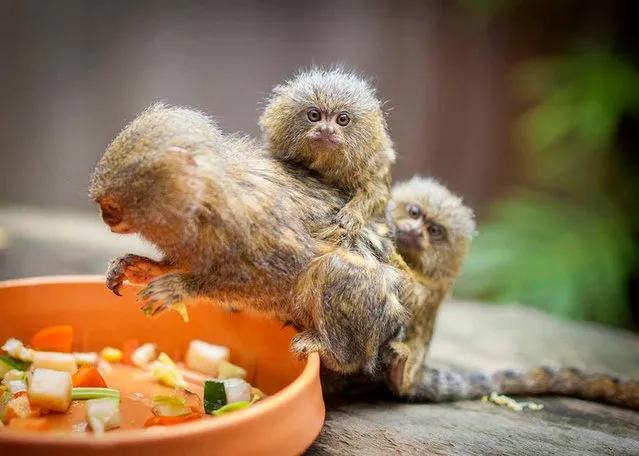
An undated handout picture made available by the Symbio Wildlife Park on 28 November 2016 shows three Pygmy Marmoset monkeys including an adult male, a female juvenile and a four-week-old baby, at the Symbio Wildlife Park in Helensburgh, South of Sydney, New South Wales, Australia. Officers were called to the wildlife park in Helensburgh on 26 November, after staff discovered the monkeys were missing from their enclosure. According to reports on 27 November, two men have been charged with stealing the three rare monkeys after they were found while driving south-west Sydney with one of the missing monkeys, the four-week-old one. Wollongong Police found the missing female juvenile, Sofia, in the Campbelltown area on 27 November, and returned her to the care of the zoo. The male marmoset, father “Gomez”, was reported still missing. (Photo by EPA/Symbio Wildlife Park)

An undated handout picture made available by the Symbio Wildlife Park on 28 November 2016 shows three Pygmy Marmoset monkeys including an adult male, a female juvenile and a four-week-old baby, at the Symbio Wildlife Park in Helensburgh, South of Sydney, New South Wales, Australia. (Photo by EPA/Symbio Wildlife Park)
Details
04 Dec 2016 09:58:00
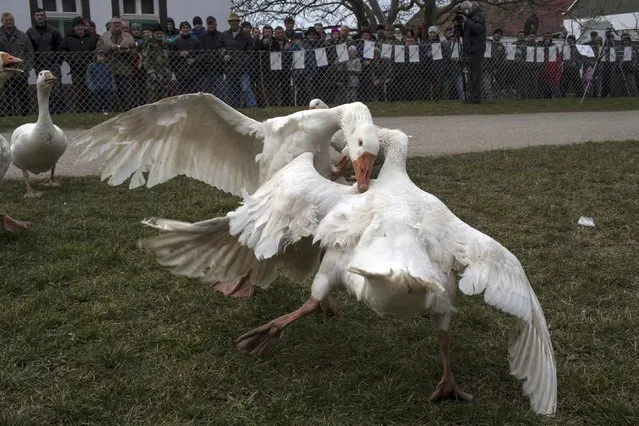
Geese fight during the annual Geese Fight Day in the northern Serbian village of Mokrin, some 160km (100 miles) from Belgrade February 22, 2015. (Photo by Marko Djurica/Reuters)

Geese fight during the annual Geese Fight Day in the northern Serbian village of Mokrin, some 160km (100 miles) from Belgrade February 22, 2015. Every year in the last week of February, goose fights are held in the northern Serbian village of Mokrin. Left alone, male geese, or ganders, are unlikely to fight each other, hence why females are brought along for whose affections the ganders then fight until one or the other gives up. (Photo by Marko Djurica/Reuters)
Details
23 Feb 2015 13:01:00
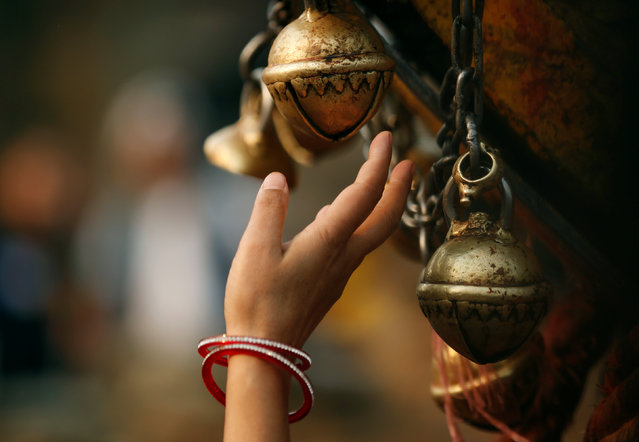
A hand of a devotee is pictured as she rings a bell while offering prayers to the chariot of God Bhairab during the Bisket festival in Bhaktapur, Nepal, April 13, 2016. (Photo by Navesh Chitrakar/Reuters)

A hand of a devotee is pictured as she rings a bell while offering prayers to the chariot of God Bhairab during the Bisket festival in Bhaktapur, Nepal, April 13, 2016. During the festival, also regarded as Nepalese New Year, images of the Hindu god Bhairava and his female counterpart Bhadrakali are enshrined in two large chariots and pulled to an open square after which rituals and festivities are performed. (Photo by Navesh Chitrakar/Reuters)
Details
15 Apr 2016 11:20:00
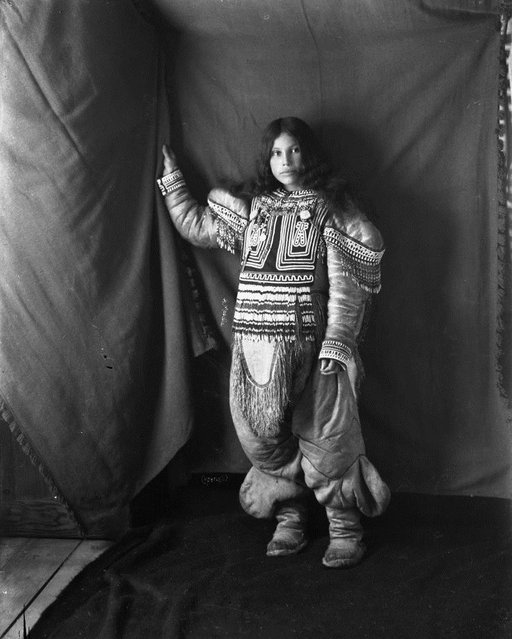
Moodie was born in 1854 in Toronto, and after a move to England she met and married John Douglas Moodie in 1878, and had six children. Here: Inuit woman, Kootucktuck, in her beaded attigi. Fullerton Harbour, Nunavut, February 1905. (Photo by Geraldine Moodie/The Guardian)

Geraldine Moodie overcame harsh conditions to become western Canada’s first professional female photographer, capturing beautiful images in the country’s most remote regions. An exhibition, “North of Ordinary: The Arctic Photographs of Geraldine and Douglas Moodie”, is at Glenbow, Calgary, 18 February – 10 September. Here: Inuit woman, Kootucktuck, in her beaded attigi. Fullerton Harbour, Nunavut, February 1905. (Photo by Geraldine Moodie/The Guardian)
Details
17 Feb 2017 00:04:00