Loading...
Done


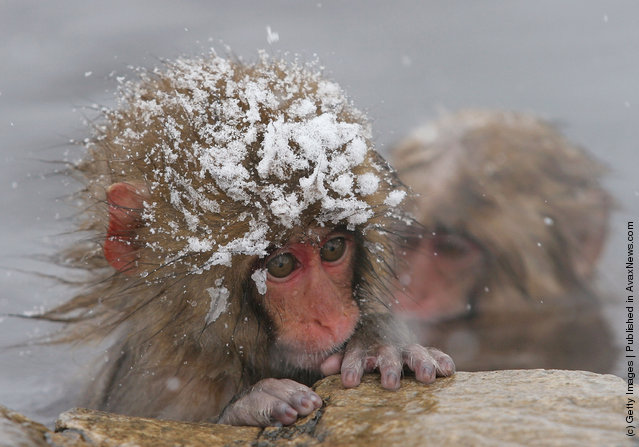
Japanese macaque monkeys enjoy sitting in the hot springs at Jigokudani-Onsen (Hell Valley) on January 23, 2005 in Jigokudani, Nagano-Prefecture, Japan. Japanese Macaques, also known as snow monkeys are the most northerly nonhuman primate in the world. In 1963 a female Macaque ventured into the hot springs to retrieve some soybeans. This behaviour was adopted by other monkeys, and eventually by the entire troop. This Macaque troop regularly visits the Jigokudani-Onsen springs to escape the cold. The hot springs are said to help relieve nerve pain and fatigue. (Photo by Koichi Kamoshida/Getty Images)
Details
20 May 2011 08:04:00
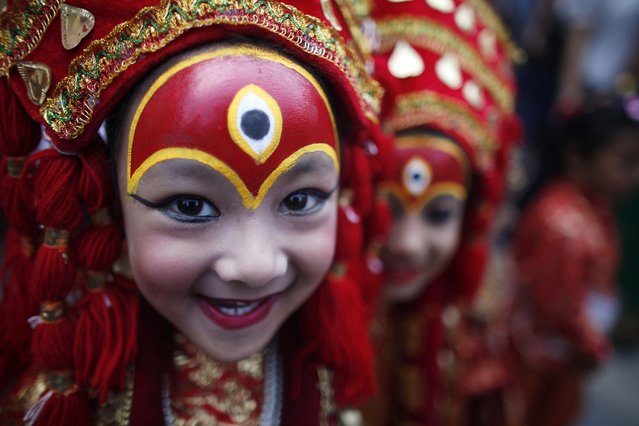
A young Nepalese girl dressed as a Kumari or living Goddess, smiles for camera as she waits for Kumari puja at Hanuman Dhoka, Basantapur Durbar Square in Katmandu, Nepal, Tuesday, Sept 17, 2013. More than hundred girls under the age of nine gathered for Kumari puja, a tradition of worshiping young pre-pubescent girls as manifestations of the divine female energy. The ritual holds a strong religious significance in Newar community. It is a community affair held primarily to save small girls from diseases and bad luck in the years to come. (AP Photo/Niranjan Shrestha)

The festival marks the end of the monsoon season and beginning of autumn. More than hundred girls under the age of nine gathered for the tradition of worshiping young pre-pubescent girls as manifestations of the divine female energy. The ritual holds a strong religious significance in Newar community. It is a community affair held primarily to save small girls from diseases and bad luck in the years to come. Photo: A young Nepalese girl dressed as a Kumari or living Goddess, smiles for camera as she waits for Kumari puja at Hanuman Dhoka, Basantapur Durbar Square in Katmandu, Nepal, Tuesday, September 17, 2013. (Photo by Niranjan Shrestha/AP Photo)
Details
18 Sep 2013 09:33:00
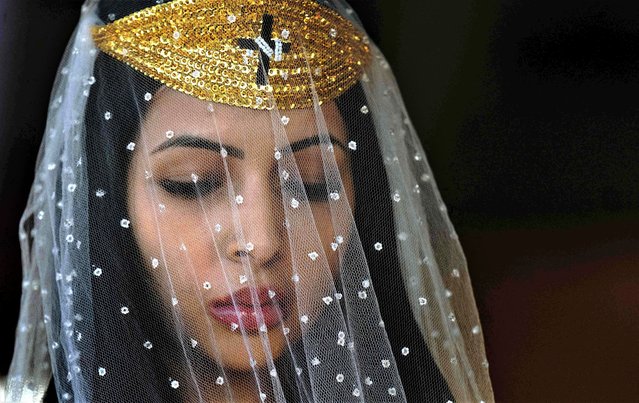
A Nymph or female devotee of the Vale do Amanhecer religious community, prays at their temple complex in Vale do Amanhecer (Sunrise Valley), a community on the outskirts of Planaltina, 50 km from the Brazilian capital, Brasilia, on April 29, 2023. This eclectic community holds its most important ritual of the year on Labour Day to honour the mediums who communicate with good and bad spirits. The group combines a range of religious practices, including Christian and Hindu, with symbols borrowed from the Incas and Mayans, as well as a belief in extraterrestrial life and intergalactic travel. The religion claims hundred temples throughout Brazil, Portugal and other countries. (Photo by Carl de Souza/AFP Photo)

A Nymph or female devotee of the Vale do Amanhecer religious community, prays at their temple complex in Vale do Amanhecer (Sunrise Valley), a community on the outskirts of Planaltina, 50 km from the Brazilian capital, Brasilia, on April 29, 2023. This eclectic community holds its most important ritual of the year on Labour Day to honour the mediums who communicate with good and bad spirits. The group combines a range of religious practices, including Christian and Hindu, with symbols borrowed from the Incas and Mayans, as well as a belief in extraterrestrial life and intergalactic travel. The religion claims hundred temples throughout Brazil, Portugal and other countries. (Photo by Carl de Souza/AFP Photo)
Details
08 Aug 2024 05:51:00
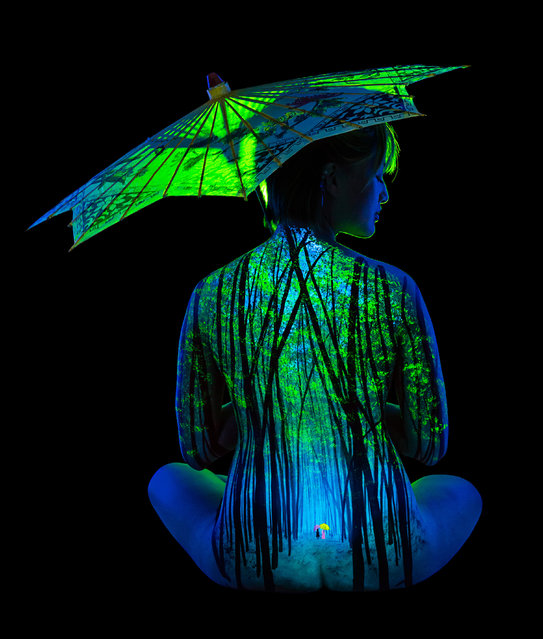
“Bamboo Mist”. (Photo by John Poppleton/Caters News)

A bodypainter uses UV paint to create electrifying masterpieces of stunning landscapes on models. John Poppletons vibrant Bodyscapes feature bright savannahs, lightning storms and vivid galaxies leaping from the bodies of his subjects. The artist, who lives in Wellsville in Utah, USA, uses a black light on his paintings to make them look as close to real life as possible. He predominantly uses female models and often paints across their backs to give him the largest surface area to work with. Here: “Bamboo Mist”. (Photo by John Poppleton/Caters News)
Details
17 Jul 2015 13:56:00
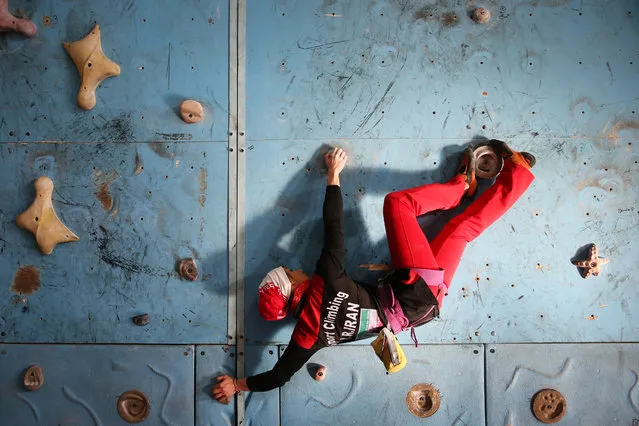
In this Monday, January 18, 2016 photo,  Iranian rock climber, Farnaz Esmaeilzadeh, scales a climbing gym in the city of Zanjan, some 330 kilometers (207 miles) west of the capital Tehran, Iran. (Photo by Ebrahim Noroozi/AP Photo)

In this Monday, January 18, 2016 photo, Iranian rock climber, Farnaz Esmaeilzadeh, scales a climbing gym in the city of Zanjan, some 330 kilometers (207 miles) west of the capital Tehran, Iran. Esmaeilzadeh, 27, who has been climbing since she was 13, has distinguished herself in international competitions despite the barriers she faces as a female athlete in conservative Iran. (Photo by Ebrahim Noroozi/AP Photo)
Details
01 Feb 2016 13:04:00
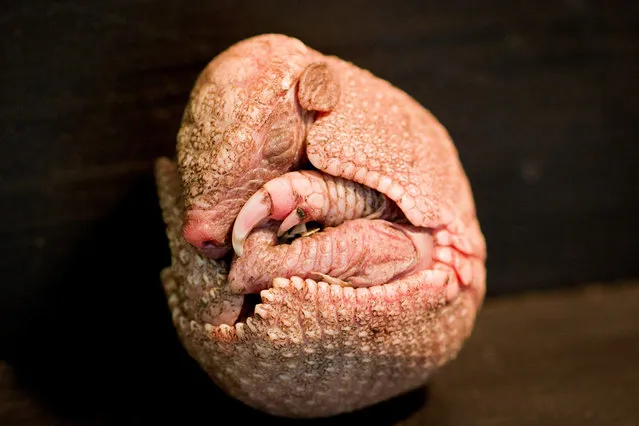
Edinburgh Zoo is proud to introduce this baby three-banded armadillo Rica who was born to mum Rio and dad Rodar in Edinburgh, Scotland, UK on Sunday 24 August 2014. (Photo by SWNS/ABACAPress)

Edinburgh Zoo is proud to introduce this baby three-banded armadillo Rica who was born to mum Rio and dad Rodar in Edinburgh, Scotland, UK on Sunday 24 August 2014. A tiny 81g at birth and around the same size as a golf ball, Rica is a female three banded armadillo who has grown rapidly in her first month, already quadrupling in weight. (Photo by SWNS/ABACAPress)
Details
29 Sep 2014 10:31:00


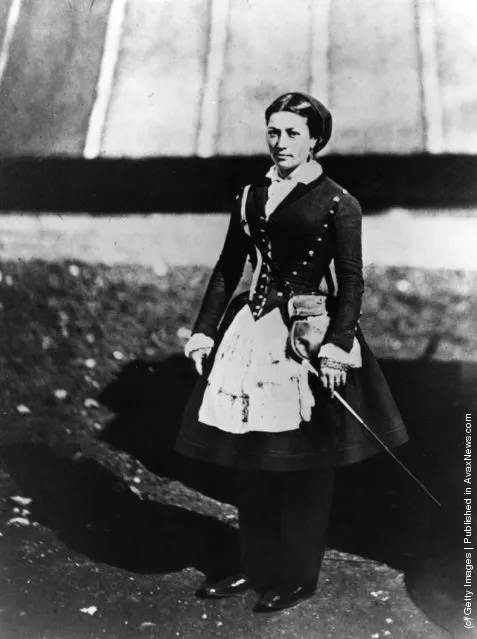
“The Crimean War (October 1853 – February 1856) was a conflict fought between the Russian Empire and an alliance of the French Empire, the British Empire, the Ottoman Empire, and the Kingdom of Sardinia. The war was part of a long-running contest between the major European powers for influence over territories of the declining Ottoman Empire. Most of the conflict took place on the Crimean Peninsula, but there were smaller campaigns in western Anatolia, Caucasus, the Baltic Sea, the Pacific Ocean and the White Sea”. – Wikipedia

Photo: A vivandiere, a female soldier selling provisions and spirits, with the Allied forces during the Crimean War. (Photo by Hulton Archive/Getty Images)
Details
18 Jul 2011 11:57:00


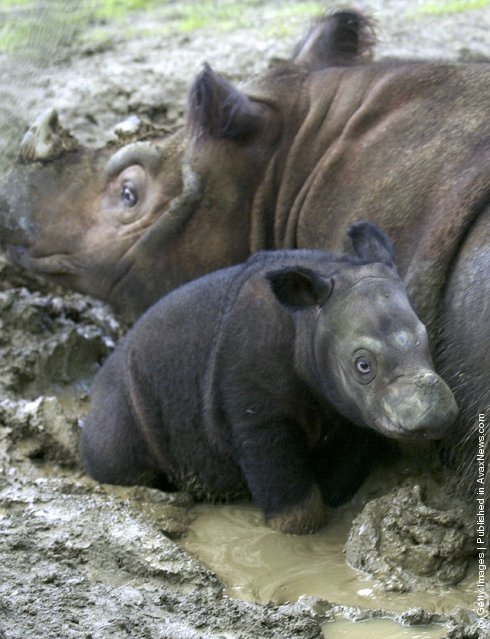
“The Sumatran Rhinoceros (Dicerorhinus sumatrensis) is a member of the family Rhinocerotidae and one of five extant rhinoceroses. It is the only extant species of the genus Dicerorhinus. It is the smallest rhinoceros, standing about 120–145 centimetres (3.9–4.76 ft) high at the shoulder, with a body length of 250 centimetres (8.2 ft) and weight of 500–800 kilograms (1,100–1,800 lb). Like the African species, it has two horns; the larger is the nasal horn, typically 15–25 centimetres (5.9–9.8 in), while the other horn is typically a stub. A coat of reddish-brown hair covers most of the Sumatran Rhino's body”. – Wikipedia

Photo: Emi, a Sumatran rhinoceros lies in the mud with her three-week-old female calf at the Cincinnati Zoo and Botanical Garden August 19, 2004 in Cincinnati, Ohio. Emi made history by becoming the first Sumatran rhino to produce two calves in captivity. (Photo by Mike Simons/Getty Images)
Details
22 Jun 2011 12:37:00