Loading...
Done
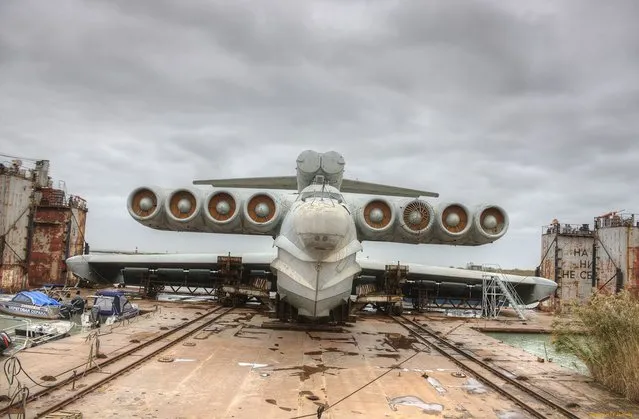
The Lun-class Ekranoplane was used by the Soviet Navy starting in 1987, and wasn't retired until the late 1990s, after the Soviet Union's fall. (Igor113)

“The Lun-class ekranoplan (NATO reporting name Duck) was a ground effect vehicle (GEV) designed by Rostislav Evgenievich Alexeev and used by the Soviet and Russian navies from 1987 until sometime in the late 1990s. It “flew” using the lift generated by the ground effect of its large wings when close to the surface of the water – about four metres or less. Although they might look similar and/or have related technical characteristics, ekranoplans like the Lun are not aircraft, seaplanes, hovercraft, or hydrofoils – ground effect is a separate technology altogether. The International Maritime Organization classifies these vehicles as maritime ships. The name Lun comes from the Russian for harrier”. – Wikipedia (Photo by Igor113)
Details
08 Aug 2014 10:51:00
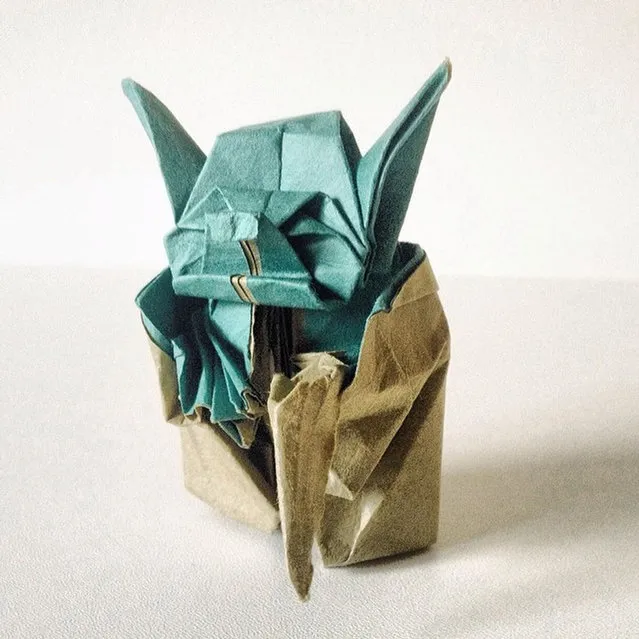
Origami By Ross Symons

As kids we have the natural desire to explore and to create. Whenever our parents would make for us a paper plane, we would become overjoyed seeing it fly across the room. However, planes are not the only thing that can be made from paper, and not only kids are fascinated by it. Some people master the art of origami and are able to create pretty much anything. You never know what’s going to come out when the artist twists and turns a piece of paper in meticulous ways. Finally, the figurine is complete, and you immediately see the striking resemblance of this piece of paper with an animal or some other creature. Ross Symons is one of those artists. He creates his figurines simply for the joy it brings him. Maybe, he uses this as a medium to enter his childhood, or maybe he has other motifs – we will never know. (Photo by Ross Symons)
Details
31 Oct 2014 12:12:00
Deconstructed Objects By Todd McLellan

It is simply staggering how complicated some items really are. We never think about it, but some items that we use every day consist of hundreds of parts meticulously put together and working perfectly. Todd McLellan is a photographer who based his newest book “Things Come Apart” on the complexity of various old and new tech. By carefully taking apart various items and arranging all of the parts in perfect order, Todd has allowed us not only to look inside various appliances, but also to appreciate the astounding complexity of these items. Just like the human mind, we are so used to seeing and talking with people that we forget just how complicated their minds really are. It would be great if we could “take apart” the human mind in order to gain some insight into the person’s thoughts and desires. However, very few people are capable of doing it, while the rest will remain blind to the obvious. (Photo by Todd McLellan)
Details
15 Nov 2014 12:30:00
Crater Lake In Oregon

As you look at the majestic Crater Lake, located in south-central Oregon, United States, it is hard to imagine that thousands of years ago this place was one giant crater with scorching hot lava spilling over the sides. Those were the times of turmoil. Now, however, this place is the essence of tranquility. The lake that was formed, after the volcano died down, is amazingly clear due to the fact that the water isn’t moving at all. No rivers go in or out of the Crater Lake, and the water lost through evaporation is compensated by the rain and snowfall. This lake is also frighteningly deep – 1,943 feet (592 m) at its deepest point – making it the deepest lake in the United States. If you love nature and if you ever come to Oregon, this is truly a sight to behold.
Details
19 Nov 2014 14:14:00
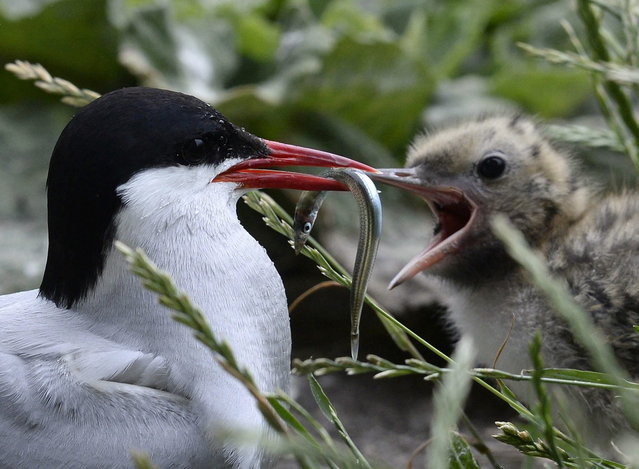
An arctic tern feeds its chick on the Farne Islands off the Northumberland coast, northern England July 8, 2013. (Photo by Nigel Roddis/Reuters)

An arctic tern feeds its chick on the Farne Islands off the Northumberland coast, northern England July 8, 2013. The Farne Islands, which lie off the coast of northeast England, are home to a huge array of wildlife. The islands are owned and protected by the British conservation charity, the National Trust, which says they host some 23 species of seabird, as well as a substantial colony of grey seals, who come to have their pups there in the autumn. Every five years the National Trust carries out a census of the islands' population of puffins, and this year's survey showed there were almost 40,000 nesting pairs on the islands – an 8 percent rise from 2008. (Photo by Nigel Roddis/Reuters)
Details
11 Dec 2013 09:21:00
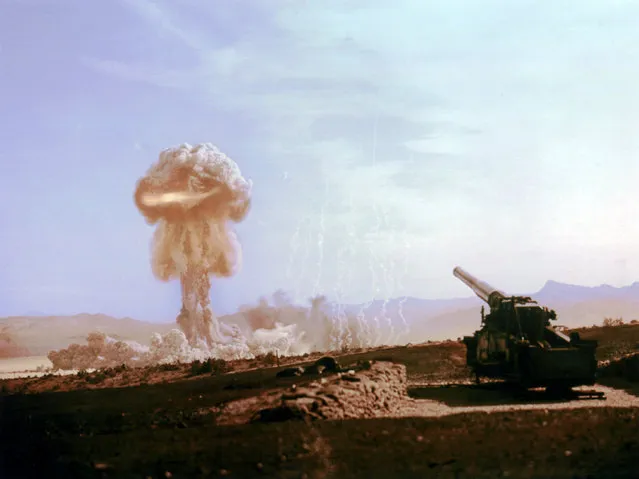
Atomic Annie at work during the Upshot-Knothole test series, 1953. (Photo by Los Alamos National Laboratory/US Army)

“A fter the former Soviet Union conducted its first nuclear test in August 1949, the US reevaluated its postwar defense policies. With the US monopoly on atomic weapons broken, military and political leaders chose to diversify the American stockpile by developing thermonuclear and tactical nuclear weapons. One of the more interesting concepts to come out of this period was atomic artillery, which was successfully tested at the Nevada Proving Grounds (now the Nevada Test Site) in May 1953”. – Alan Carr. Photo: Atomic Annie at work during the Upshot-Knothole test series, 1953. (Photo by Los Alamos National Laboratory/US Army)
Details
11 Mar 2013 11:43:00
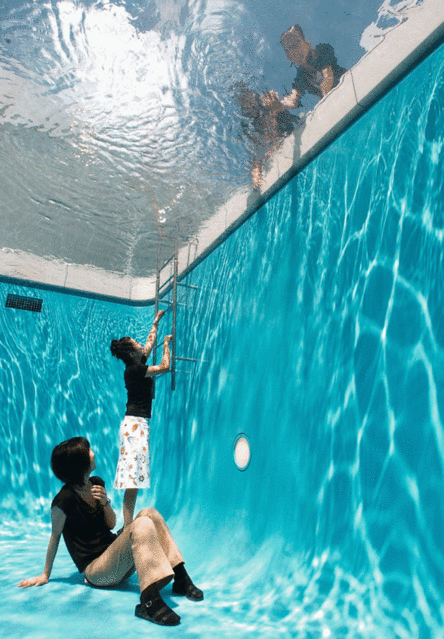
Swimming Pool Art Installation by Leandro Erlich

In one of the Museum’s courtyards is a swimming pool framed by a limestone deck. When seen from the deck, the pool appears to be filled with deep, shimmering water. In fact, however, a layer of water only some 10 centimeters deep is suspended over transparent glass. Below the glass is an empty space with aquamarine walls that viewers can enter. The work sets up an unfolding sequence of experiences—we view the pool through the glass wall enclosing the courtyard; from the deck, looking down into the pool; and from the interior of the pool, looking up. The Swimming Pool might hence be considered a place where, slowly, with time, different perspectives and perceptions of self and others all come to intersect.
Details
25 Aug 2012 07:31:00
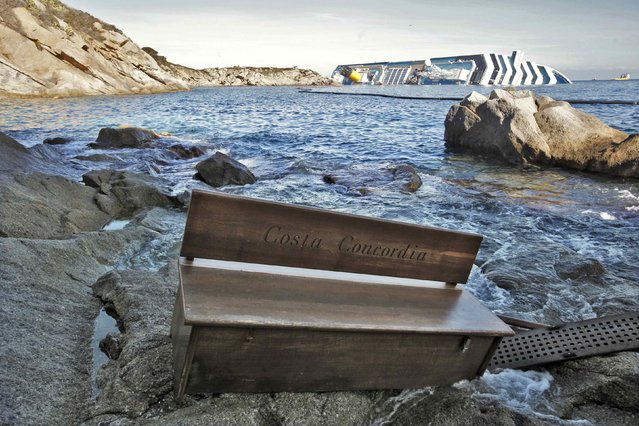
A bench engraved with the name of the grounded Costa Concordia cruise ship (seen at rear) is seen washed up on the shore of Giglio island, in this January 20, 2012 file photo. (Photo by Paul Hanna/Reuters)

A bench engraved with the name of the grounded Costa Concordia cruise ship (seen at rear) is seen washed up on the shore of Giglio island, in this January 20, 2012 file photo. The trial of Francesco Schettino, accused of causing the deaths of 32 people in the 2012 Costa Concordia cruise ship disaster, nears its climax with a verdict expected over the coming days. The prosecution has demanded that he be jailed for 26 years but the captain denies all the charges against him. Schettino was the commander of the vessel when it came too close to shore and hit rocks off the Tuscan holiday island of Giglio. (Photo by Paul Hanna/Reuters)
Details
10 Feb 2015 11:58:00