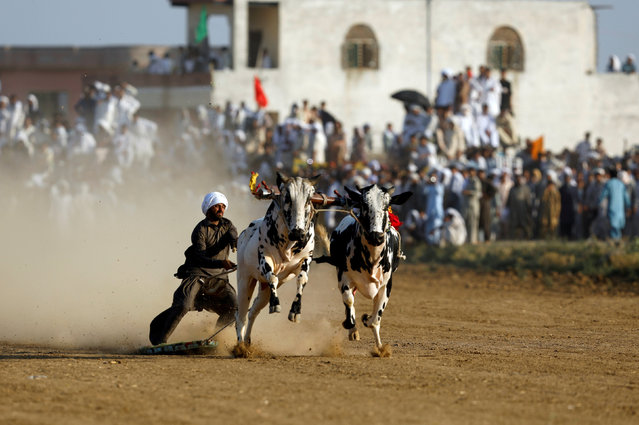
A bull savar (jockey) guides his bulls as he competes in a bull race on the outskirts of Islamabad, Pakistan July 1, 2018. (Photo by Faisal Mahmood/Reuters)
Masked guests attend the “Grand Bal Christian Dior” during the Haute Couture Spring-Summer 2018 fashion collection presented in Paris, Monday, January 22, 2018. (Photo by Kamil Zihnioglu/AP Photo)
A car passes through an area of the boardwalk hit by strong waves in Havana, Cuba, 05 February 2024. The Cuban Institute of Meteorology (Insmet) recorded strong gusts of wind of up to 104 kilometers per hour and strong waves in the west of the island due to a cold front associated with an “extratropical low”. (Photo by Ernesto Mastrascusa/EPA)
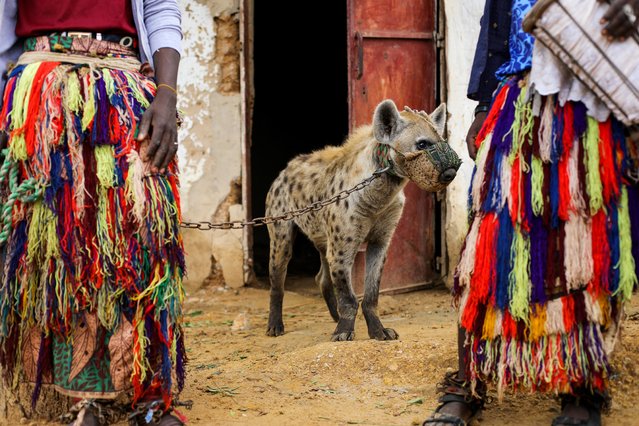
A hyena stands chained to its handler at a circus in Gabasawa, Kano State, Nigeria, July 27, 2021. Hyenas are often viewed as repulsive and sinister, partly due to their scavenging habits in the wild, but in northern Nigeria some men keep the creatures in their homes, display them at festivals and even use their dung to make remedies. (Photo by Afolabi Sotunde/Reuters)
Dancers perform during a rehearsal for the “2023 Christmas Spectacular Starring the Radio City Rockettes” at St. Paul the Apostle Church on Thursday, October 19, 2023, in New York. (Photo by Andres Kudacki/AP Photo)
Costume details featuring Joao Candido, a black sailor who led a revolt against the physical punishment of Brazilian Navy soldiers at the beginning of the 20th century, lie inside the Paraíso do Tuiuti Samba school at the Samba City complex in Rio de Janeiro, Brazil, Tuesday, January 16, 2024. Samba schools are gearing up for this year's Carnival, scheduled from Feb. 9-17. (Photo by Bruna Prado/AP Photo)
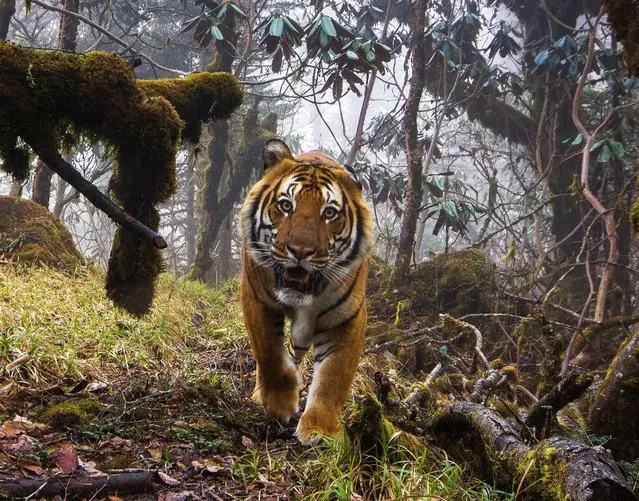
Rare images of wild tigers in Bhutan, captured by camera traps, show tigers and other animals using high-altitude wildlife corridors which are lifelines to isolated tiger populations and critical to genetic diversity, conservation and growth. Here: A wild Bengal tiger (Panthera tigris tigris) captured on a camera trap in corridor eight at an altitude of 3,540 metres in Trongsa, Bhutan. (Photo by Emmanuel Rondeau/WWF UK/The Guardian)
The Mile O' Mud is a 7/8-mile oval track with a 1/8-mile diagonal lane slashed through the center. The racing lanes are approximately 60 feet wide. On average, the muddy water is four to six feet deep, with three strategically placed holes. The largest hole, located in front of the grandstand, is the treacherous “Sippy Hole”, named for the legendary driver “Mississippi” Milton Morris, Swamp Buggy King 1955, who repeatedly got stuck in it. (Photo by Malcolm Lightner)