Loading...
Done
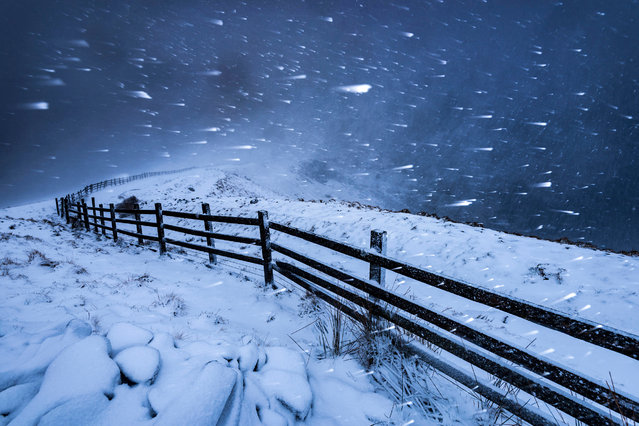
Blizzard in the High Peak, Derbyshire, by John Finney: “After a difficult journey in the snow, I made my way from Mam Tor down onto the Great Ridge. As the clouds got darker, I placed the tripod and camera at just the right angle to avoid snow getting onto the lens, and used a flash gun and a relatively slow shutter speed to highlight the fast motion of the blizzard”. Classic view, adult class – winner. (Photo by John Finney/Landscape Photographer of the Year)

Blizzard in the High Peak, Derbyshire, by John Finney: “After a difficult journey in the snow, I made my way from Mam Tor down onto the Great Ridge. As the clouds got darker, I placed the tripod and camera at just the right angle to avoid snow getting onto the lens, and used a flash gun and a relatively slow shutter speed to highlight the fast motion of the blizzard”. Classic view, adult class – winner. (Photo by John Finney/Landscape Photographer of the Year)
Details
22 Oct 2018 00:01:00
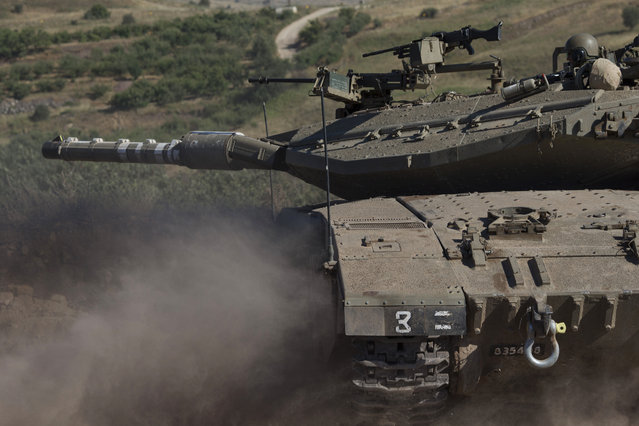
An Israeli tank moves into position in the Israeli controlled Golan Heights during fighting between forces loyal to Syrian President Bashar Assad and rebels in the Druze village of Khader in Syria, Tuesday, June 16, 2015. As many as 20 members of the Druze minority sect were killed last week, the deadliest violence against the Druze since Syria's conflict started in March 2011, sparking fears of a massacre against the sect. (AP Photo/Ariel Schalit)

An Israeli tank moves into position in the Israeli controlled Golan Heights during fighting between forces loyal to Syrian President Bashar Assad and rebels in the Druze village of Khader in Syria, Tuesday, June 16, 2015. As many as 20 members of the Druze minority sect were killed last week, the deadliest violence against the Druze since Syria's conflict started in March 2011, sparking fears of a massacre against the sect. (AP Photo/Ariel Schalit)
Details
23 Jun 2015 01:17:00


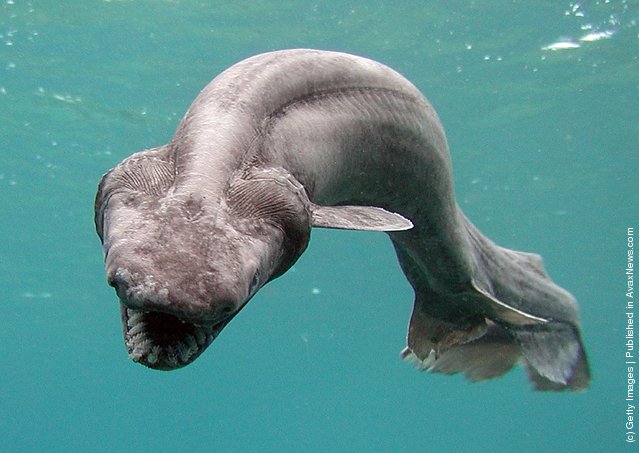
“The frilled shark (Chlamydoselachus anguineus) is one of two extant species of shark in the family Chlamydoselachidae, with a wide but patchy distribution in the Atlantic and Pacific Oceans. This uncommon species is found over the outer continental shelf and upper continental slope, generally near the bottom though there is evidence of substantial upward movements. It has been caught as deep as 1,570 m (5,150 ft), whereas in Suruga Bay, Japan it is most common at depths of 50–200 m (160–660 ft). Exhibiting several “primitive” features, the frilled shark has often been termed a «living fossil»”. – Wikipedia

Photo: A 1.6 meter long Frill shark swims in a tank after being found by a fisherman at a bay in Numazu, on January 21, 2007 in Numazu, Japan. The frill shark, also known as a Frilled shark usually lives in waters of a depth of 600 meters and so it is very rare that this shark is found alive at sea-level. It's body shape and the number of gill are similar to fossils of sharks which lived 350,000,000 years ago. (Photo by Awashima Marine Park/Getty Images)

Details
05 May 2011 10:01:00
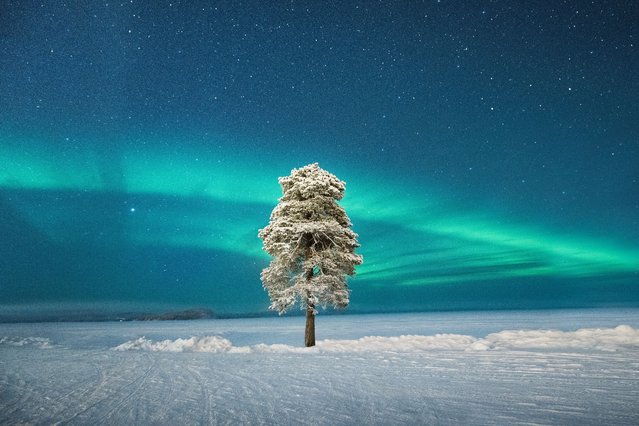
Aurorae category runner-up: Lone Tree under a Scandinavian Aurora by Tom Archer (UK). The photographer decided to explore the area around the hotel on a very crisp -35C evening in Finnish Lapland. When he found this tree, he decided to wait for the misty conditions to change and could not believe his luck when the sky cleared and the aurora came out in the perfect spot. Archer spent about an hour photographing it before his camera started to lock up because of the harsh conditions, but by then he was happy to call it a night. (Photo by Tom Archer/2020 Astronomy Photographer of the Year)

Aurorae category runner-up: Lone Tree under a Scandinavian Aurora by Tom Archer (UK). The photographer decided to explore the area around the hotel on a very crisp -35C evening in Finnish Lapland. When he found this tree, he decided to wait for the misty conditions to change and could not believe his luck when the sky cleared and the aurora came out in the perfect spot. Archer spent about an hour photographing it before his camera started to lock up because of the harsh conditions, but by then he was happy to call it a night. (Photo by Tom Archer/2020 Astronomy Photographer of the Year)
Details
17 Sep 2020 00:03:00
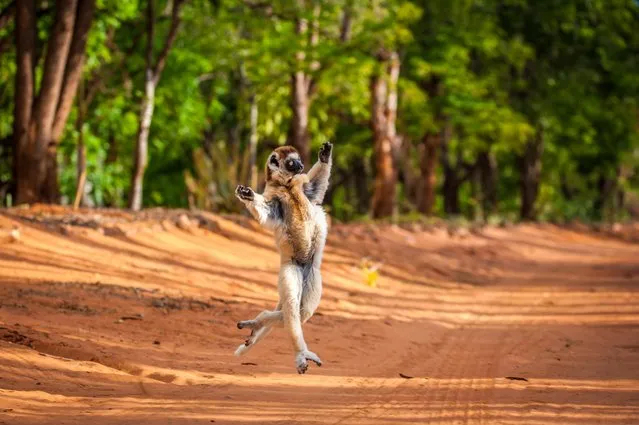
The Sifaka jumps along the road. (Photo by Shannon Wild/Caters News Agency)

The Verreauxs Sifaka, otherwise known as Dancing Sifaka, who was caught strutting its stuff in Madagascar, has definitely learnt a lesson or two from King Julian – from the 2005 film “Madagascar”. Raising both of its arms and lunging from side to side, this lemur definitely likes to move it, move it. (Photo by Shannon Wild/Caters News Agency)
Details
24 Jan 2018 06:17:00
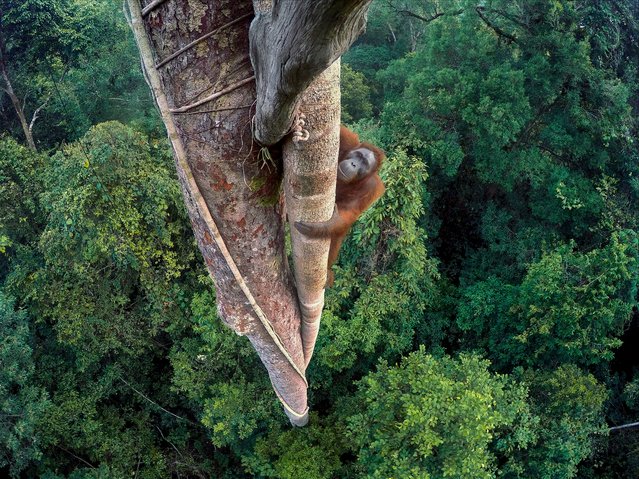
“Entwined Lives”. Tim Laman, US Winner, Wildlife photographer of the year. A young male orangutan makes the 30-metre climb up the thickest root of the strangler fig high above the canopy in Gunung Palung national park, one of the few protected orangutan strongholds in Indonesian Borneo. Laman had to do three days of climbing to position several GoPro cameras that he could trigger remotely. This shot was the one he had long visualised, looking down on the orangutan within its forest home. (Photo by Tim Laman/2016 Wildlife Photographer of the Year)

“Entwined Lives”. Tim Laman, US Winner, Wildlife photographer of the year. A young male orangutan makes the 30-metre climb up the thickest root of the strangler fig high above the canopy in Gunung Palung national park, one of the few protected orangutan strongholds in Indonesian Borneo. Laman had to do three days of climbing to position several GoPro cameras that he could trigger remotely. This shot was the one he had long visualised, looking down on the orangutan within its forest home. (Photo by Tim Laman/2016 Wildlife Photographer of the Year)
Details
19 Oct 2016 12:08:00
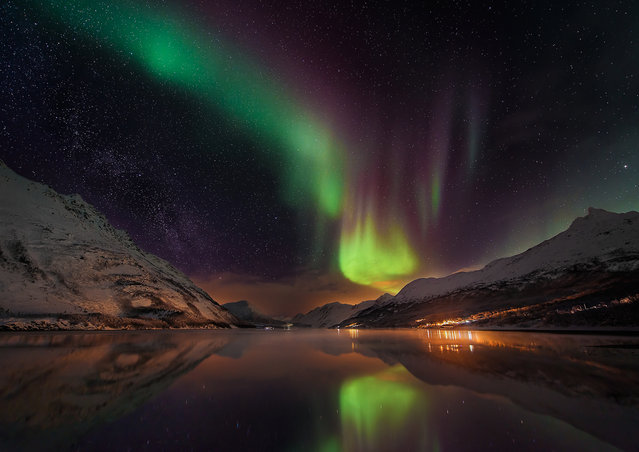
Some of the best entries so far in the 2016 Insight Astronomy Photographer of the Year competition. There are two weeks left to enter, and the winners will be announced in September. Here: Aurora over Laksvatn Fjord, Laksvatn, Norway. The aurora borealis dances in the skies over the town of Laksvatn, with the Milky Way to the left. The image is a single shot with no compositing, only post-processing to bring out the aurora, and some colour corrections. (Photo by Matt Walford/National Maritime Museum)

Some of the best entries so far in the 2016 Insight Astronomy Photographer of the Year competition. There are two weeks left to enter, and the winners will be announced in September. Here: Aurora over Laksvatn Fjord, Laksvatn, Norway. The aurora borealis dances in the skies over the town of Laksvatn, with the Milky Way to the left. The image is a single shot with no compositing, only post-processing to bring out the aurora, and some colour corrections. The photographer Matt Walford said: “I love the way the northern lights look like they are just wistfully dancing over the fjord, framed by the mountains on either side”. (Photo by Matt Walford/National Maritime Museum)
Details
01 Jul 2016 12:13:00
Underwater photographer of the year – winner. Dancing Octopus by Gabriel Barathieu (France). Location: Island of Mayotte, off the coast of south-east Africa. “Balletic and malevolent”, one judge said of this octopus, hunting in a lagoon. Barathieu waited until spring tides when there was just 30cm of water on the flats and plenty of light in the shallows. (Photo by Gabriel Barathieu/UPY2017)

Underwater photographer of the year – winner. Dancing Octopus by Gabriel Barathieu (France). Location: Island of Mayotte, off the coast of south-east Africa. “Balletic and malevolent”, one judge said of this octopus, hunting in a lagoon. Barathieu waited until spring tides when there was just 30cm of water on the flats and plenty of light in the shallows. (Photo by Gabriel Barathieu/UPY2017)
Details
16 Feb 2017 00:06:00