Loading...
Done
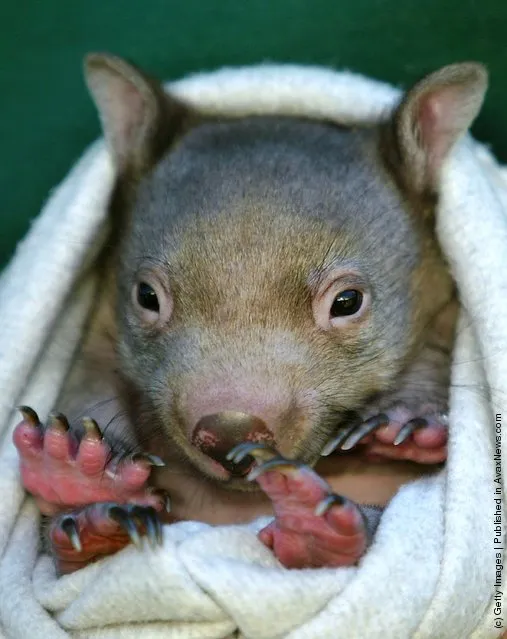
A baby Common Wombat

“Wombats are Australian marsupials; they are short-legged, muscular quadrupeds, approximately 1 metre (39 in) in length with a short, stubby tail. They are adaptable in their habitat tolerances, and are found in forested, mountainous, and heathland areas of south-eastern Australia, including Tasmania, as well as an isolated patch of about 300 ha in Epping Forest National Park in central Queensland”. – Wikipedia

Photo: “Abdul”, a baby Common Wombat, is one of the marsupials on show during the spring baby boom at Taronga Zoo September 1, 2005 in Sydney, Australia. “Abdul” was orphaned when his mother was killed by a car. (Photo by Mark Nolan/Getty Images)
Details
20 Aug 2011 11:23:00
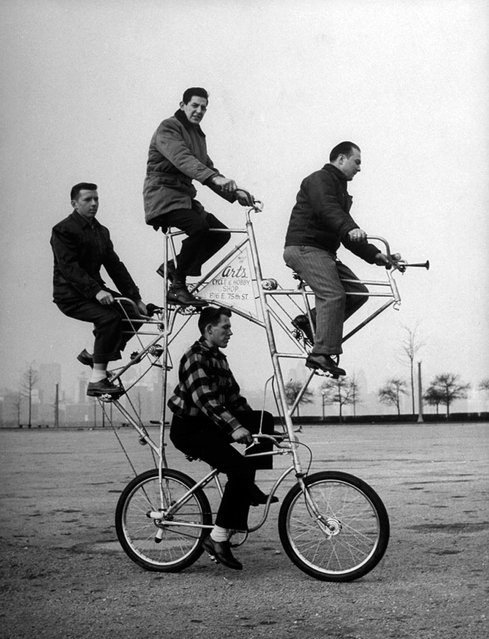
Four-man bicycle is powered by five chains and has brakes on both its wheels, 1948. The bike was built by Art Rothschild (top position) who broke three ribs while learning how to ride it. (Photo by Wallace Kirkland/Time & Life Pictures)

Four-man bicycle is powered by five chains and has brakes on both its wheels, 1948. The bike was built by Art Rothschild (top position) who broke three ribs while learning how to ride it. (Photo by Wallace Kirkland/Time & Life Pictures)
Details
05 May 2013 11:17:00
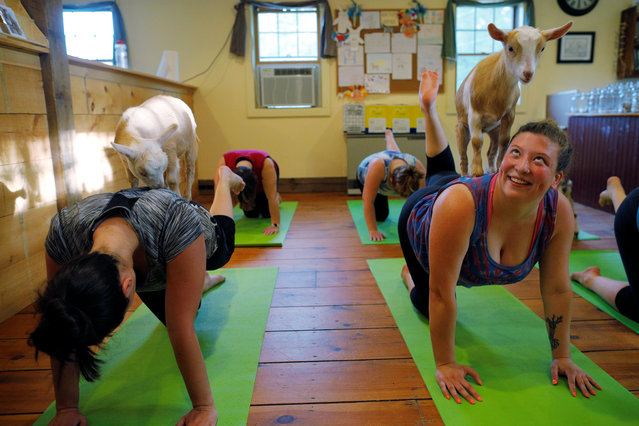
Goats climb on students during a yoga class with eight students and five goats at Jenness Farm in Nottingham, New Hampshire, U.S. on May 18, 2017. Tucked away in a wooded corner of southern New Hampshire, Jenness Farm is the latest small U.S. agricultural operation to cash in on the social media-driven trend, in which yoga enthusiasts practice moves like the cat pose and bridge pose while goats climb around and sometimes on them. (Photo by Brian Snyder/Reuters)

Goats climb on students during a yoga class with eight students and five goats at Jenness Farm in Nottingham, New Hampshire, U.S. on May 18, 2017. Tucked away in a wooded corner of southern New Hampshire, Jenness Farm is the latest small U.S. agricultural operation to cash in on the social media-driven trend, in which yoga enthusiasts practice moves like the cat pose and bridge pose while goats climb around and sometimes on them. (Photo by Brian Snyder/Reuters)
Details
20 May 2017 09:31:00


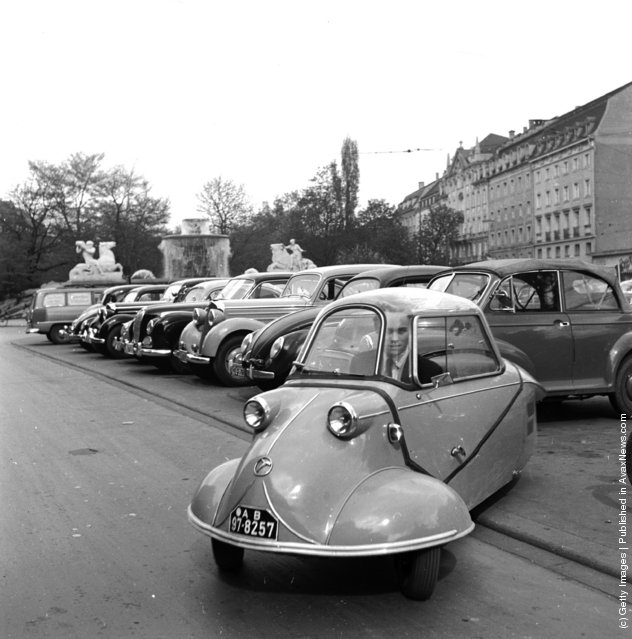
A three wheeled “cabin” scooter manufactured by German aircraft engineers Messerschmitt & Co at factories in Regensburg. (Photo by Hans Enzwieser/BIPs/Getty Images). 1955
Details
22 Jul 2013 19:49:00
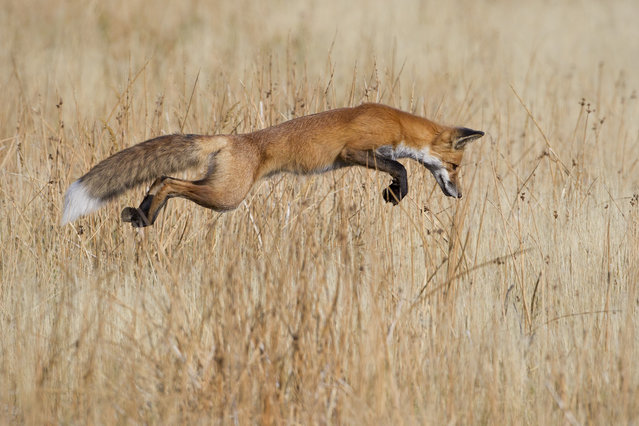
Canada: “Lucky pounce”. (Photo by Connor Stefanison/Wildlife Photographer of the Year 2013)

The winners of The London’s Natural History Museum's prestigious Wildlife Photographer of the Year for 2013 have finally been unveiled. Selected from almost 43,000 entries from 96 countries, the winners offer a glimpse of the stunning array of natural beauty on our planet. Photo: Canada: “Lucky pounce”. “Anticipating the pounce – that was the hardest part”, says Connor, who had come to Yellowstone National Park, Wyoming, USA, in search of wildlife as much as the spectacular landscape. He had found this fox, his first ever, on his last day in the park. It was so absorbed in hunting that Connor had plenty of time to get out of the car and settle behind a rock. It quartered the grassland, back and forth, and then started staring intently at a patch of ground, giving Connor just enough warning of the action to come. When it sprung up, Connor got his shot. And when it landed, the fox got his mouse. (Photo by Connor Stefanison/Wildlife Photographer of the Year 2013)
Details
17 Oct 2013 08:12:00
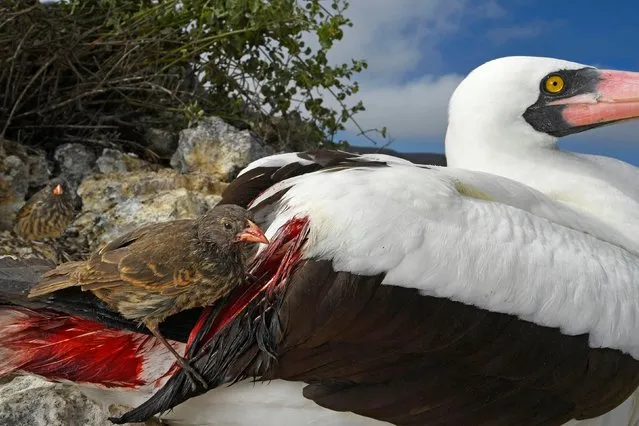
Bloodthirsty by Thomas P Peschak, Germany/South Africa — winner, Behaviour: birds. When rations run short on Wolf Island, in the remote northern Galápagos, the sharp-beaked ground finches become vampires. Their sitting targets are Nazca boobies and other large birds. The finches rely on a scant diet of seeds and insects, which regularly dries up, so they drink blood to survive. ‘I’ve seen more than half a dozen finches drinking from a single Nazca booby,’ says Tom. Rather than leave their nests the boobies tolerate the vampires, and the blood loss doesn’t seem to cause permanent harm. (Photo by Thomas P Peschak/2018 Wildlife Photographer of the Year)

Bloodthirsty by Thomas P. Peschak, Germany/South Africa — winner, Behaviour: birds. When rations run short on Wolf Island, in the remote northern Galápagos, the sharp-beaked ground finches become vampires. Their sitting targets are Nazca boobies and other large birds. The finches rely on a scant diet of seeds and insects, which regularly dries up, so they drink blood to survive. ‘I’ve seen more than half a dozen finches drinking from a single Nazca booby,’ says Tom. Rather than leave their nests the boobies tolerate the vampires, and the blood loss doesn’t seem to cause permanent harm. (Photo by Thomas P. Peschak/2018 Wildlife Photographer of the Year)
Details
19 Oct 2018 00:05:00
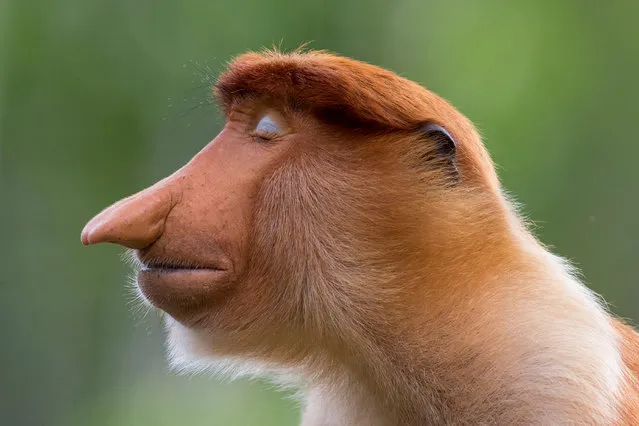
Winner – Animal Portraits: The pose by Mogens Trolle, Denmark. A young male proboscis monkey cocks his head slightly and closes his eyes. Unexpected pale blue eyelids now complement his immaculately groomed auburn hair. He poses for a few seconds as if in meditation. He is a wild visitor to the feeding station at Labuk Bay Proboscis Monkey Sanctuary in Sabah, Borneo – “the most laid-back character”, says Trolle, “quite unlike anything I’ve ever seen on another monkey” – connects us, he hopes, with a fellow primate. (Photo by Mogens Trolle/Wildlife Photographer of the Year 2020)

Winner – Animal Portraits: The pose by Mogens Trolle, Denmark. A young male proboscis monkey cocks his head slightly and closes his eyes. Unexpected pale blue eyelids now complement his immaculately groomed auburn hair. He poses for a few seconds as if in meditation. He is a wild visitor to the feeding station at Labuk Bay Proboscis Monkey Sanctuary in Sabah, Borneo – “the most laid-back character”, says Trolle, “quite unlike anything I’ve ever seen on another monkey” – connects us, he hopes, with a fellow primate. (Photo by Mogens Trolle/Wildlife Photographer of the Year 2020)
Details
16 Oct 2020 00:03:00
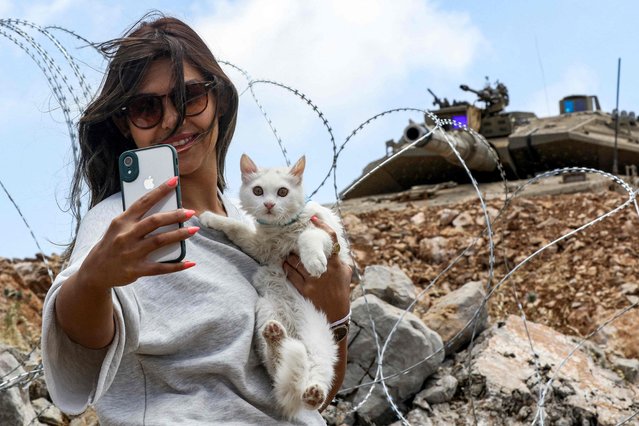
A woman uses a phone to take a “selfie” photo with cat as she stands along the barbed wire fence demarcating the “blue line” – drawn by the United Nations to mark Israel's withdrawal from southern Lebanon in 2000 – while an Israeli Merkava battle tank is deployed nearby, at a position along the border near the village of Kfar Shuba in southern Lebanon on June 11, 2023. (Photo by Mahmoud Zayyat/AFP Photo)

A woman uses a phone to take a “selfie” photo with cat as she stands along the barbed wire fence demarcating the “blue line” – drawn by the United Nations to mark Israel's withdrawal from southern Lebanon in 2000 – while an Israeli Merkava battle tank is deployed nearby, at a position along the border near the village of Kfar Shuba in southern Lebanon on June 11, 2023. (Photo by Mahmoud Zayyat/AFP Photo)
Details
20 Jun 2023 03:44:00