Loading...
Done
Football Soccer, England vs Wales, EURO 2016, Group B, Stade Bollaert-Delelis, Lens, France on June 16, 2016. Soccer fan Laura Woods from England fixes her makeup near riot police near the Lens stadium before the England vs Wales  game. (Photo by Wolfgang Rattay/Reuters)

Football Soccer, England vs Wales, EURO 2016, Group B, Stade Bollaert-Delelis, Lens, France on June 16, 2016. Soccer fan Laura Woods from England fixes her makeup near riot police near the Lens stadium before the England vs Wales game. (Photo by Wolfgang Rattay/Reuters)
Details
17 Jun 2016 13:57:00
A Ukrainian serviceman of the 53rd brigade fires a RPG-9 towards Russian positions at the frontline close to Donetsk, Ukraine, Saturday, August 19, 2023. (Photo by Libkos/AP Photo)

A Ukrainian serviceman of the 53rd brigade fires a RPG-9 towards Russian positions at the frontline close to Donetsk, Ukraine, Saturday, August 19, 2023. (Photo by Libkos/AP Photo)
Details
20 Sep 2023 03:23:00
Members of the public enjoy a tea dance at the Royal Albert Hall in London, United Kingdom on April 12, 2022. (Photo by Sarah Lee/The Guardian)

Members of the public enjoy a tea dance at the Royal Albert Hall in London, United Kingdom on April 12, 2022. (Photo by Sarah Lee/The Guardian)
Details
15 Oct 2023 05:57:00
Singer Anastacia and teacher dancer Maykel Fonts perform during the “Dancing with the Stars” TV show in Rome, Italy on March 24, 2018. (Photo by PA:Press Association)

American singer-songwriter, producer and former dancer Anastacia and teacher dancer Maykel Fonts perform during the “Dancing with the Stars” TV show in Rome, Italy on March 24, 2018. (Photo by PA Press Association)
Details
01 Apr 2018 00:01:00
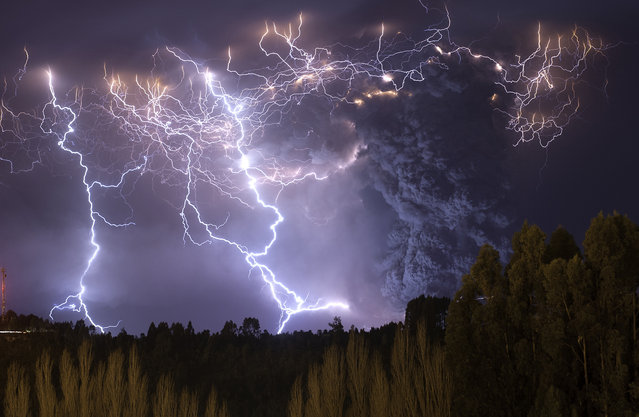
The eruption of Cordon Caulle began on June 4, 2011, located in the Region of Los Rios in Chile. For about 12 months, people and animals became accustomed to living with the daily fall of ash, which also caused problems in the air traffic in South America. The explosions and lightning during first days of the eruption could be seen from hundreds of miles around. This photograph was taken on the second night of eruption from the town of Lago Ranco. (Photo and caption by Francisco Negroni/National Geographic Traveler Photo Contest)

The eruption of Cordon Caulle began on June 4, 2011, located in the Region of Los Rios in Chile. For about 12 months, people and animals became accustomed to living with the daily fall of ash, which also caused problems in the air traffic in South America. The explosions and lightning during first days of the eruption could be seen from hundreds of miles around. This photograph was taken on the second night of eruption from the town of Lago Ranco. (Photo and caption by Francisco Negroni/National Geographic Traveler Photo Contest)

ATTENTION! All pictures are presented in high resolution. To see Hi-Res images – just TWICE click on any picture. In other words, click small picture – opens the BIG picture. Click BIG picture – opens VERY BIG picture.
Details
23 Jun 2013 11:24:00
A person carries a fan in Westminster, London, Britain, 12 July 2022. Britain has been issued with an amber weather warning for the weekend as experts predict that temperatures could rise to the high thirties and Sunday could be the hottest day on record for the UK. (Photo by Tolga Akmen/EPA/EFE/Rex Features/Shutterstock)

A person carries a fan in Westminster, London, Britain, 12 July 2022. Britain has been issued with an amber weather warning for the weekend as experts predict that temperatures could rise to the high thirties and Sunday could be the hottest day on record for the UK. (Photo by Tolga Akmen/EPA/EFE/Rex Features/Shutterstock)
Details
14 Jul 2022 04:51:00
She dared not breathe. (Photo by Rachel Baran)

“She dared not breathe”. (Photo by Rachel Baran)

Details
05 Dec 2012 12:19:00
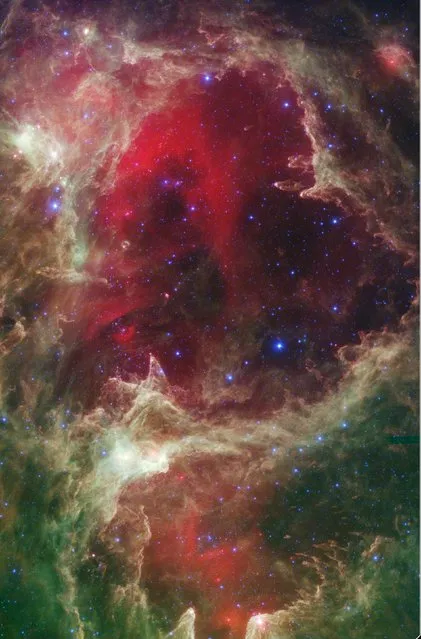
An infrared portrait from NASA's Spitzer Space Telescope which shows generations of stars is seen in this undated NASA handout image released February 14, 2013. In this wispy star-forming region, called W5, the oldest stars can be seen as blue dots in the centers of the two hollow cavities (other blue dots are background and foreground stars not associated with the region). Red shows heated dust that pervades the region's cavities, while green highlights dense clouds. (Photo by NASA/Reuters/JPL-Caltech/Harvard-Smithsonian/Handout)

An infrared portrait from NASA's Spitzer Space Telescope which shows generations of stars is seen in this undated NASA handout image released February 14, 2013. In this wispy star-forming region, called W5, the oldest stars can be seen as blue dots in the centers of the two hollow cavities (other blue dots are background and foreground stars not associated with the region). Red shows heated dust that pervades the region's cavities, while green highlights dense clouds. (Photo by NASA/Reuters/JPL-Caltech/Harvard-Smithsonian/Handout)
Details
03 Mar 2013 08:44:00