Loading...
Done
Street Art By Suso33

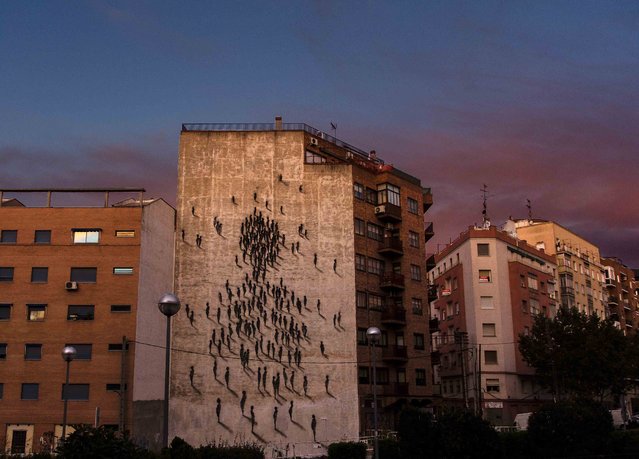
Suso33 spent the last few days perched on a yellow crane to work on this impressive new piece on the streets of Madrid, Spain. Using a rather simple technique, the Spanish artist painted a brilliant piece which enters directly amongst our favourite artworks this year. This mural is a concentration of slightly outlined figures which are persecuted by their shadows, but if the viewer, instead of focusing on details, looks at the entire picture, what he sees is another figure. Take a look at more images after the jump and if you are in the area, you'll be able to find the piece at plaza del Poeta Leopoldo de Luis.
Details
30 Mar 2014 17:58:00
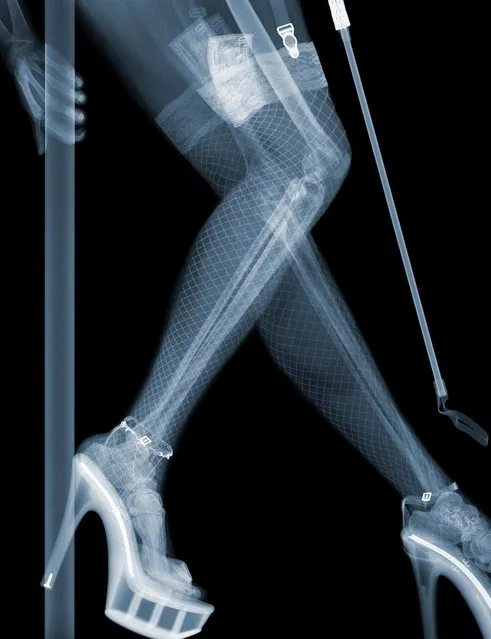
“Stripper”: Has tucked her cash away safely. (Photo by Nick Veasey/Barcroft Media)

British artist Nick Veasey used an X-ray machine to show us exactly what's going on under people's clothes. The equipment took copies of items separately before they were mashed together to create characters and situations. The work is part of Veasey's latest exhibition named “X-ray Voyeurism”. In order to create the work, the 51-year-old has spent the last 20 years exposing himself to harmful radiation in his studio. Photo: “Stripper”: Has tucked her cash away safely. (Photo by Nick Veasey/Barcroft Media)
Details
22 Jun 2014 10:49:00
Audi E-Bike Worthersee

One of the highlights on the Audi stand is the bicycle technology concept known as the Audi e-bike Wörthersee – a sport bike that does not fit into any of the usual categories. It is neither a pedelec nor a conventional bike, but is best described as a high-end pedelec made by Audi for sport, fun and tricks. The Audi e-bike Wörthersee combines the Audi brand’s principal competences – design, ultra, connect and e-tron – and explores the limits of what is technically feasible in terms of design, lightweight construction, networking and electric mobility.
Details
11 Jul 2014 11:34:00
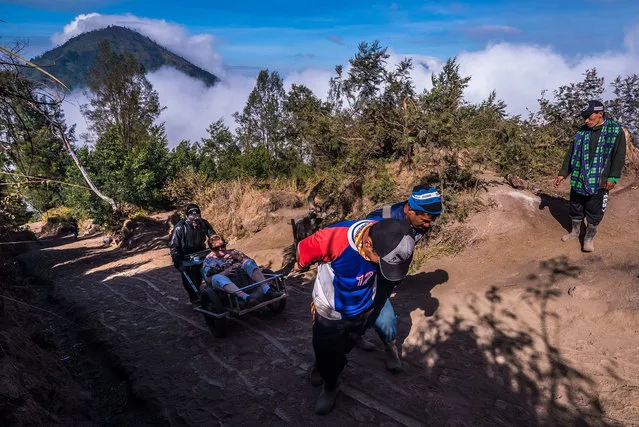
Miners pulling up lazy tourists to the rim of Kawah Ijen (Ijen Volcano), East Java, Indonesia on September 21, 2017. They will earn as much as they would bring down a load of sulfur. Nomadic Explorer, Cultural Lifestyle Photographer Claudio Sieber captured striking images of miners working at Ijen volcanic range in East Java, Indonesia. The sulphur miners risk their lives daily as they climb the active volcano carrying heavy loads, which they sell to sugar refineries. Shortly after midnight curious tourists are flocking in hundreds through the gate of Ijen's foothills to be right on time, driven by the images others took before them. Kawah Ijen is the one of the world's largest acidic volcanic crater lake; famous for its turquoise color as well as the unreal atmosphere it offers during darkness. A dusty path zigzags 3 kilometers up to the crater rim. This doesn't mean anything challenging; in particular, special sights have to be deserved anyway. The irritating smell of sulfur announces the near of the crater's existence. Arriving on the crater's rim the reward for the torture becomes visible. Blue fire darts its tongues through the fumes of sulfur dioxide. Somehow, the spectacle isn't as romantic as expected, since it is also the rough working space of approx. 150 sulfur miners who start their shift at 1 am. Lately, harvesting the abundance of devil's gold received international attention. This did obviously not really improve a miner's lifestyle; neither did it contribute to a better wage. (Photo by Claudio Sieber/Barcroft Images)

Miners pulling up lazy tourists to the rim of Kawah Ijen (Ijen Volcano), East Java, Indonesia on September 21, 2017. They will earn as much as they would bring down a load of sulfur. Nomadic Explorer, Cultural Lifestyle Photographer Claudio Sieber captured striking images of miners working at Ijen volcanic range in East Java, Indonesia. The sulphur miners risk their lives daily as they climb the active volcano carrying heavy loads, which they sell to sugar refineries. (Photo by Claudio Sieber/Barcroft Images)
Details
02 Oct 2017 08:31:00
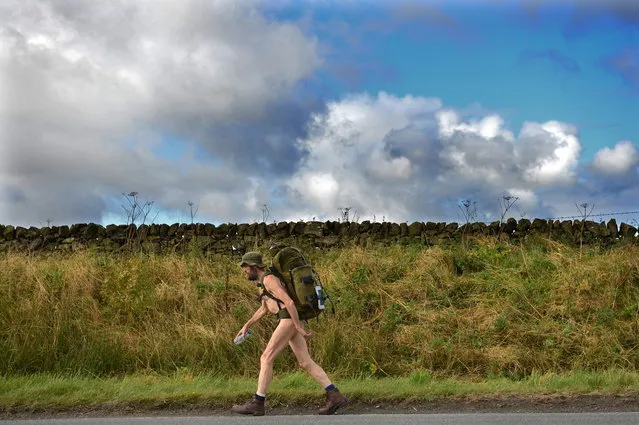
Stephen Gough the naked rambler makes his way south through Peebles in the Scottish Borders, following his release from Saughton Prison yesterday after serving his latest sentence on October 6, 2012 in Peebles, Scotland. The rambler has 18 convictions and has been in prison on and off since 2006 with offences ranging from not wearing clothes in front of the sheriff, breach of the peace and contempt of court. (Photo by Jeff J. Mitchell)

“Stephen Gough (born c. 1959), also known as Steve Gough and the Naked Rambler, is an activist, and a British former Royal Marine. In 2003-2004, he walked the length of Great Britain naked. He did it again in 2005-2006, but was arrested in England and in Scotland. He subsequently spent six years in prison, having been repeatedly rearrested for public nudity within a short period, each time he was released. He has spent most of his sentences in Saughton and Perth prisons, in Scotland”. – Wikipedia

Photo: Stephen Gough the naked rambler makes his way south through Peebles in the Scottish Borders, following his release from Saughton Prison yesterday after serving his latest sentence on October 6, 2012 in Peebles, Scotland. (Photo by Jeff J. Mitchell)
Details
07 Oct 2012 08:18:00
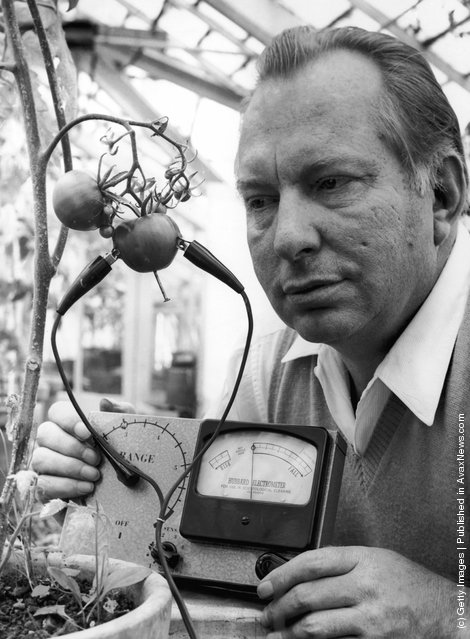
American science fiction writer L. Ron Hubbard, founder of the Church of Scientology, uses his Hubbard Electrometer

“Lafayette Ronald Hubbard (March 13, 1911 – January 24, 1986), better known as L. Ron Hubbard (and often referred to by his initials, LRH), was an American pulp fiction author and religious leader who founded the Church of Scientology. After establishing a career as a writer, becoming best known for his science fiction and fantasy stories, he developed a self-help system called Dianetics which was first published in May 1950. He subsequently developed his ideas into a wide-ranging set of doctrines and rituals as part of a new religious movement that he called Scientology. His writings became the guiding texts for the Church of Scientology and a number of affiliated organizations that address such diverse topics as business administration, literacy and drug rehabilitation”. – Wikipedia

Photo: American science fiction writer L. Ron Hubbard, founder of the Church of Scientology, uses his Hubbard Electrometer (patent pending) to determine whether tomatoes experience pain, 1959. His work led him to the conclusion that tomatoes “scream when sliced”. (Photo by Scott Lauder/Evening Standard/Hulton Archive/Getty Images)
Details
09 Sep 2011 09:34:00
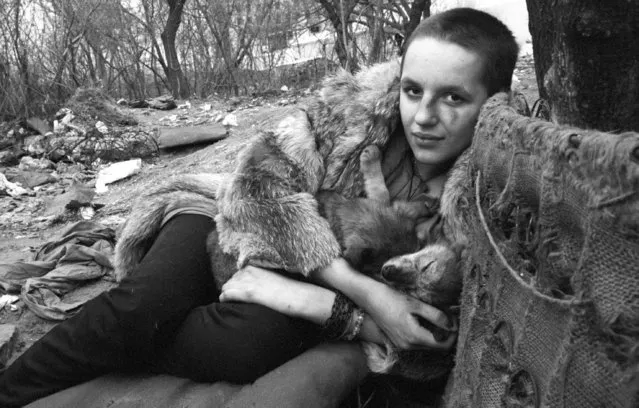
Suffering from a broken nose and bruised ribs Natasha Dzhuley, 16, relaxes after inhaling glue for the first time – something she swore she would never do, 2002. She was beaten by her pimps men in what Ruslana believes was a warning to other prostitutes to stay in line. Though another child believes her pimp had her beaten because she was pregnant. Less than a week after this picture of Natasha was taken she was dragged away by six men. She has not been heard or seen since. (Photo by Kurt Vinion /Getty Images)

Suffering from a broken nose and bruised ribs Natasha Dzhuley, 16, relaxes after inhaling glue for the first time – something she swore she would never do, 2002. She was beaten by her pimps men in what Ruslana believes was a warning to other prostitutes to stay in line. Though another child believes her pimp had her beaten because she was pregnant. Less than a week after this picture of Natasha was taken she was dragged away by six men. She has not been heard or seen since. (Photo by Kurt Vinion /Getty Images)
Details
18 Feb 2017 00:05:00
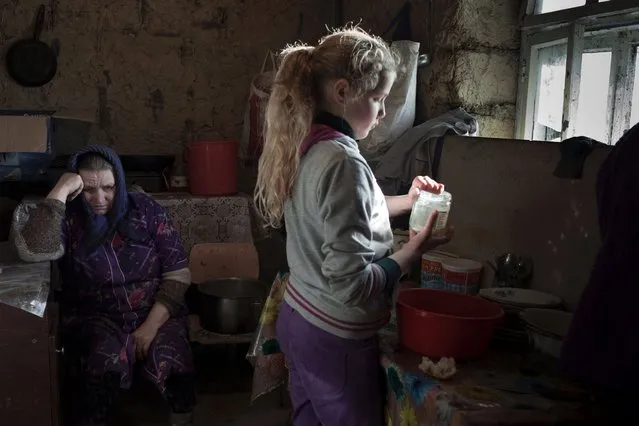
According to the U.S. government, Moldova, one of the poorest countries in Europe, depends on about $1.6 billion annually sent back from the roughly one million Moldovans who left for work in in Europe, Russia, and other former Soviet Bloc countries. Photographer Myriam Meloni went to Moldova to document what she refers to as “social orphans” – children whose parents have emigrated to another country in search of a job and a better future for their families. Here: Lulia is seen washing dishes in her grandmother's house, where she lives. (Photo by Myriam Meloni)

According to the U.S. government, Moldova, one of the poorest countries in Europe, depends on about $1.6 billion annually sent back from the roughly one million Moldovans who left for work in in Europe, Russia, and other former Soviet Bloc countries. Photographer Myriam Meloni went to Moldova to document what she refers to as “social orphans” – children whose parents have emigrated to another country in search of a job and a better future for their families. Here: Lulia is seen washing dishes in her grandmother's house, where she lives. (Photo by Myriam Meloni)
Details
12 Mar 2016 14:57:00