Loading...
Done
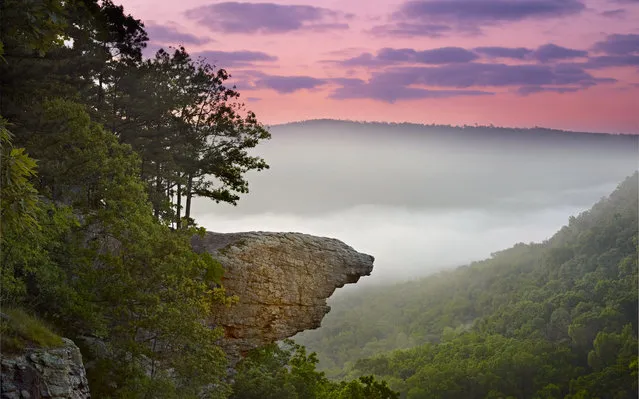
Hawksbill Crag In The Ozark National Forest

The Hawksbill Crag, also known as Whitaker Point, is located along the northern edge of the Upper Buffalo Wilderness in the Ozark National Forest, just south of the Buffalo National River. It is easily one of the most photograped and recognizable features in Arkansas, and is often seen on publications depicting the outdoors in Arkansas. The hike to it is an easy 3.0 mile round trip, and offers scenic vistas, huge boulders, beautiful waterfalls and colorful wildflowers.
Details
21 Jun 2013 11:43:00
Sadhu Project by Photographer Denis Rouvre

“They’ve been obsessing me for years. I searched and found them in Benares, on the banks of the river Gange (India). They arrive here to get rid of everything and to wait for death. This existence can last for years, sometimes decades, almost a life. Opposite to mine, well organised and filled as a human life can be, to try in vain to push the limits of its end”. – Denis Rouvre. (Photo by Denis Rouvre)
Details
15 Dec 2013 11:12:00
Pygmy Marmoset - The Smallest Monkey

The pygmy marmoset (Cebuella pygmaea) is a small New World monkey native to rainforests of the western Amazon Basin in South America. It is notable for being the smallest monkey in the world at just over 100 grams (3.5 oz). It is generally found in evergreen and river edge forests and is a gum-feeding specialist
Details
29 Jan 2014 12:59:00
International Fireworks Festival 2007 In Seoul

Fireworks illuminate the sky over downtown Seoul during the International fireworks festival 2007 at Han River on October 13, 2007 in Seoul, South Korea. The United States, Japan and South Korea have team was attending the festival. (Photo by Chung Sung-Jun/Getty Images)
Details
14 Dec 2011 12:44:00
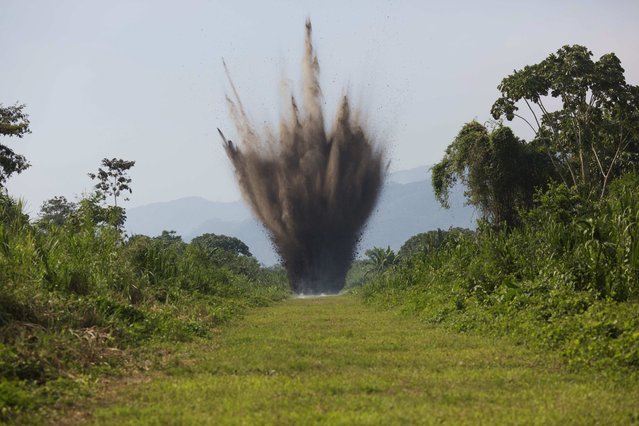
In this September 19, 2014 photo, explosives are detonate by Peruvian counternarcotics forces on a part of a clandestine grassy airstrip in the Apurimac, Ene and Mantaro River Valleys, or VRAEM, the world's No. 1 coca-growing region, in Ayacucho, Peru. The dynamiting of craters by Peruvian security forces into clandestine airstrips cuts into profits but hardly discourages cocaine traffickers who net tens of thousands of dollars with each flight flown from these airstrips. (Photo by Rodrigo Abd/AP Photo)

In this September 19, 2014 photo, explosives are detonate by Peruvian counternarcotics forces on a part of a clandestine grassy airstrip in the Apurimac, Ene and Mantaro River Valleys, or VRAEM, the world's No. 1 coca-growing region, in Ayacucho, Peru. The dynamiting of craters by Peruvian security forces into clandestine airstrips cuts into profits but hardly discourages cocaine traffickers who net tens of thousands of dollars with each flight flown from these airstrips. (Photo by Rodrigo Abd/AP Photo)
Details
23 Sep 2014 12:56:00
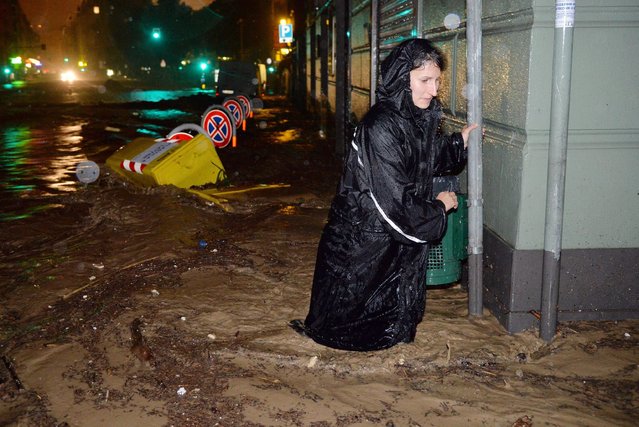
A woman walks through flood water during heavy downpour at a street in Genoa, Italy, 10 October 2014. At least one person died due to flooding after heavy rains caused the Bisagno river, which runs through Genoa city to overflow. Part of the city was in black-out with flooded streets and parked cars dragged away by the water's force. (Photo by Luca Zennaro/EPA)

A woman walks through flood water during heavy downpour at a street in Genoa, Italy, 10 October 2014. At least one person died due to flooding after heavy rains caused the Bisagno river, which runs through Genoa city to overflow. Part of the city was in black-out with flooded streets and parked cars dragged away by the water's force. (Photo by Luca Zennaro/EPA)
Details
11 Oct 2014 13:41:00
Ebiowei, 48, carries an empty oil container on his head to a place where it would be filled with refined fuel at an illegal refinery site near river Nun in Nigeria's oil state of Bayelsa November 27, 2012. (Photo by Akintunde Akinleye/Reuters)

Ebiowei, 48, carries an empty oil container on his head to a place where it would be filled with refined fuel at an illegal refinery site near river Nun in Nigeria's oil state of Bayelsa November 27, 2012. Locals in the industry say workers can earn $50 to $60 a day. Thousands of people in Nigeria engage in a practice known locally as “oil bunkering” – hacking into pipelines to steal crude then refining it or selling it abroad. The practice, which leaves oil spewing from pipelines for miles around, managed to lift around a fifth of Nigeria's two million barrel a day production last year according to the finance ministry. (Photo by Akintunde Akinleye/Reuters)
Details
18 Jan 2013 14:29:00
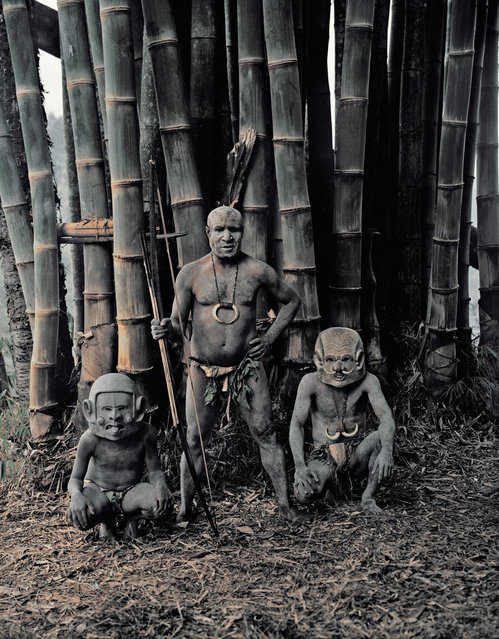
“Asaro from the Eastern Highlands”. The mudmen could not cover their faces with mud because the people of Papua New Guinea thought that the mud from the Asaro river was poisonous. So instead of covering their faces with this alleged poison, they made masks from pebbles that they heated and water from the waterfall, with unusual designs such as long or very short ears either going down to the chin or sticking up at the top, long joined eyebrows attached to the top of the ears, horns and sideways mouths. (Jimmy Nelson)

“Asaro from the Eastern Highlands”. The mudmen could not cover their faces with mud because the people of Papua New Guinea thought that the mud from the Asaro river was poisonous. So instead of covering their faces with this alleged poison, they made masks from pebbles that they heated and water from the waterfall, with unusual designs such as long or very short ears either going down to the chin or sticking up at the top, long joined eyebrows attached to the top of the ears, horns and sideways mouths. (Photo and caption by Jimmy Nelson)
Details
20 Oct 2013 08:54:00