Loading...
Done
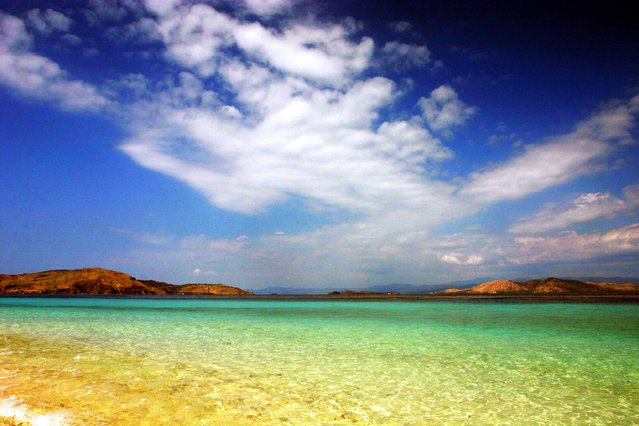
Komodo National Park

The Komodo National Park is a national park in Indonesia located within the Lesser Sunda Islands in the border region between the provinces of East Nusa Tenggara and West Nusa Tenggara. The park includes the three larger islands Komodo, Padar and Rinca, and 26 smaller ones, with a total area of 1,733 km² (603 km² of it land). The national park was founded in 1980 to protect the Komodo dragon, the world's largest lizard. Later it was dedicated to protecting other species, including marine species. In 1991 the national park was declared a UNESCO World Heritage Site and later as Man and Biosphere Reserve.
Details
12 Aug 2013 12:28:00
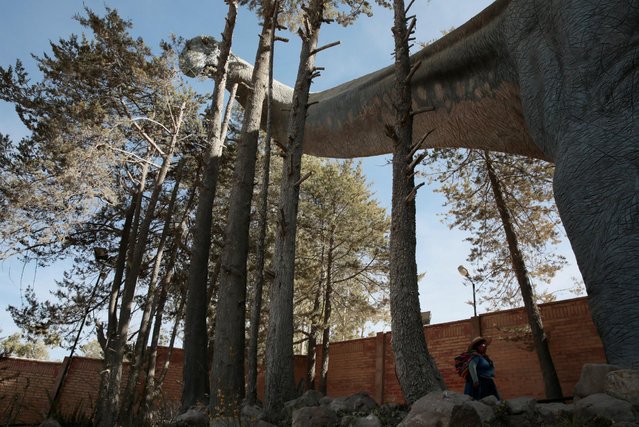
A visitor walks underneath a replica of a Titanosaur at the Cretaceous park in Cal Orcko, on the outskirts of Sucre, Bolivia, July 22, 2016. (Photo by David Mercado/Reuters)

A visitor walks underneath a replica of a Titanosaur at the Cretaceous park in Cal Orcko, on the outskirts of Sucre, Bolivia, July 22, 2016. A footprint measuring over a meter wide that was made by a meat-eating predator some 80 million years ago has been discovered in Bolivia, one of the largest of its kind ever found. (Photo by David Mercado/Reuters)
Details
28 Jul 2016 13:32:00
People wearing and holding helmets take part in a drill simulating a 7.2 magnitude earthquake in Tokyo, Japan, August 26, 2016. (Photo by Kim Kyung-Hoon/Reuters)

People wearing and holding helmets take part in a drill simulating a 7.2 magnitude earthquake in Tokyo, Japan, August 26, 2016. The drill was held in Ginza, a high-end shopping and business district, and held ahead of the 93rd anniversary of the Great Kanto Earthquake of 1923 which claimed at least 100,000 casualties. It was one of the largest natural disasters in recorded history and since 1960, September 1st, and the period around that date has been declared as national disaster prevention awareness period. (Photo by Kim Kyung-Hoon/Reuters)
Details
27 Aug 2016 10:47:00
A contestant performs in wooden Pujllay dance shoes known as “ojotas”, in a contest to elect the Queen of Great Power, in La Paz, Bolivia, Friday, May 24, 2019. (Photo by Juan Karita/AP Photo)

A contestant performs in wooden Pujllay dance shoes known as “ojotas”, in a contest to elect the Queen of Great Power, in La Paz, Bolivia, Friday, May 24, 2019. The largest religious festival in the Andes choses its queen in a tight contest to head the Festival of the Lord Jesus of the Great Power, mobilizing thousands of dancers and more than 4,000 musicians into the streets of La Paz. (Photo by Juan Karita/AP Photo)
Details
27 May 2019 00:01:00
Viking re-enactors representing the rival armies of the Vikings and Anglo-Saxons skirmish near Clifford’s Tower during the Jorvik Viking Festival on February 23, 2019 in York, England. (Photo by Christopher Thomond/The Guardian)

Viking re-enactors representing the rival armies of the Vikings and Anglo-Saxons skirmish near Clifford’s Tower during the Jorvik Viking Festival on February 23, 2019 in York, England. The annual Jorvik Viking Festival held in York is recognised as the largest event of its kind in Europe. This year the festival remembers the role that the Viking women played during those turbulent times. (Photo by Christopher Thomond/The Guardian)
Details
26 Feb 2019 00:05:00
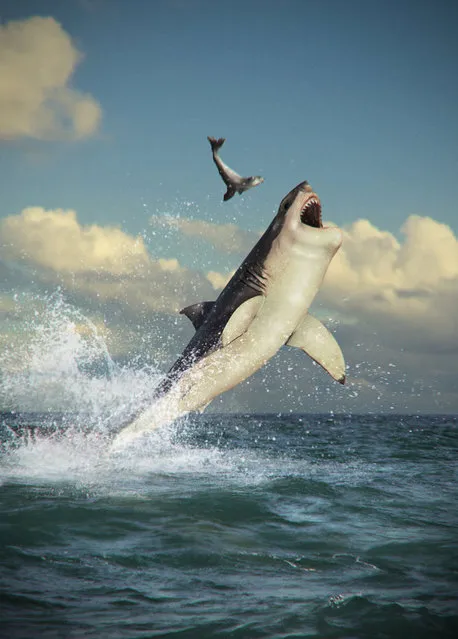
Perfect Predators: White Sharks

The great white shark, Carcharodon carcharias, also known as the great white, white pointer, white shark, or white death, is a species of large lamniform shark which can be found in the coastal surface waters of all the major oceans. The great white shark is mainly known for its size, with the largest individuals known to have approached or exceeded 6 m (20 ft) in length, and 2,268 kg (5,000 lb) in weight. This shark reaches its maturity around 15 years of age and can have a life span of over 30 years.
Details
01 Apr 2013 10:02:00
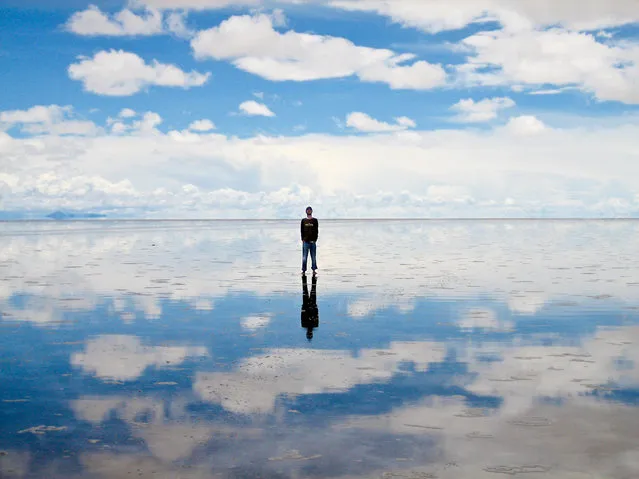
Salar de Uyuni

Salar de Uyuni (or Salar de Tunupa) is the world's largest salt flat at 10,582 square kilometers (4,086 sq mi). It is located in the Potosí and Oruro departments in southwest Bolivia, near the crest of the Andes, and is elevated 3,656 meters (11,995 ft) above mean sea level. The Salar was formed as a result of transformations between several prehistoric lakes. It is covered by a few meters of salt crust, which has an extraordinary flatness with the average altitude variations within one meter over the entire area of the Salar.
Details
04 Aug 2012 08:42:00
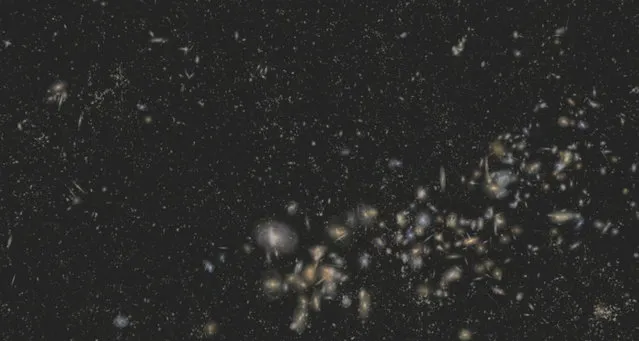
New 3-D Map of Massive Galaxies and Distant Black Holes Offers Clues to Dark Matter and Dark Energy

“The Sloan Digital Sky Survey III (SDSS-III) has released the largest-ever three-dimensional map of massive galaxies and distant black holes, which will help astronomers explain the mysterious “dark matter” and “dark energy” that scientists know makes up 96 percent of the Universe”. – SDSS-III
Details
10 Aug 2012 09:01:00