Loading...
Done
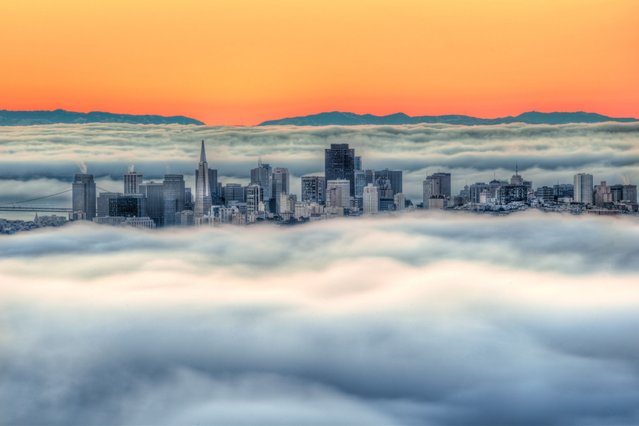
Golden gate Bridge Fog Thick early morning fog engulfed a huge world famous bridge so that only the very tip of it is visible above the clouds. Photographer Ali Erturk, 33, hiked to the spot at 4am to capture the stunning sight of the Golden Gates bridge immersed in the dense swirls of fog. (Photo by Solent News and Photo Agency)

Golden gate Bridge Fog Thick early morning fog engulfed a huge world famous bridge so that only the very tip of it is visible above the clouds. Photographer Ali Erturk, 33, hiked to the spot at 4am to capture the stunning sight of the Golden Gates bridge immersed in the dense swirls of fog. (Photo by Solent News and Photo Agency)
Details
16 Jul 2014 14:33:00
In this aerial view fishing boats are seen on the shore of the Lake Malawi at the Senga village on May 20, 2019 in Senga, Malawi. Hundreds of local traders gather each morning and afternoon at Senga, but fish populations are falling in Lake Malawi, Africa's third largest body of freshwater. (Photo by Gianluigi Guercia/AFP Photo)

In this aerial view fishing boats are seen on the shore of the Lake Malawi at the Senga village on May 20, 2019 in Senga, Malawi. Hundreds of local traders gather each morning and afternoon at Senga, but fish populations are falling in Lake Malawi, Africa's third largest body of freshwater. (Photo by Gianluigi Guercia/AFP Photo)
Details
18 Jul 2019 00:03:00
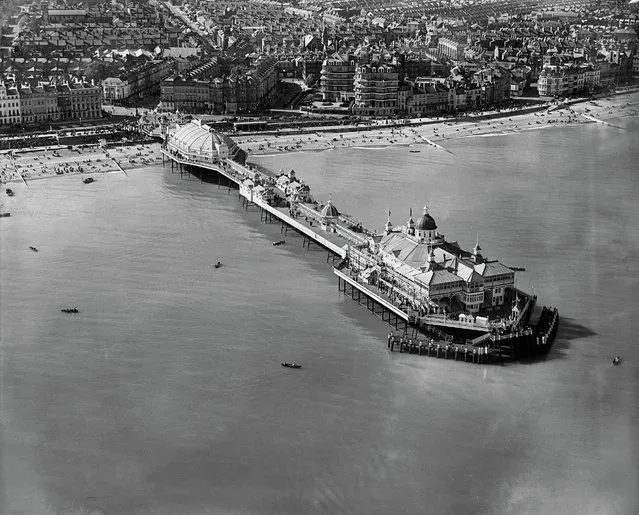
While the lido was described as bringing “modernism to the masses” on the British coast it was just the latest example of a trend that had been developing since Victorian times – transforming seaside towns into resorts for leisure and entertainment. In the latter half of the nineteenth century, the fashion was for local authorities to build great piers stretching from the promenade out into the sea

While the lido was described as bringing “modernism to the masses” on the British coast it was just the latest example of a trend that had been developing since Victorian times – transforming seaside towns into resorts for leisure and entertainment. In the latter half of the nineteenth century, the fashion was for local authorities to build great piers stretching from the promenade out into the sea. The Eastbourne Pier, pictured here in May 1931, was erected between 1866 and 1870 to an ingenious design by Eugenius Birch, which saw the structure sitting on special cups allowing the supporting struts to “move” in bad weather. Arranged on the pier's 1,000-foot length were kiosks, a theatre, a ballroom and a camera obscura. 1931. (Photo by Aerofilms Collection via “A History of Britain From Above”)

Details
25 Feb 2014 12:59:00
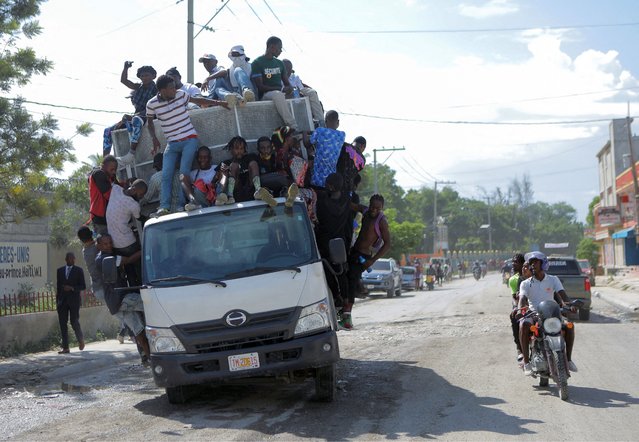
Supporters of Haiti's former President Jean-Bertrand Aristide march to his home to congratulate him at his 69th birthday, in Port-au-Prince, Haiti on July 15, 2022. (Photo by Ralph Tedy Erol/Reuters)

Supporters of Haiti's former President Jean-Bertrand Aristide march to his home to congratulate him at his 69th birthday, in Port-au-Prince, Haiti on July 15, 2022. (Photo by Ralph Tedy Erol/Reuters)
Details
28 Jul 2022 04:32:00
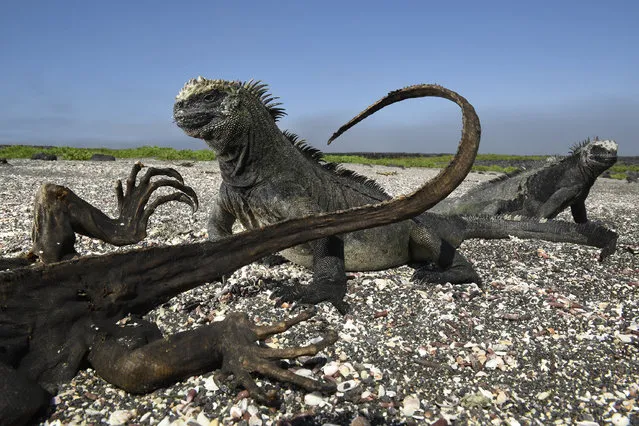
Galapagos – Rocking the Cradle: Four major ocean currents converge along the Galapagos archipelago, creating the conditions for an extraordinary diversity of animal life, April 25, 2016. The islands are home to at least 7,000 flora and fauna species, of which 97 percent of the reptiles, 80 percent of the land birds, 50 percent of the insects and 30 percent of the plants are endemic. The local ecosystem is highly sensitive to the changes in temperature, rainfall and ocean currents that characterize the climatic events known as El Niño and La Niña. These changes cause marked fluctuations in weather and food availability. Many scientists expect the frequency of El Niño and La Niña to increase as a result of climate change, making the Galapagos a possible early-warning location for its effects. (Photo by Thomas P. Peschak for National Geographic/World Press Photo)

Galapagos – Rocking the Cradle: Four major ocean currents converge along the Galapagos archipelago, creating the conditions for an extraordinary diversity of animal life, April 25, 2016. The islands are home to at least 7,000 flora and fauna species, of which 97 percent of the reptiles, 80 percent of the land birds, 50 percent of the insects and 30 percent of the plants are endemic. (Photo by Thomas P. Peschak for National Geographic/World Press Photo)
Details
16 Apr 2018 00:01:00
An Orthodox priest conducts a blessing in front of the Soyuz TMA-20M for the next International Space Station (ISS) crew, comprised of Jeff Williams of the U.S. and Oleg Skriprochka and Alexey Ovchinin of Russia, at the launchpad at the Baikonur cosmodrome, Kazakhstan, March 17, 2016, ahead of its launch scheduled on March 19. (Photo by Shamil Zhumatov/Reuters)

An Orthodox priest conducts a blessing in front of the Soyuz TMA-20M for the next International Space Station (ISS) crew, comprised of Jeff Williams of the U.S. and Oleg Skriprochka and Alexey Ovchinin of Russia, at the launchpad at the Baikonur cosmodrome, Kazakhstan, March 17, 2016, ahead of its launch scheduled on March 19. (Photo by Shamil Zhumatov/Reuters)
Details
18 Mar 2016 12:13:00
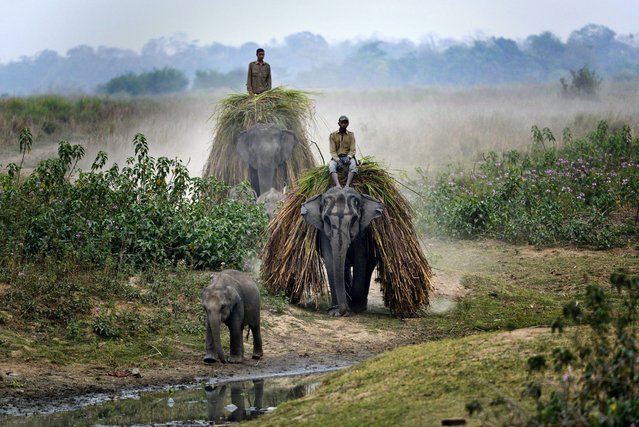
Mahouts return home with their elephants carrying grass to feed them on the eve of the rhino census in Kaziranga National Park in Assam state, India, 24 March 2015. Kaziranga will be closed to visitors for the next two days for a census of the rhinos commencing 25 March, in a previous census in 2013 in the park the population of the Indian rhinos was 2329. (Photo by EPA/Stringer)

Mahouts return home with their elephants carrying grass to feed them on the eve of the rhino census in Kaziranga National Park in Assam state, India, 24 March 2015. Kaziranga will be closed to visitors for the next two days for a census of the rhinos commencing 25 March, in a previous census in 2013 in the park the population of the Indian rhinos was 2329. (Photo by EPA/Stringer)
Details
28 Mar 2015 11:46:00
Nepal's Kumari, or living goddess, adjusts her ornament as she watches the Rato Machindranath chariot Festival in Lalitpur, Nepal, Friday, April 24, 2015. Nepal's living goddesses are young pre-pubescent girls considered by devotees to be incarnations of a Hindu goddess. Selected as toddlers, living goddesses usually keep their positions until they reach puberty. (Photo by Niranjan Shrestha/AP Photo)

Nepal's Kumari, or living goddess, adjusts her ornament as she watches the Rato Machindranath chariot Festival in Lalitpur, Nepal, Friday, April 24, 2015. Nepal's living goddesses are young pre-pubescent girls considered by devotees to be incarnations of a Hindu goddess. Selected as toddlers, living goddesses usually keep their positions until they reach puberty. (Photo by Niranjan Shrestha/AP Photo)
Details
25 Apr 2015 10:05:00