Loading...
Done
Tridacna Gigas, or Giant Clams

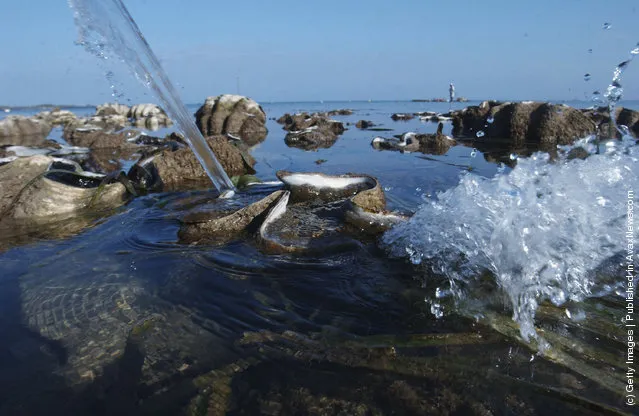
“The giant clam, Tridacna gigas (known as pā’ua in Cook Islands Māori), is the largest living bivalve mollusc. T. gigas is one of the most endangered clam species. It was mentioned as early as 1825 in scientific reports. One of a number of large clam species native to the shallow coral reefs of the South Pacific and Indian oceans, they can weigh more than 200 kilograms (440 lb) measure as much as 120 cm (47 in) across, and have an average lifespan in the wild of 100 years or more”. – Wikipedia

Photo: Tridacna Gigas, or Giant Clams spew water as a traditional fisherman passes by a small sanctuary on January 23, 2004 near Bolinao in the Northern Philippines. The clams, prime builders for coral reefs and providing shelter for spawning fish and other marine life, are exposed by low tides in the sanctuary. Overfishing and pollution throughout the country are not only threatening food security, but are also starting to choke one of the few working clam sanctuaries in the world. (Photo by David Greedy/Getty Images)
Details
01 Oct 2011 13:10:00
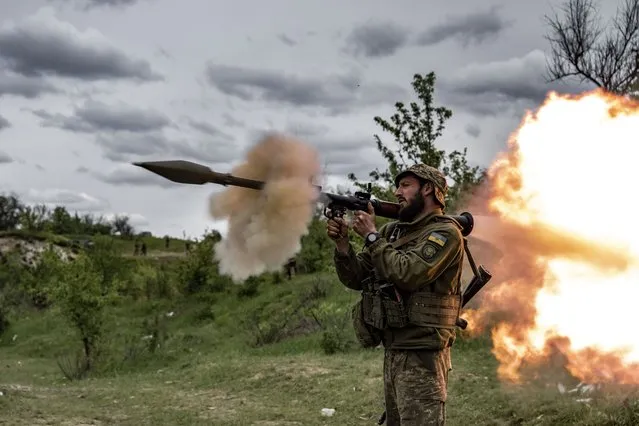
A soldier fires a rocket gun as Ukrainian soldiers in the Donetsk region, where the country's most intense clashes occur, attend intensive combat training by using both domestic and foreign weapons amid Russia-Ukraine war in Donetsk, Ukraine on May 08, 2023. Infantry is always prepared in a conflict where heavy weaponry like aircraft, helicopters, tanks and other heavy armored vehicles, artillery systems, and mortars are widely deployed on frontline. Combat readiness and experience training of the 57th Brigade of the Ukrainian army continues in Donetsk. (Photo by Muhammed Enes Yildirim/Anadolu Agency via Getty Images)

A soldier fires a rocket gun as Ukrainian soldiers in the Donetsk region, where the country's most intense clashes occur, attend intensive combat training by using both domestic and foreign weapons amid Russia-Ukraine war in Donetsk, Ukraine on May 08, 2023. Infantry is always prepared in a conflict where heavy weaponry like aircraft, helicopters, tanks and other heavy armored vehicles, artillery systems, and mortars are widely deployed on frontline. Combat readiness and experience training of the 57th Brigade of the Ukrainian army continues in Donetsk. (Photo by Muhammed Enes Yildirim/Anadolu Agency via Getty Images)
Details
29 May 2023 03:28:00
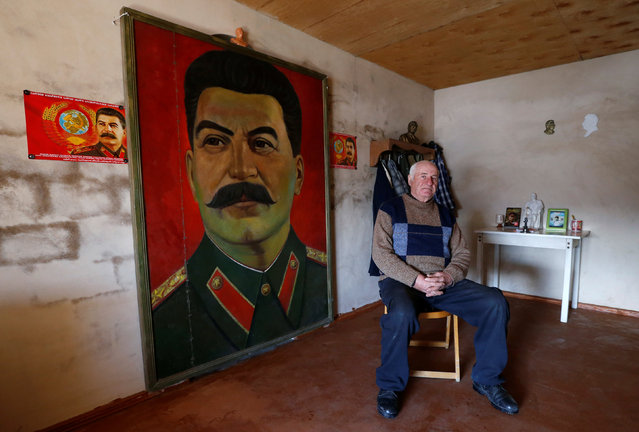
Retired builder Vasili Sidamonidze, 70, poses for a portrait at his home in Gori, Georgia, December 6, 2016. “Unfortunately, Stalin is not popular nowadays. Our people don't respect him. Only we, members of the (Communist) Party, respect him”, Sidamonidze said. “I always try to attend Stalin's birthday anniversaries in Gori. Unfortunately many people don't want to join us even if they live nearby. They look at us from their windows”. Stalin, who was born in Gori in 1878 and died in 1953, is largely reviled today in Georgia, which regained its independence during the 1991 collapse of the Soviet Union. Over the years, his memorials have been dismantled, most recently in 2010 when authorities removed a statue of the dictator from Gori's central square. But Stalin is still revered by a small group of mainly elderly supporters who stress his role in the industrialisation of the Soviet Union and in defeating Nazi Germany in World War Two. Each Dec. 21, a few dozen people mark his birthday by gathering outside a Gori museum dedicated to Stalin, where they make speeches and walk to the square where a 6-meter-high bronze statue of him once stood, calling for it to be reinstated. Opponents say it was a symbol of Moscow's still lingering shadow. In 2008, Russia fought a brief war with Georgia and recognised its breakaway regions of Abkhazia and South Ossetia as independent states. (Photo by David Mdzinarishvili/Reuters)

Retired builder Vasili Sidamonidze, 70, poses for a portrait at his home in Gori, Georgia, December 6, 2016. “Unfortunately, Stalin is not popular nowadays. Our people don't respect him. Only we, members of the (Communist) Party, respect him”, Sidamonidze said. “I always try to attend Stalin's birthday anniversaries in Gori. Unfortunately many people don't want to join us even if they live nearby. They look at us from their windows”. (Photo by David Mdzinarishvili/Reuters)
Details
17 Dec 2016 07:59:00
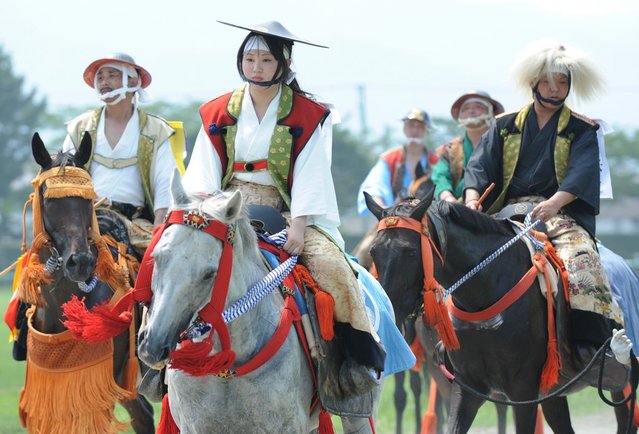
A young woman (C) clad in samurai costume leads other local poeple as she rides her horse during a parade at the annual Soma Nomaoi festival in Minamisoma, Fukushima Prefecture, on July 28, 2012.  The traditional full-scale festival kicked off for the first time after the accident of the Fukushima Dai-ichi Nuclear Power Plant following the massive earthquake and the tsunami on March 11, 2011. (Photo by Toru Yamanaka/AFP Photo)

Soma-Nomaoi is a festival that recreates a battle scene from more than 1,000 years ago. It is annually held for 4 days from July 22 to 25 in Haramachi City, Fukushima Prefecture, in the eastern part of Japan. In this historical event, 600 mounted samurai in traditional Japanese armor, with long swords at their side and ancestral flagstaffs streaming from their backs, ride across open fields. Soma-Nomaoi has been designated an Important Intangible Folk Cultural Property.

Photo: A young woman (C) clad in samurai costume leads other local poeple as she rides her horse during a parade at the annual Soma Nomaoi festival in Minamisoma, Fukushima Prefecture, on July 28, 2012. The traditional full-scale festival kicked off for the first time after the accident of the Fukushima Dai-ichi Nuclear Power Plant following the massive earthquake and the tsunami on March 11, 2011. (Photo by Toru Yamanaka/AFP Photo)
Details
02 Aug 2012 12:59:00
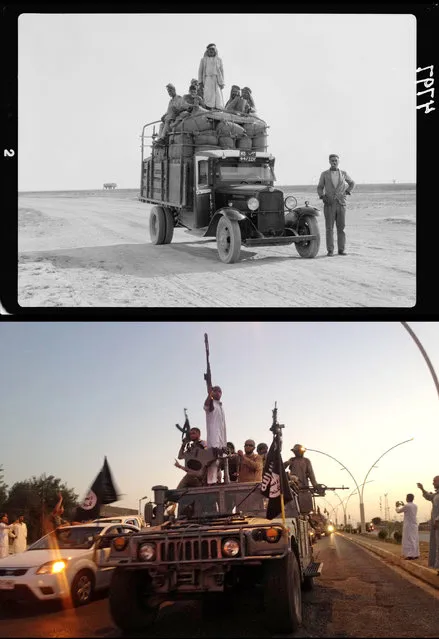
This combination of two photographs shows a 1932 image of men on a lorry on the road to Mosul, northern Iraq, from the Library of Congress, top, and fighters from the Islamic State group parading in a commandeered Iraqi security forces armored vehicle down a main road in Mosul on Monday, June 23, 2014. (Photo by AP Photo)


Iraq's second largest city, Mosul, is locked under the rule of extremists from the Islamic State group trying to purge it of everything they see as contradicting their stark vision of Islam. A trove of photographs now housed at the Library of Congress offers a glimpse of a different Mosul – before wars, insurgency, sectarian strife and now radicals' rule. The scenes were taken in the autumn of 1932 by staff from the American Colony Photo Department during a visit to Iraq at the end of the British mandate. (Photo by AP Photo)
Details
21 Sep 2014 11:13:00
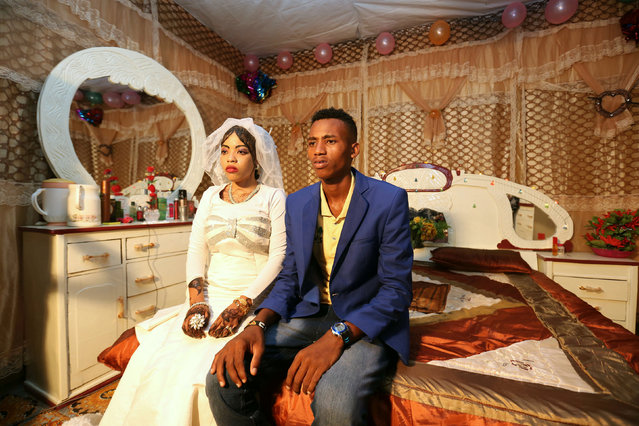
Somali couple Mohamed Noor (L) and Huda Omar pose for a photograph at their makeshift home during their wedding ceremony in Mogadishu's Rajo camp, Somalia August 17, 2016. Having met two years ago, the pair have just married at Rajo camp, where some 400 families live. Most, like Noor's parents, came here in the early 1990s to flee famine. They stayed on as years of conflict ravaged the Horn of Africa nation. As at any wedding, there is plenty of dancing and sweet treats for the young couple as they start married life in Noor's simple home, made of iron and plastic sheets. Noor works as a mason with his father. Others here are builders or sell sweets, nuts and stick toothbrushes to make money. Some beg around the seaside city, which like the rest of Somalia has been gripped by violence since the toppling of dictator Mohamed Siad Barre in 1991. (Photo by Feisal Omar/Reuters)

Somali couple Mohamed Noor (L) and Huda Omar pose for a photograph at their makeshift home during their wedding ceremony in Mogadishu's Rajo camp, Somalia August 17, 2016. Having met two years ago, the pair have just married at Rajo camp, where some 400 families live. Most, like Noor's parents, came here in the early 1990s to flee famine. (Photo by Feisal Omar/Reuters)
Details
14 Sep 2016 10:35:00
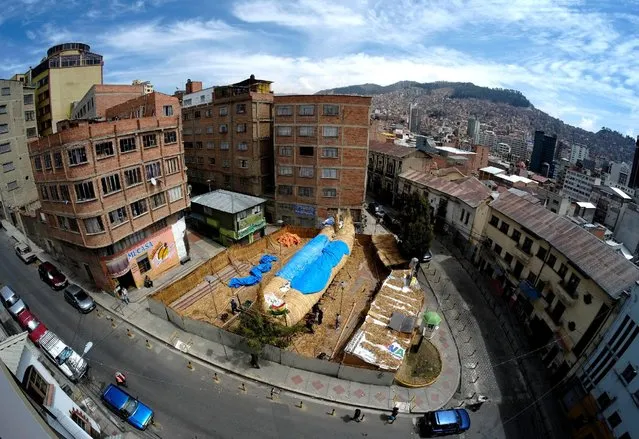
Aerial view of the “Viracocha III”, a boat made only from the totora reed, as it is being prepared to cross the Pacific from Chile to Australia on an expected six-month journey, La Paz, Bolivia, October 19, 2016. An expedition in a boat made only of reeds crafted by indigenous Bolivians is getting ready to cross the Pacific from South America to Australia, in a fresh attempt to prove that ancient mariners were capable of making the journey. Phil Buck, a 51-year-old explorer from the United States, already has led two similar expeditions and will captain the “Viracocha III” set to depart from northern Chile in February on an expected six-month journey. (Photo by David Mercado/Reuters)

Aerial view of the “Viracocha III”, a boat made only from the totora reed, as it is being prepared to cross the Pacific from Chile to Australia on an expected six-month journey, La Paz, Bolivia, October 19, 2016. An expedition in a boat made only of reeds crafted by indigenous Bolivians is getting ready to cross the Pacific from South America to Australia, in a fresh attempt to prove that ancient mariners were capable of making the journey. (Photo by David Mercado/Reuters)
Details
20 Oct 2016 10:53:00
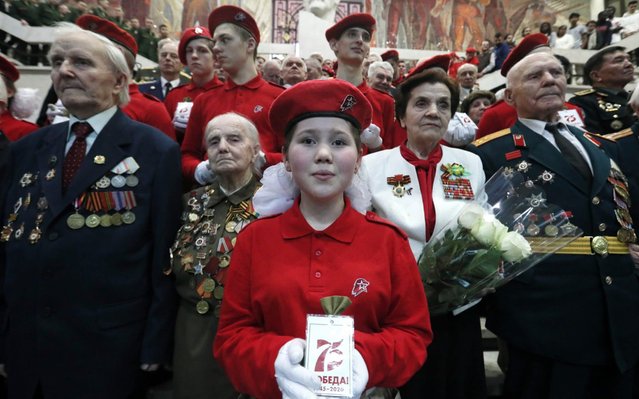
WWII veterans attend a ceremony to place tobacco pouches of soil from WWII mass graves of Red Army soldiers abroad, in the custody of the Central Armed Forces Museum in Moscow, Russia on March 6, 2020. The grave soil has been brought from Abkhazia, Germany, Kyrgyzstan, US, Ukraine, France, Estonia, Mongolia, Bulgaria, UK, Uzbekistan and South Ossetia. (Photo by Alexander Shcherbak/TASS)

WWII veterans attend a ceremony to place tobacco pouches of soil from WWII mass graves of Red Army soldiers abroad, in the custody of the Central Armed Forces Museum in Moscow, Russia on March 6, 2020. The grave soil has been brought from Abkhazia, Germany, Kyrgyzstan, US, Ukraine, France, Estonia, Mongolia, Bulgaria, UK, Uzbekistan and South Ossetia. (Photo by Alexander Shcherbak/TASS)
Details
02 Apr 2020 00:01:00