Loading...
Done
A monkey catches knives as it balances on a board during a daily training session at a monkey farm in Baowan village, Xinye county of China's central Henan province, February 2, 2016. Baowan village of China's central Henan province appears to be your average farming community from the surface, but at a closer look, one can hear monkey hoots from every direction. Although no official number exists, villagers say that they have been a breeding ground for both monkeys and monkey trainers for centuries. (Photo by Jason Lee/Reuters)

A monkey catches knives as it balances on a board during a daily training session at a monkey farm in Baowan village, Xinye county of China's central Henan province, February 2, 2016. Baowan village of China's central Henan province appears to be your average farming community from the surface, but at a closer look, one can hear monkey hoots from every direction. Although no official number exists, villagers say that they have been a breeding ground for both monkeys and monkey trainers for centuries. (Photo by Jason Lee/Reuters)
Details
04 Feb 2016 11:35:00
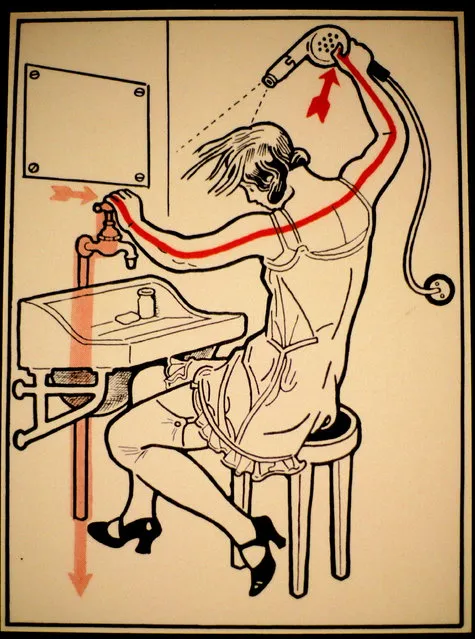
The book “Elektroschutz in 132 Bildern” (Electrical Protection in 132 Pictures) was published in Vienna in the early 1900s by a Viennese physician named Stefan Jellinek (1878-1968, a founder of the Electro-Pathological Museum). The pictures are nice and direct and unambiguous; they teach, graphically, that the surest way to kill yourself with electricity is to form a complete path from source (usually the bright red arrow) to ground (the screened back, pink arrow). Arrowheads provide the path for current flow. (Photo by The Vienna Technical Museum)

The book “Elektroschutz in 132 Bildern” (Electrical Protection in 132 Pictures) was published in Vienna in the early 1900s by a Viennese physician named Stefan Jellinek (1878-1968, a founder of the Electro-Pathological Museum). The pictures are nice and direct and unambiguous; they teach, graphically, that the surest way to kill yourself with electricity is to form a complete path from source (usually the bright red arrow) to ground (the screened back, pink arrow). Arrowheads provide the path for current flow. (Photo by The Vienna Technical Museum)
Details
11 Aug 2014 11:10:00
“The Reward”. “A spot that a friend and I found that takes a bit of effort to get to. Needs the right swell and wind direction to come together for the backwash to really happen. We had been many times with OK results, but this morning everything lined up perfectly and I was rewarded with this split-second moment in time under some amazing morning light”. (Photo by Scott Harrison/2019 UK Surf Photo of the Year)

“The Reward”. “A spot that a friend and I found that takes a bit of effort to get to. Needs the right swell and wind direction to come together for the backwash to really happen. We had been many times with OK results, but this morning everything lined up perfectly and I was rewarded with this split-second moment in time under some amazing morning light”. (Photo by Scott Harrison/2019 UK Surf Photo of the Year)
Details
03 Jan 2020 00:03:00
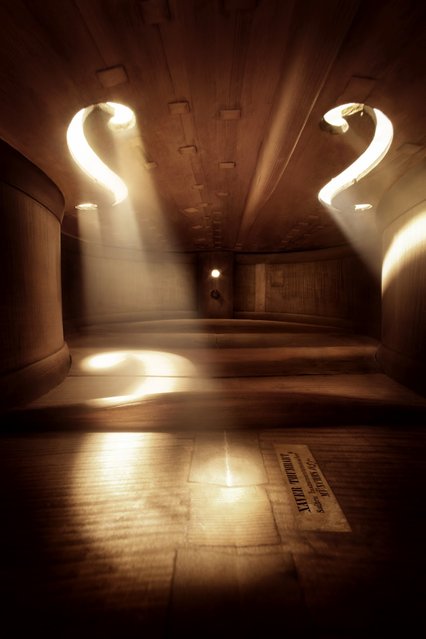
Inside Instruments By Bjoern Ewers And  Mierswa Kluska

This print campaign for the Berlin Philharmonic orchestra uses macro photographs taken inside the cramped spaces of instruments making the inner workings of a violin, cello, flute, and pipe organ appear vast and spacious, almost as if you could walk around inside them. So wonderfully done. Art directed by photographer Bjoern Ewers, you can see more over on Behance.
Details
22 Feb 2013 15:16:00
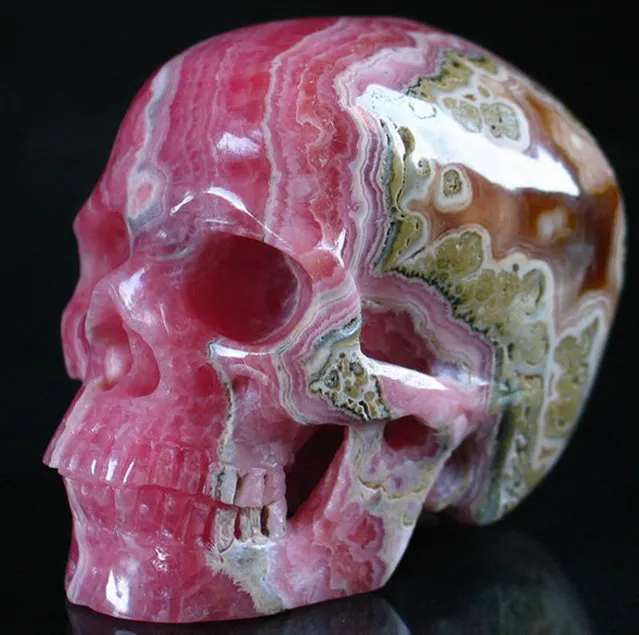
Rhodochrosite - The Mineral And Gemstone Kingdom

Rhodochrosite is a manganese carbonate mineral with chemical composition MnCO3. In its (rare) pure form, it is typically a rose-red color, but impure specimens can be shades of pink to pale brown. It streaks white, and its Mohs hardness varies between 3.5 and 4. Its specific gravity is between 3.5 and 3.7. It crystallizes in the trigonal system, and cleaves with rhombohedral carbonate cleavage in three directions.
Details
30 Sep 2014 10:25:00
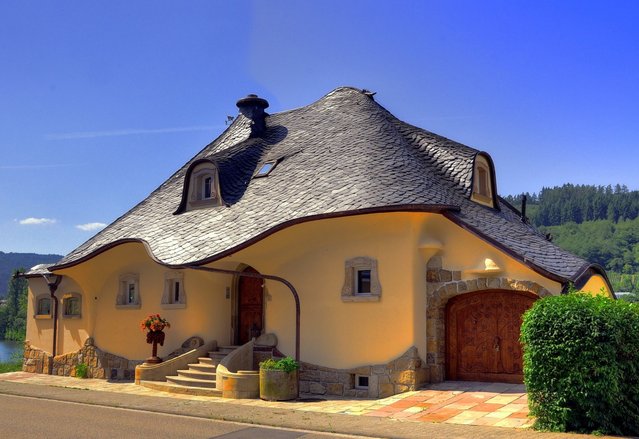
Impressive Architecture in Zell, Germany

The materialisation of this house is a dream come true for the owner. This house was built in Germany, in the town called Zell and what is the most astonishing about it is the stone used in the whole design. It was built by Walter Andre and it looks as if it just got out from a fairytale, and everything from its fantastic roof to it’s sandstone windows points in that direction.
Details
09 Jan 2014 10:10:00
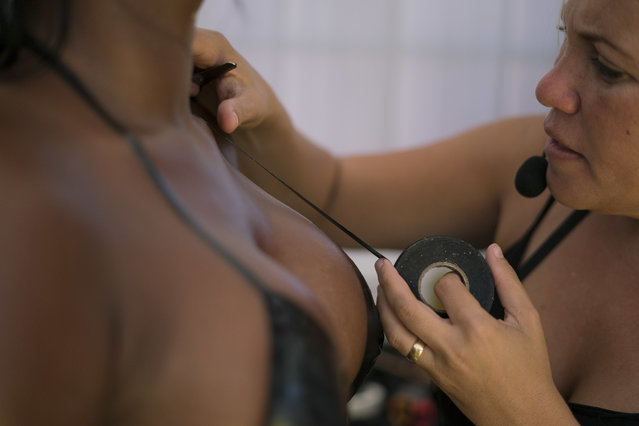
In this January 11, 2017 photo, Erika Martins uses black electrical tape to create a customer's bikini, in order to attain crisp tan lines, on her rooftop Erika Bronze salon in the suburb of Realengo in Rio de Janeiro, Brazil. Martins wears a microphone connected to an open speaker system in order to direct her assistants to clients who need more tanning lotion or a sprinkling of water on their skin. (Photo by Renata Brito/AP Photo)

In this January 11, 2017 photo, Erika Martins uses black electrical tape to create a customer's bikini, in order to attain crisp tan lines, on her rooftop Erika Bronze salon in the suburb of Realengo in Rio de Janeiro, Brazil. Martins wears a microphone connected to an open speaker system in order to direct her assistants to clients who need more tanning lotion or a sprinkling of water on their skin. (Photo by Renata Brito/AP Photo)
Details
25 Jan 2017 11:21:00
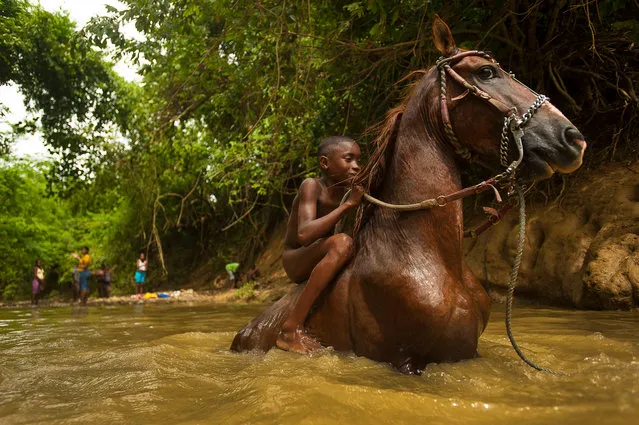
This image of a young bareback rider was taken in the village of Palenque de San Basilio, in Colombia’s Bolívar department. Founded by freed slaves in the 17th century, it became the first free town in the Americas, following a decree by the Spanish crown. Most of today’s inhabitants are direct descendants of those slaves and have preserved many of their customs, including their own language, Palenquero. (Photo by Sebastián Suki Beláustegui/The Guardian)

This image of a young bareback rider was taken in the village of Palenque de San Basilio, in Colombia’s Bolívar department. Founded by freed slaves in the 17th century, it became the first free town in the Americas, following a decree by the Spanish crown. Most of today’s inhabitants are direct descendants of those slaves and have preserved many of their customs, including their own language, Palenquero. (Photo by Sebastián Suki Beláustegui/The Guardian)
Details
07 Sep 2017 09:13:00