Loading...
Done
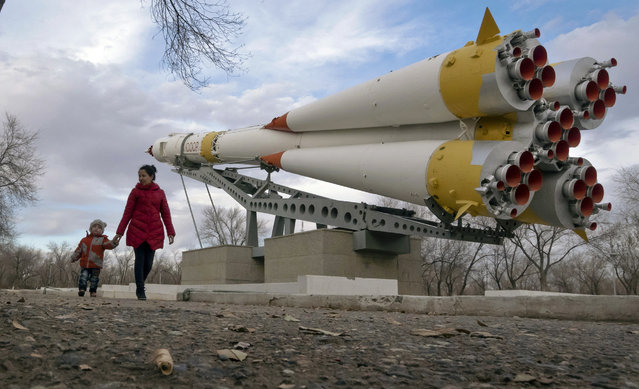
A woman walks with her child past a Soyuz rocket, installed as a monument at the Russian leased Baikonur cosmodrome, the world's first and largest operational space launch facility, in Baikonur, Kazakhstan, Saturday, November 12, 2016. The new Soyuz mission to the International Space Station (ISS) is scheduled for Friday, Nov. 18. (Photo by Dmitri Lovetsky/AP Photo)

A woman walks with her child past a Soyuz rocket, installed as a monument at the Russian leased Baikonur cosmodrome, the world's first and largest operational space launch facility, in Baikonur, Kazakhstan, Saturday, November 12, 2016. The new Soyuz mission to the International Space Station (ISS) is scheduled for Friday, Nov. 18. (Photo by Dmitri Lovetsky/AP Photo)
Details
08 Feb 2017 00:03:00
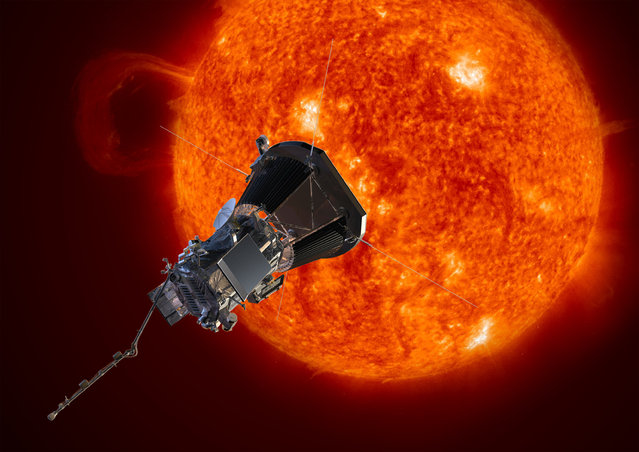
This image made available by the Johns Hopkins University Applied Physics Laboratory on Wednesday, May 31, 2017 depicts NASA's Solar Probe Plus spacecraft approaching the sun. On Wednesday, NASA announced it will launch the probe in summer 2018 to explore the solar atmosphere. It will be subjected to brutal heat and radiation like no other man-made structure before. (Photo by Johns Hopkins University Applied Physics Laboratory via AP Photo)

This image made available by the Johns Hopkins University Applied Physics Laboratory on Wednesday, May 31, 2017 depicts NASA's Solar Probe Plus spacecraft approaching the sun. On Wednesday, NASA announced it will launch the probe in summer 2018 to explore the solar atmosphere. It will be subjected to brutal heat and radiation like no other man-made structure before. (Photo by Johns Hopkins University Applied Physics Laboratory via AP Photo)
Details
08 Sep 2017 09:42:00
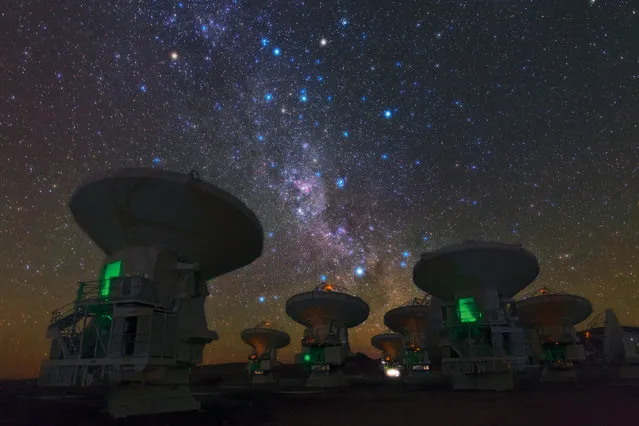
The antennas of the European Southern Observatory's Atacama Large Millimeter/Submillimeter Array, also known as ALMA, are set against the splendor of the Milky Way in this picture by Babak Tafreshi

The antennas of the European Southern Observatory's Atacama Large Millimeter/Submillimeter Array, also known as ALMA, are set against the splendor of the Milky Way in this picture by Babak Tafreshi. Construction of the full ALMA array is due to be completed in Chile's Atacama Desert in 2013, but the facility is already making scientific observations with a partial array of antennas. (Photo by ESO/B. Tafreshi/TWAN)
Details
03 Jun 2012 11:57:00
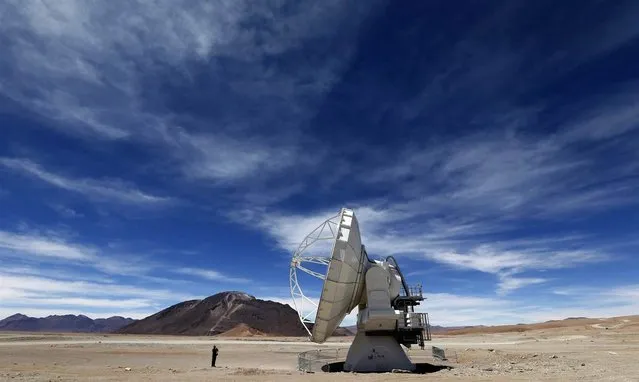
A man takes a photo of a radio antenna that's part of the Atacama Large Milimeter Array Observatory on March 12, 2013 at Llano de Chajnantor, about 43 miles (70 kilometers) from San Pedro de Atacama, Chile. The $1.5 billion ALMA facility, which had its official inauguration on March 13, is considered the world's most expensive ground-based observatory. (Photo by Felipe Trueba/EPA)

A man takes a photo of a radio antenna that's part of the Atacama Large Milimeter Array Observatory on March 12, 2013 at Llano de Chajnantor, about 43 miles (70 kilometers) from San Pedro de Atacama, Chile. The $1.5 billion ALMA facility, which had its official inauguration on March 13, is considered the world's most expensive ground-based observatory. (Photo by Felipe Trueba/EPA)
Details
03 Apr 2013 09:25:00
Indigenous dancers participate in a traditional healing ceremony for the mother earth at El Salvador del Mundo Square in San Salvador, December 10, 2014. Salvadorean indigenous organizations participated in a ceremony to ask for solutions to stop climate change and respect planet earth as the U.N. Climate Change Conference COP 20 is bring held in Peru. (Photo by Jose Cabezas/Reuters)

Indigenous dancers participate in a traditional healing ceremony for the mother earth at El Salvador del Mundo Square in San Salvador, December 10, 2014. Salvadorean indigenous organizations participated in a ceremony to ask for solutions to stop climate change and respect planet earth as the U.N. Climate Change Conference COP 20 is bring held in Peru. The two-week long United Nations climate summit opened on December 1 in Lima, with experts and analysts from around the world gathering to discuss melting glaciers and extreme weather patterns. (Photo by Jose Cabezas/Reuters)
Details
12 Dec 2014 12:51:00
Ground personnel work next to the Soyuz TMA-13M capsule of the International Space Station (ISS) crew of Alexander Gerst of Germany, Maxim Suraev of Russia and Reid Wiseman of the U.S. after its landing near the town of Arkalyk in northern Kazakhstan November 10, 2014. (Photo by Shamil Zhumatov/Reuters)

Ground personnel work next to the Soyuz TMA-13M capsule of the International Space Station (ISS) crew of Alexander Gerst of Germany, Maxim Suraev of Russia and Reid Wiseman of the U.S. after its landing near the town of Arkalyk in northern Kazakhstan November 10, 2014. A veteran Russian cosmonaut and two International Space Station crewmates, one from the United States and one from Germany, returned safely to Earth on Sunday with a parachute landing of their Soyuz capsule in Kazakhstan, ending 5-1/2 months in orbit. (Photo by Shamil Zhumatov/Reuters)
Details
10 Nov 2014 13:58:00
An infrared portrait from NASA's Spitzer Space Telescope which shows generations of stars is seen in this undated NASA handout image released February 14, 2013. In this wispy star-forming region, called W5, the oldest stars can be seen as blue dots in the centers of the two hollow cavities (other blue dots are background and foreground stars not associated with the region). Red shows heated dust that pervades the region's cavities, while green highlights dense clouds. (Photo by NASA/Reuters/JPL-Caltech/Harvard-Smithsonian/Handout)

An infrared portrait from NASA's Spitzer Space Telescope which shows generations of stars is seen in this undated NASA handout image released February 14, 2013. In this wispy star-forming region, called W5, the oldest stars can be seen as blue dots in the centers of the two hollow cavities (other blue dots are background and foreground stars not associated with the region). Red shows heated dust that pervades the region's cavities, while green highlights dense clouds. (Photo by NASA/Reuters/JPL-Caltech/Harvard-Smithsonian/Handout)
Details
03 Mar 2013 08:44:00
Liu Yang, China's first female astronaut, waves during a departure ceremony at Jiuquan Satellite Launch Center, on June 16, 2012. (Photo by Jason Lee/Reuters via The Atlantic)

Liu Yang, China's first female astronaut, waves during a departure ceremony at Jiuquan Satellite Launch Center, on June 16, 2012. (Photo by Jason Lee/Reuters via The Atlantic)
Details
10 Jul 2013 08:37:00