Loading...
Done
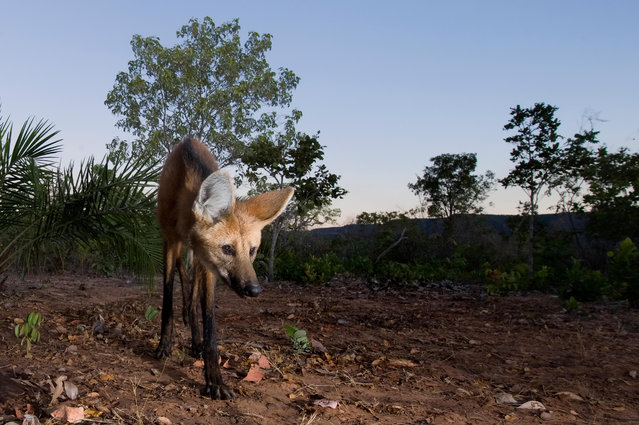
The maned wolf is among the large mammals in the Brazilian Cerrado that are threatened by the increasing conversion of grasslands into farmland for grazing and growing crops. (Photo by Ben Cranke/Nature Picture Library/Alamy Stock Photo)

Global wildlife populations will decline by 67% by 2020 unless urgent action is taken to reduce human impact on species and ecosystems, warns the biennial Living Planet Index report from WWF (World Wide Fund for Nature) and ZSL (Zoological Society of London). From elephants to eels, here are some of the wildlife populations most affected by human activity. Here: The maned wolf is among the large mammals in the Brazilian Cerrado that are threatened by the increasing conversion of grasslands into farmland for grazing and growing crops. (Photo by Ben Cranke/Nature Picture Library/Alamy Stock Photo)
Details
28 Oct 2016 10:47:00
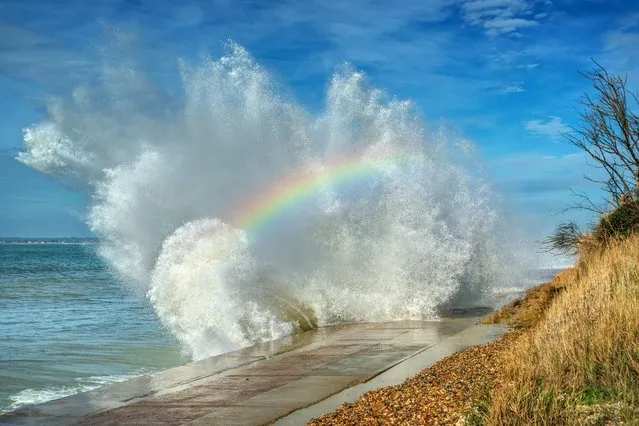
Some wave over the rainbow – a splash of colour is captured in spray over the sea wall at Totland Bay on the Isle of Wight off the south coast of England on February 16, 2022. (Photo by Jamie Russell/Bournemouth News)

Some wave over the rainbow – a splash of colour is captured in spray over the sea wall at Totland Bay on the Isle of Wight off the south coast of England on February 16, 2022. (Photo by Jamie Russell/Bournemouth News)
Details
12 Apr 2022 05:57:00
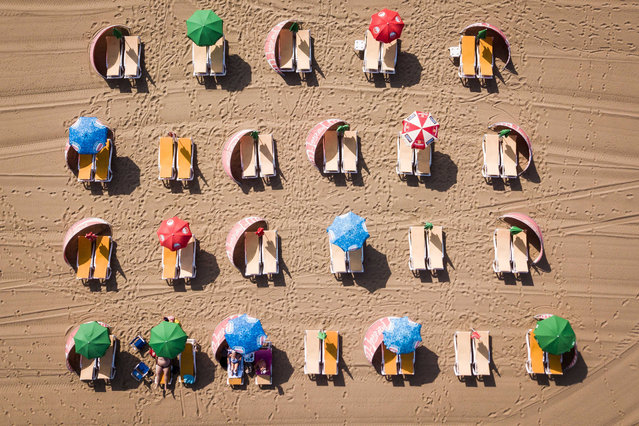
An image taken with a drone shows beach umbrellas and deck chairs as beachgoers enjoy the hot weather in Scheveningen, the Netherlands, 24 July 2019. The Royal Dutch Meteorological Institute has issued an official warning due to high temperatures affecting the country as well as Western Europe. (Photo by Sem van der Wal/EPA/EFE)

An image taken with a drone shows beach umbrellas and deck chairs as beachgoers enjoy the hot weather in Scheveningen, the Netherlands, 24 July 2019. The Royal Dutch Meteorological Institute has issued an official warning due to high temperatures affecting the country as well as Western Europe. (Photo by Sem van der Wal/EPA/EFE)
Details
13 Aug 2020 00:03:00
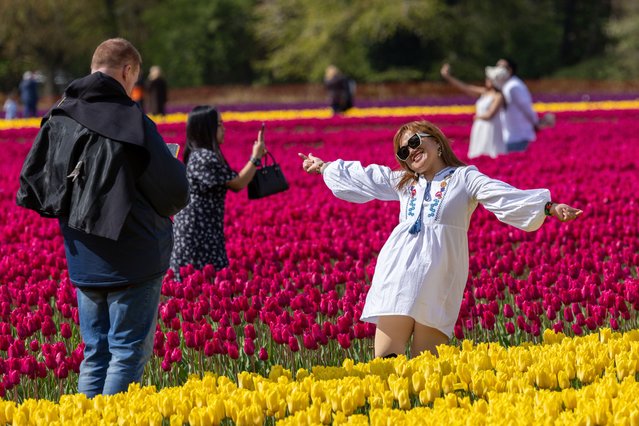
Colourful pictures all round as people pose on April 7, 2025 in the bright rows of tulips at the family-run Norfolk Tulips near King’s Lynn, UK made famous due to being used to recreate the Emerald City in the Wicked film. (Photo by Bav Media)

Colourful pictures all round as people pose on April 7, 2025 in the bright rows of tulips at the family-run Norfolk Tulips near King’s Lynn, UK made famous due to being used to recreate the Emerald City in the Wicked film. (Photo by Bav Media)
Details
18 Jul 2025 02:47:00
Christians looting a Muslim shop in the “Combattants” district of Bangui. (Photo by Pierre Terdjman/Paris Match)

The 26th annual Visa Pour l’Image, the “Cannes Film Festival” of photojournalism kicks off, filling the French city of Perpignan with more than 3,000 of the world’s best photojournalists and photo editors, along with agencies from around the world. This year’s Visa Pour l’Image showcases 26 exhibitions around the city. Photo: Christians looting a Muslim shop in the “Combattants” district of Bangui. (Photo by Pierre Terdjman/Paris Match)
Details
02 Sep 2014 12:47:00
On August 31, 2012, a long filament of solar material that had been hovering in the sun's atmosphere, the corona, erupted out into space at 4:36 p.m. EDT. The coronal mass ejection, or CME, traveled at over 900 miles per second. The CME did not travel directly toward Earth, but did connect with Earth's magnetic environment, or magnetosphere, causing aurora to appear on the night of Monday, September 3. (Photo by NASA/GSFC/SDO)

On August 31, 2012, a long filament of solar material that had been hovering in the sun's atmosphere, the corona, erupted out into space at 4:36 p.m. EDT. The coronal mass ejection, or CME, traveled at over 900 miles per second. The CME did not travel directly toward Earth, but did connect with Earth's magnetic environment, or magnetosphere, causing aurora to appear on the night of Monday, September 3. (Photo by NASA/GSFC/SDO via The Atlantic)
Details
14 Sep 2012 09:01:00
Commended. In late May, about a quarter of a million snow geese arrive from North America to nest on Wrangel Island, in northeastern Russia. They form the world's largest breeding colony of snow geese. Photographer Sergey Gorshkov spent two months on the remote island photographing the unfolding dramas. (Photo by Sergey Gorshkov/Veolia Environnement Wildlife Photographer)

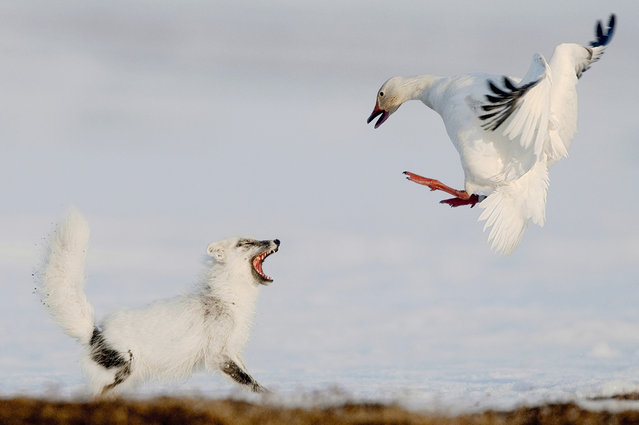
Commended. In late May, about a quarter of a million snow geese arrive from North America to nest on Wrangel Island, in northeastern Russia. They form the world's largest breeding colony of snow geese. Photographer Sergey Gorshkov spent two months on the remote island photographing the unfolding dramas. Arctic foxes take advantage of the abundance of eggs, caching surplus eggs for leaner times. But a goose (here the gander) is easily a match for a fox, which must rely on speed and guile to steal eggs. “The battles were fairly equal”, notes Sergey, “and I only saw a fox succeed in grabbing an egg on a couple of occasions, despite many attempts”. Surprisingly, “the geese lacked any sense of community spirit”, he adds, “and never reacted when a fox harassed a neighboring pair nesting close by”. (Photo by Sergey Gorshkov/Veolia Environnement Wildlife Photographer)
Details
16 Jun 2015 12:30:00
A visitor poses for a photograph in front of a 3D painting depicting a Japanese Imperial army soldier at a 3D art gallery in Beijing January 16, 2015. (Photo by Kim Kyung-Hoon/Reuters)

A visitor poses for a photograph in front of a 3D painting depicting a Japanese Imperial army soldier at a 3D art gallery in Beijing January 16, 2015. (Photo by Kim Kyung-Hoon/Reuters)
Details
17 Jan 2015 12:27:00