Loading...
Done
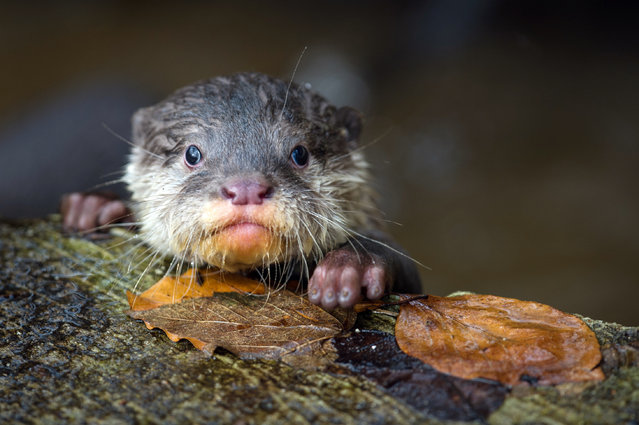
A young oriental small-clawed otter at the zoo in Neumuenster, Germany, March 5, 2014. The six young otters (one male, five female) were born on December 7, 2013. (Photo by Maja Hitij/EPA)

A young oriental small-clawed otter at the zoo in Neumuenster, Germany, March 5, 2014. The six young otters (one male, five female) were born on December 7, 2013. (Photo by Maja Hitij/EPA)
Details
08 Mar 2014 11:28:00
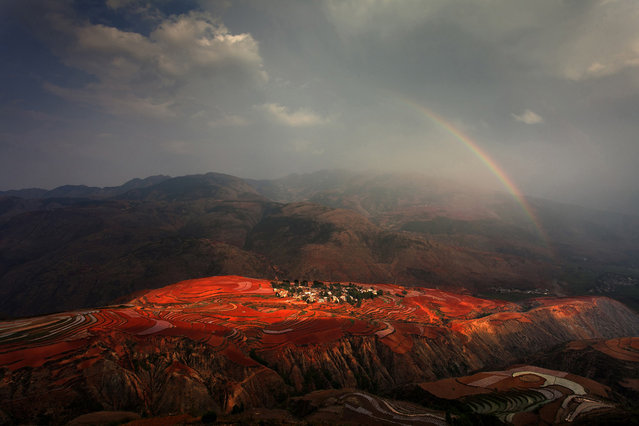
“Red Land: Sunset Cloud Village is one of the most picturesque places in Red Land, China. As its name indicates, it's best to see before sunset. The reddish brown soil turns redder after rainfall and after farmers plow the land”. (Photo and comment by Peng Jiang/National Geographic Photo Contest via The Atlantic)

“Red Land: Sunset Cloud Village is one of the most picturesque places in Red Land, China. As its name indicates, it's best to see before sunset. The reddish brown soil turns redder after rainfall and after farmers plow the land”. (Photo and comment by Peng Jiang/National Geographic Photo Contest via The Atlantic)


Details
05 Dec 2012 11:07:00
A woman walks behind the installation “Wandering boy is forever attractive” (1985) by Tetsumi Kudo during the press preview at the exhibition “Tetsumi Kudo – Retrospective” in the Fridericianum in Kassel, Germany, Friday, September 23, 2016. The exhibition offers an in-depth, comprehensive view of works by the Japanese artist Kudo. It starts on Sept. 25, 2016 and lasts until Jan. 1, 2017. (Photo by Jens Meyer/AP Photo)

A woman walks behind the installation “Wandering boy is forever attractive” (1985) by Tetsumi Kudo during the press preview at the exhibition “Tetsumi Kudo – Retrospective” in the Fridericianum in Kassel, Germany, Friday, September 23, 2016. The exhibition offers an in-depth, comprehensive view of works by the Japanese artist Kudo. It starts on Sept. 25, 2016 and lasts until Jan. 1, 2017. (Photo by Jens Meyer/AP Photo)
Details
24 Sep 2016 11:18:00
In this photo provided by Mickey Nuttall, members of an international team of skydivers join hands, flying head-down to build their world record skydiving formation, Friday, July 31, 2015, over Ottawa, Ill. (Photo by Jason Peters via AP Photo)

In this photo provided by Mickey Nuttall, members of an international team of skydivers join hands, flying head-down to build their world record skydiving formation, Friday, July 31, 2015, over Ottawa, Ill. (Photo by Jason Peters via AP Photo)
Details
01 Aug 2015 12:45:00
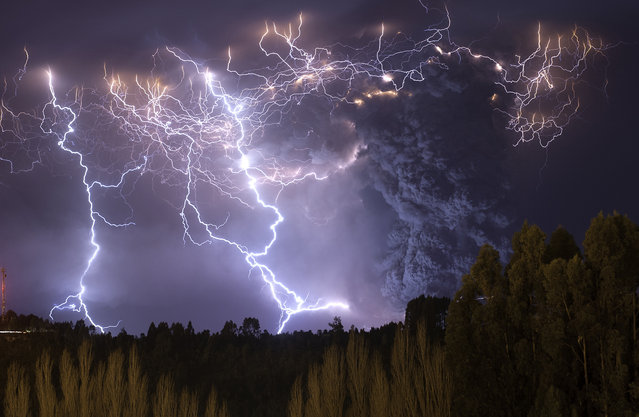
The eruption of Cordon Caulle began on June 4, 2011, located in the Region of Los Rios in Chile. For about 12 months, people and animals became accustomed to living with the daily fall of ash, which also caused problems in the air traffic in South America. The explosions and lightning during first days of the eruption could be seen from hundreds of miles around. This photograph was taken on the second night of eruption from the town of Lago Ranco. (Photo and caption by Francisco Negroni/National Geographic Traveler Photo Contest)

The eruption of Cordon Caulle began on June 4, 2011, located in the Region of Los Rios in Chile. For about 12 months, people and animals became accustomed to living with the daily fall of ash, which also caused problems in the air traffic in South America. The explosions and lightning during first days of the eruption could be seen from hundreds of miles around. This photograph was taken on the second night of eruption from the town of Lago Ranco. (Photo and caption by Francisco Negroni/National Geographic Traveler Photo Contest)

ATTENTION! All pictures are presented in high resolution. To see Hi-Res images – just TWICE click on any picture. In other words, click small picture – opens the BIG picture. Click BIG picture – opens VERY BIG picture.
Details
23 Jun 2013 11:24:00
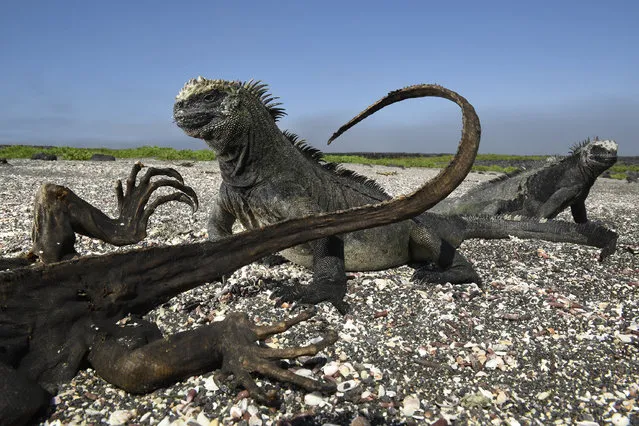
Galapagos – Rocking the Cradle: Four major ocean currents converge along the Galapagos archipelago, creating the conditions for an extraordinary diversity of animal life, April 25, 2016. The islands are home to at least 7,000 flora and fauna species, of which 97 percent of the reptiles, 80 percent of the land birds, 50 percent of the insects and 30 percent of the plants are endemic. The local ecosystem is highly sensitive to the changes in temperature, rainfall and ocean currents that characterize the climatic events known as El Niño and La Niña. These changes cause marked fluctuations in weather and food availability. Many scientists expect the frequency of El Niño and La Niña to increase as a result of climate change, making the Galapagos a possible early-warning location for its effects. (Photo by Thomas P. Peschak for National Geographic/World Press Photo)

Galapagos – Rocking the Cradle: Four major ocean currents converge along the Galapagos archipelago, creating the conditions for an extraordinary diversity of animal life, April 25, 2016. The islands are home to at least 7,000 flora and fauna species, of which 97 percent of the reptiles, 80 percent of the land birds, 50 percent of the insects and 30 percent of the plants are endemic. (Photo by Thomas P. Peschak for National Geographic/World Press Photo)
Details
16 Apr 2018 00:01:00