Loading...
Done
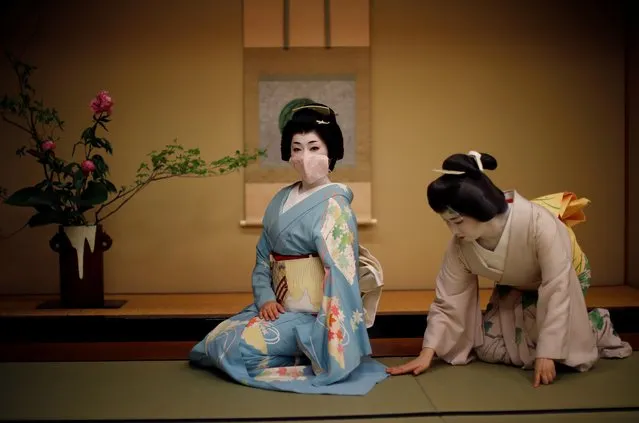
Mayu adjusts Koiku’s kimono, as Koiku wears a protective face mask while posing for a photograph, before they work at a party where they will entertain with other geisha at Japanese luxury restaurant Asada in Tokyo, Japan, June 23, 2020. The coronavirus pandemic has made Tokyo's geisha fear for their centuries-old profession as never before. Though the number of geisha - famed for their witty conversation, beauty and skill at traditional arts - has been falling for years, they were without work for months due to Japan's state of emergency and now operate under awkward social distancing rules. Engagements are down 95 percent, and come with new rules: no pouring drinks for customers or touching them even to shake hands, and sitting 2 meters apart. Masks are hard to wear with their elaborate wigs, so they mostly don't. “I was just full of anxiety”, said Mayu, 47. “I went through my photos, sorted my kimonos ... The thought of a second wave is terrifying”. (Photo by Kim Kyung-Hoon/Reuters)

Mayu adjusts Koiku’s kimono, as Koiku wears a protective face mask while posing for a photograph, before they work at a party where they will entertain with other geisha at Japanese luxury restaurant Asada in Tokyo, Japan, June 23, 2020. (Photo by Kim Kyung-Hoon/Reuters)
Details
23 Jul 2020 00:03:00
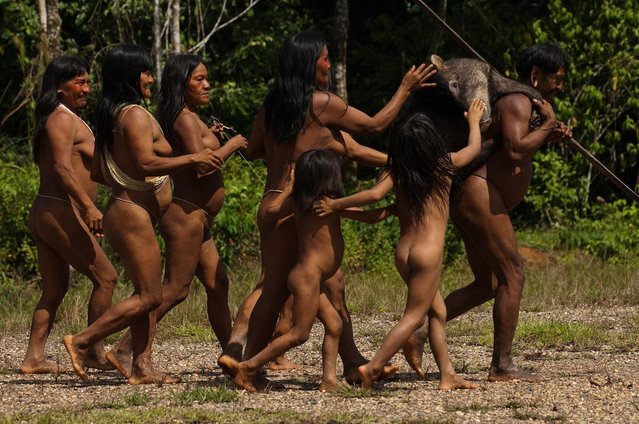
Spectacular images offering insight into the lives of the Huaorani people in the Ecuadorian Amazon have been revealed showing how they use traditional methods to hunt monkeys for food. The stunning pictures were taken by conservation photographer Pete Oxford from Torquay, Devon in the Ecuadorian Amazon. “The Huaorani Indians are a forest people highly in tune with their environment. Many are now totally acculturated since the 1950s by missionaries”, said Pete. “Today they face radical change to their culture to the proximity of oil exploration within their territory and the Yasuni National Park and Biosphere Reserve, they are vastly changed. Some still live very traditionally and for this shoot, through my Huaorani friend, a direct relative of those photographed he wanted to depict them as close to their original culture as possible. They still largely hunt with blow pipes and spears eating a lot of monkeys and peccaries”. The Huaorani are also known as the Waorani, Waodani or the Waos and are native Amerindians. Their lands are located between the Curaray and Napo rivers and speak the Huaorani language. Pete says that during his visit he was welcomed into the group and hopes that ancient cultures can be saved. Here: The tribe were seen celebrating after a hunter returned to camp with a wild pig. (Photo by Pete Oxford/Mediadrumworld.com)

Spectacular images offering insight into the lives of the Huaorani people in the Ecuadorian Amazon have been revealed showing how they use traditional methods to hunt monkeys for food. The stunning pictures were taken by conservation photographer Pete Oxford from Torquay, Devon in the Ecuadorian Amazon. Here: The tribe were seen celebrating after a hunter returned to camp with a wild pig. (Photo by Pete Oxford/Mediadrumworld.com)
Details
20 Jan 2017 07:58:00
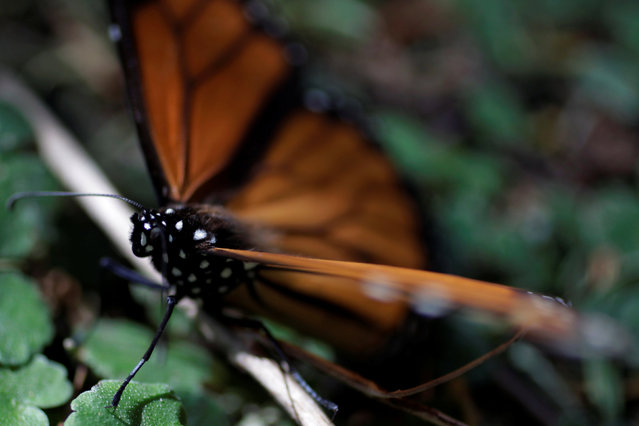
A monarch butterfly rests on the ground at the Sierra Chincua butterfly sanctuary on a mountain in Angangeo, Michoacan November 24, 2016. Angangueo is a town and municipality located in far eastern Michoacán state in central Mexico noted for its history of mining and its location in the Monarch Butterfly Biosphere Reserve. The Monarch Butterfly Biosphere Reserve is a World Heritage Site containing most of the over-wintering sites of the eastern population of the monarch butterfly. The reserve is located in the Trans-Mexican Volcanic Belt pine-oak forests ecoregion on the border of Michoacán and State of Mexico, 100 km (62 miles), northwest of Mexico City. Millions of butterflies arrive in the reserve annually. Butterflies only inhabit a fraction of the 56,000 hectares of the reserve from October–March. (Photo by Carlos Jasso/Reuters)

A monarch butterfly rests on the ground at the Sierra Chincua butterfly sanctuary on a mountain in Angangeo, Michoacan November 24, 2016. Angangueo is a town and municipality located in far eastern Michoacán state in central Mexico noted for its history of mining and its location in the Monarch Butterfly Biosphere Reserve. The Monarch Butterfly Biosphere Reserve is a World Heritage Site containing most of the over-wintering sites of the eastern population of the monarch butterfly. (Photo by Carlos Jasso/Reuters)
Details
26 Nov 2016 10:20:00
Aerial photo taken on April 20, 2018 shows the view of advection fog above Qingdao, a coastal city in east China' s Shandong Province. (Photo by Lu Hui/Xinhua News Agency/Eyevine)

Aerial photo taken on April 20, 2018 shows the view of advection fog above Qingdao, a coastal city in east China' s Shandong Province. (Photo by Lu Hui/Xinhua News Agency/Eyevine)
Details
19 May 2018 00:03:00
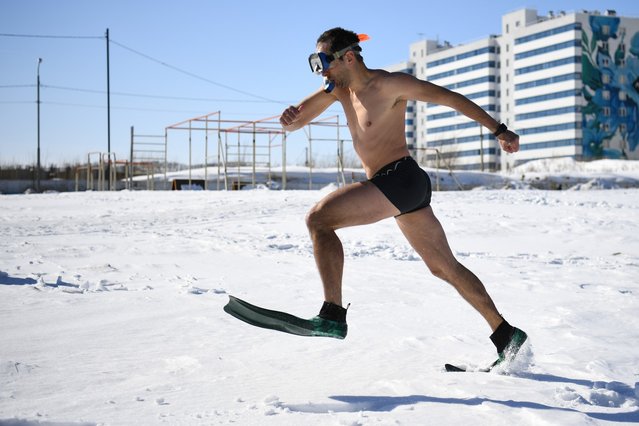
A member of a winter swimming club wears flippers during the celebration of Maslenitsa, also known as Pancake Week, a pagan holiday, marking the end of the winter, in Novosibirsk, Russia. (Photo by Alexandr Kryazhev/Sputnik/Profimedia)

A member of a winter swimming club wears flippers during the celebration of Maslenitsa, also known as Pancake Week, a pagan holiday, marking the end of the winter, in Novosibirsk, Russia. (Photo by Alexandr Kryazhev/Sputnik/Profimedia)
Details
15 Mar 2021 10:27:00
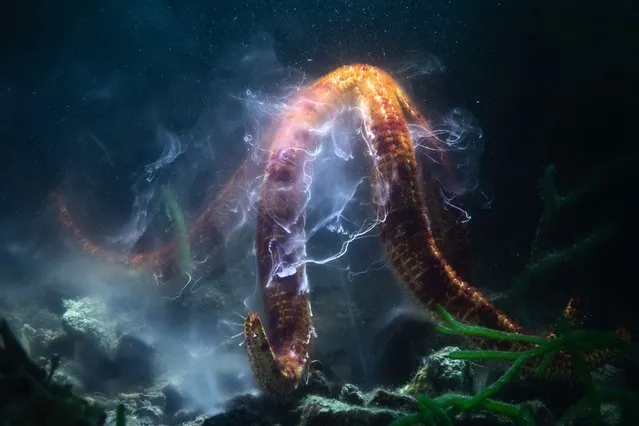
Shooting star by Tony Wu, US/Japan. Winner, underwater. The electrifying reproductive dance of a giant sea star. As the surrounding water filled with sperm and eggs from spawning sea stars, Wu faced several challenges. Stuck in a small, enclosed bay with only a macro lens for photographing small subjects, he backed up to squeeze the undulating sea star into his field of view. The dancing posture of spawning sea stars rising and swaying may help release eggs and sperm, or may help sweep the eggs and sperm into the currents where they fertilise together in the water. Kinko Bay, Japan. (Photo by Tony Wu/Wildlife Photographer of the Year)

Shooting star by Tony Wu, US/Japan. Winner, underwater. The electrifying reproductive dance of a giant sea star. As the surrounding water filled with sperm and eggs from spawning sea stars, Wu faced several challenges. Stuck in a small, enclosed bay with only a macro lens for photographing small subjects, he backed up to squeeze the undulating sea star into his field of view. The dancing posture of spawning sea stars rising and swaying may help release eggs and sperm, or may help sweep the eggs and sperm into the currents where they fertilise together in the water. Kinko Bay, Japan. (Photo by Tony Wu/Wildlife Photographer of the Year)
Details
15 Oct 2022 03:50:00
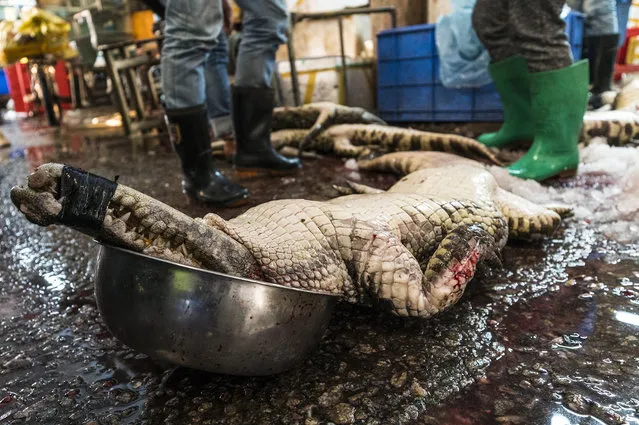
A dead crocodile is seen on Huangsha Seafood Market in Guangzhou, Guandong Province, China, 22 January 2018. Tsukiji Market of China or Huangsha Seafood Market is biggest one in Southern China and one of the biggest in China, as there are literally hundreds of different varieties of fish and seafood scattered throughout the market. Since the proximity of the fish market is so close to the Zhujiang River, it's quite easy for the large fishing vessels and fishermen to unload their fresh catch right at the market, which ensures that the fish and seafood remain fresh. Fish and other seafood are coming there from all around the globe. Seafood Market is full of different kinds of live fish, live shellfish, and live seafood on display in crystal clear tanks and it's common to see 5-star chefs, retailers and expats to source for fresh and high-quality seafood supplies for reasonable prices. While it is a wholesale fish market, since many Guangzhou restaurants and businesses come to purchase their seafood here, the public is welcome to come and even purchase. Many local Chinese have the vendors slice up fresh salmon fillets to take home or carry seafood into one of the nearby specialty restaurants, where they will cook if for them and serve it with vegetables and other side dishes of their choice. One of the biggest attractions for both, tourists and buyers, on market are crocodiles, which are brought there alive in wooden cases with taped jaws so they can?t accidentally bite. They are from crocodile farms from Guangdong, China and from Vietnam. Crocodile meat is popular in most Asian countries and it is consider as delicate one. Crocodiles weight from 10 to 25 kg and bigger ones are about 2 years old. They cost about 70 RMB (8.90 EURO) when bout as whole, or if you buy as parts most expensive and appreciated parts are paws 120 RMB (15.26 EURO) per kg, and tail 100 RMB (12.72 EURO) per kg. (Photo by Aleksandar Plavevski/EPA/EFE)

A dead crocodile is seen on Huangsha Seafood Market in Guangzhou, Guandong Province, China, 22 January 2018. Tsukiji Market of China or Huangsha Seafood Market is biggest one in Southern China and one of the biggest in China, as there are literally hundreds of different varieties of fish and seafood scattered throughout the market. (Photo by Aleksandar Plavevski/EPA/EFE)
Details
17 Apr 2020 00:05:00
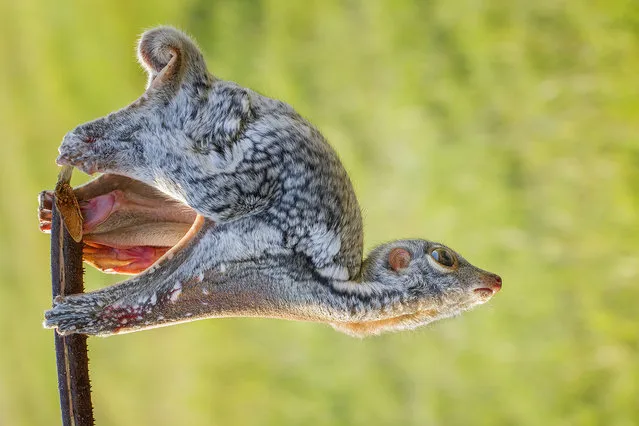
“Warming up”. This photo I capture in the early afternoon, the animal species of lemurs fly. Photo location: Sambas, West Kalimantan, Indonesia. (Photo and caption by Hendy Mp/National Geographic Photo Contest)

“Warming up”. This photo I capture in the early afternoon, the animal species of lemurs fly. Photo location: Sambas, West Kalimantan, Indonesia. (Photo and caption by Hendy Mp/National Geographic Photo Contest)
Details
03 Oct 2014 11:52:00