Loading...
Done
Journalists (L) walk along the new Caminito del Rey (The King's Little Pathway) in El Chorro-Alora, near Malaga, southern Spain March 15, 2015. (Photo by Jon Nazca/Reuters)

Journalists (L) walk along the new Caminito del Rey (The King's Little Pathway) in El Chorro-Alora, near Malaga, southern Spain March 15, 2015. Dubbed by many media outlets as the world's scariest pathway, the three-kilometre long pathway, which was built at about 100 metres (330 ft) above the gorge of Los Gaitanes between the years of 1901 and 1905, was closed in 2001 after five people died. A new walkway has then been built over the old walkway and will open to the public on March 28, 2015. (Photo by Jon Nazca/Reuters)
Details
16 Mar 2015 09:56:00
Spring - Autumn By Cue Qozop

People don’t realize how much our exterior can affect our mood. If we make ourselves smile, we might feel a little better, yet if we frown, we soon get the irresistible urge to listen to Blues and weep over the days long gone. The same goes for our clothing. Many people, especially the elderly, tend to dress in the same old rags, without ever feeling the need to change something about their appearance. However, as Cue Qozop clearly demonstrates in his Spring – Autumn photoset, clothes can completely alter the appearance and the mood of the wearer. Elderly people dressed in young people’s clothes look much younger and happier. They look as if they are full of vigor and are about to set out on an amazing adventure.
Details
09 Apr 2015 09:50:00
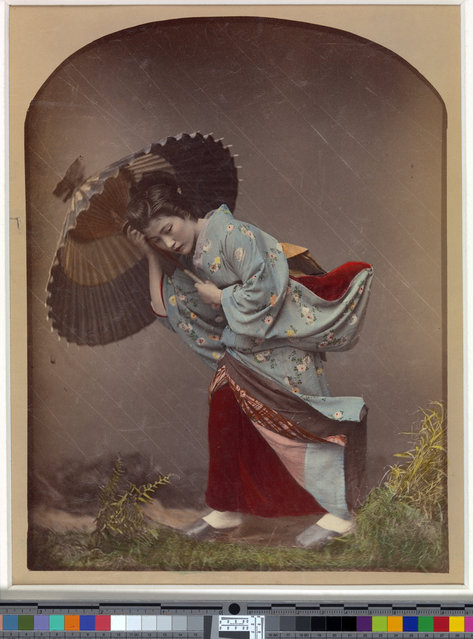
“Woman with Umbrella in Rain” by Raimund von Stillfried. Artist: Kusakabe Kimbei (Japanese, 1841–1934), 1870s. (Photo courtesy of The Metropolitan Museum of Art)

“Woman with Umbrella in Rain” by Raimund von Stillfried. Artist: Kusakabe Kimbei (Japanese, 1841–1934), 1870s. Commercial photography studios in Meiji-era Japan were renowned for the subtlety and refinement of their coloring techniques. This hand-tinted image of a young woman caught in a heavy rainstorm achieved its naturalistic effect by knitting together multiple strands of artifice: the greenery in the foreground was a studio prop; the flaps of the kimono were suspended by thin wires to create the impression of a strong wind; and long, diagonal marks were made on the negative to suggest streaks of rain. (Photo courtesy of The Metropolitan Museum of Art)
Details
12 May 2013 10:13:00


“Chameleons (family Chamaeleonidae) are a distinctive and highly specialized clade of lizards. They are distinguished by their parrot-like zygodactylous feet, their separately mobile and stereoscopic eyes, their very long, highly modified, and rapidly extrudable tongues, their swaying gait, the possession by many of a prehensile tail, crests or horns on their distinctively shaped heads, and the ability of some to change color. Uniquely adapted for climbing and visual hunting, the approximately 160 species of chameleon range from Africa, Madagascar, Spain and Portugal, across south Asia, to Sri Lanka, have been introduced to Hawaii, California and Florida, and are found in warm habitats that vary from rain forest to desert conditions”. – Wikipedia

Photo: A woman with the latest fashion accessory, a chameleon. (Photo by Fox Photos/Getty Images). Circa 1926
Details
20 Mar 2011 15:45:00


“The red panda (Ailurus fulgens, or shining-cat), is a small arboreal mammal native to the eastern Himalayas and southwestern China. It is the only species of the genus Ailurus. Slightly larger than a domestic cat, it has reddish-brown fur, a long, shaggy tail, and a waddling gait due to its shorter front legs. It feeds mainly on bamboo, but is omnivorous and may also eat eggs, birds, insects, and small mammals. It is a solitary animal, mainly active from dusk to dawn, and is largely sedentary during the day”. – Wikipedia

Photo: In this handout image provided by Taronga Zoo, Seba, a baby Red Panda, explores his new home at Taronga Zoo on April 7, 2011 in Sydney, Australia. The Red Panda cub was born at Christmas and is the 45th to be born at the zoo since 1977. (Photo by Peter Hardin/Taronga Zoo via Getty Images)
Details
07 Apr 2011 08:51:00
A U.S. Air Force SR-71A, also known as the Blackbird, is put through it's paces during a test flight

“The Lockheed SR-71 “Blackbird” was an advanced, long-range, Mach 3+ strategic reconnaissance aircraft. It was developed as a black project from the Lockheed A-12 reconnaissance aircraft in the 1960s by the Lockheed Skunk Works. Clarence “Kelly” Johnson was responsible for many of the design's innovative concepts. During reconnaissance missions the SR-71 operated at high speeds and altitudes to allow it to outrace threats. If a surface-to-air missile launch was detected, the standard evasive action was simply to accelerate and outrun the missile”. – Wikipedia

Photo: A U.S. Air Force SR-71A, also known as the “Blackbird”, is put through it's paces during a test flight over Beale Air Force Base in California. The aircraft is a strategic reconnaissance plane by Lockheed and is the world's fastest and highest flying operational aircraft. (Photo by Getty Images)
Details
07 Sep 2011 12:17:00
Ophiocordyceps Sinensis A.K.A. Caterpillar Fungus

“There are over 680 documented species of the sac fungus genus Ophiocordyceps, and one of the best known of these is Ophiocordyceps sinensis, colloquially known as caterpillar fungus. The fungus is known in Tibetan as yartsa gunbu or yatsa gunbu. O. sinensis is known in the West as a medicinal mushroom and its use has a long history in Traditional Chinese medicine as well as Traditional Tibetan medicine. The highly valuable fungus-caterpillar combination is hand-collected and is used as an aphrodisiac and as a treatment for a variety of ailments from fatigue to cancer”. – Wikipedia

Photo: Nomads dig for Chinese caterpillar fungus from a mountain May 25, 2007 in Guide County, Hainan Prefecture, Qinghai Province, China. Nomads can earn about 2,000 yuan to 5,000 yuan (about U.S. $260 to $653 ) through their work during the fifty-day Chinese caterpillar fungus gathering season. (Photo by China Photos/Getty Images)
Details
26 Sep 2011 10:47:00
Keep your eyes peeled: A Chinese teenager slipped and stabbed himself in the face with a 7cm knife while peeling an apple. Ren Hanzhi's father recalled: “He was walking to the sofa while peeling the apple. Suddenly he slipped down and his face hit onto the sharp knife. I dared not pull out the knife as my son was screaming”. (Photo by Rex Features)

Keep your eyes peeled: A Chinese teenager slipped and stabbed himself in the face with a 7cm knife while peeling an apple. Ren Hanzhi's father recalled: “He was walking to the sofa while peeling the apple. Suddenly he slipped down and his face hit onto the sharp knife. I dared not pull out the knife as my son was screaming”. The nearest hospital referred the 13-year-old to a larger unit. Chief surgeon Peng Liwei, who operated to remove the knife, commented: “It's shocking. The knife, which is more than 20cm long, penetrated 7cm into his face. The surgery was successful and the patient could recover fully in around a month”. (Photo by Rex Features)
Details
27 Jun 2014 10:43:00