Loading...
Done
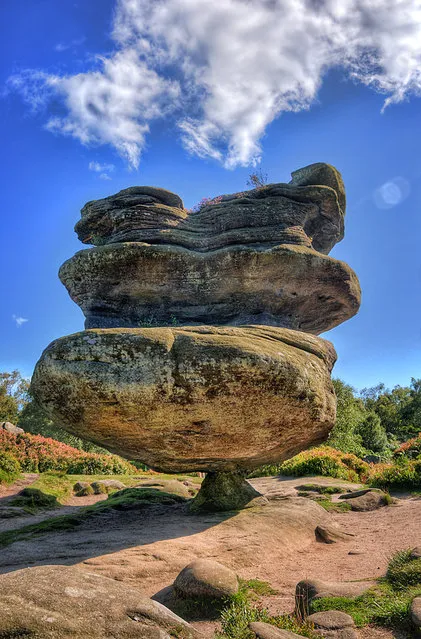
Brimham rocks, Nidderdale North Yorkshire, England

“A balancing rock, also called balanced rock or precarious boulder, is a naturally occurring geological formation featuring a large rock or boulder, sometimes of substantial size, resting on other rocks, bedrock or on glacial till. Some formations known by this name only appear to be balancing but are in fact firmly connected to a base rock by a pedestal or stem”. – Wikipedia

Photo: “The Brimham Rocks are balancing rock formations located on Brimham Moor in North Yorkshire, England. The rocks stand at a height of nearly 30 metres in an area owned by the National Trust which is part of the Nidderdale Area of Outstanding Natural Beauty”. – Wikipedia. (Photo by Tee Time Tony)
Details
06 May 2012 11:45:00
An erotic danser picks up fake 2-dollar bills during a private dance with a Yakuza customer in a strip tease bar in Kabukicho, a bar which is controlled by the ODO family – 2010. (Photo and caption by Anton Kusters)

The Belgian photographer Anton Kusters spent two years photographing the Yakuza, Japan’s most notorious gang. He returned with some amazing images that he made into a book called “Odo Yakuza Tokyo”. (Odo means “the way of the cherry blossom” and is the credo of the Yakuza family he followed. Photo: An erotic danser picks up fake 2-dollar bills during a private dance with a Yakuza customer in a strip tease bar in Kabukicho, a bar which is controlled by the ODO family – 2010. (Photo and caption by Anton Kusters)
Details
31 Aug 2014 08:42:00
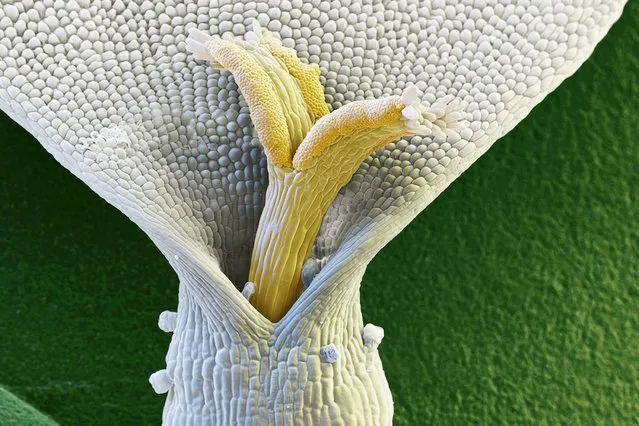
Scanning electron micrograph (SEM) of an Arabidopsis thaliana flower, also commonly known as thale cress. Some of the anthers are open, revealing pollen grains ready for dispersal. Arabidopsis was the first plant to have its entire genome sequenced and is widely used as a model organism in molecular and plant biology. Horizontal width of image is 1200 microns. Magnification 100x. (Photo by Stefan Eberhard/Wellcome Images)

Beautiful, strange and occasionally alarming pictures from the shortlist for this year’s Wellcome image awards – which celebrate the very best in science photography and imaging – from an x-ray of a bat to a micrograph of a kidney stone. The exhibition opens on 12 March at three science centres and the Museum of Science and Industry in Manchester. Photo: Scanning electron micrograph (SEM) of an Arabidopsis thaliana flower, also commonly known as thale cress. Some of the anthers are open, revealing pollen grains ready for dispersal. Arabidopsis was the first plant to have its entire genome sequenced and is widely used as a model organism in molecular and plant biology. Horizontal width of image is 1200 microns. Magnification 100x. (Photo by Stefan Eberhard/Wellcome Images)
Details
11 Mar 2014 05:58:00
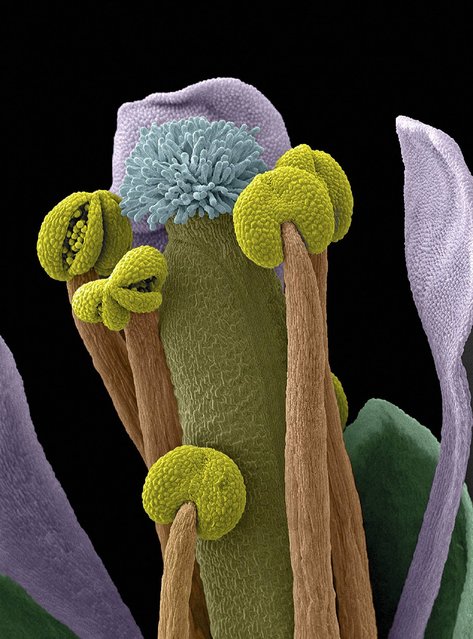
The floret of a Chamomile flower up close and personal. (Photo by Oliver Meckes/Barcroft Media)

These images have been created using a colour scanning electron microscope (SEM) by the award-winning Eye of Science, comprised of snapper Oliver Meckes and biologist Nicole Ottawa. For a decade the pair, based in Reutlingen in the south of Germany, worked with an old SEM they saved from the scrapheap, but for the last five years they have used a £250,000 FEI Quanta Series Field Emission SEM. Oliver said: “Flowers are beautiful in 'normal' view, but when you look closer, some parts get very bizarre and unexpected structures appear – flowers within flowers, worlds within worlds”. Photo: The floret of a Chamomile flower up close and personal. (Photo by Oliver Meckes/Barcroft Media)
Details
26 May 2014 13:51:00
Screenshot of Krystle and Hernan, taken on a foot mounted GoPro. (Photo by Krystle Wright/Caters News)

“Daredevil photographer Krystle Wright suffered a catalogue of injuries after an accident on a shoot in Pakistan. The 26-year-old was left with internal bruising, tendon damage, two fractures, a torn ligament and 10 stitches above her eye following the horrific fall in the Himalayas. Wright took to the air on a dual paraglider and flew at a stomach-churning 18,000 feet to capture the incredible images. But as she neared the end of her trip Wright hit a bolder and blacked out following a bad take-off. The keen photographer, from Queensland, Australia, has travelled the world shooting some of the most awe-inspiring extreme sport stunts”. – Caters News. Photo: Screenshot of Krystle and Hernan, taken on a foot mounted GoPro. (Photo by Krystle Wright/Caters News)
Details
10 Dec 2013 07:45:00
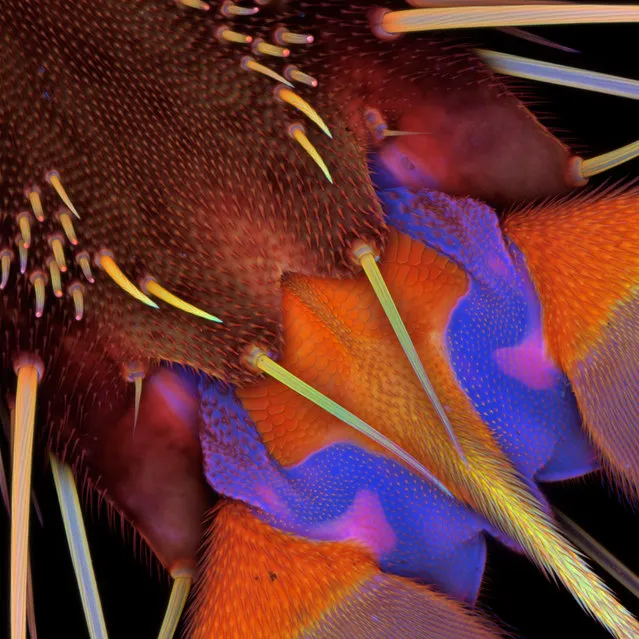
Pretarsus of the third leg of a female drone fly (Eristalis tenax), ventral view, by Dr. Jan Michels, Institute of Zoology, Christian-Albrechts-University of Kiel, Germany. (Photo by Olympus BioScapes)

“Microscope images forge an extraordinary bond between science and art, said Hidenao Tsuchiya, Olympus America's Vice President and General Manager for the Scientific Equipment Group. We founded this competition to focus on the fascinating stories coming out of today's life science research laboratories. The thousands of images that people have shared with the competition over the years reflect some of the most exciting work going on in research today – work that can help shed light on the living universe and ultimately save lives. We look at BioScapes and these beautiful images as sources of education and inspiration to us and the world”. – OlympusBioScapes

Photo: Pretarsus of the third leg of a female drone fly (Eristalis tenax), ventral view, by Dr. Jan Michels, Institute of Zoology, Christian-Albrechts-University of Kiel, Germany. (Photo by Olympus BioScapes)
Details
29 Jul 2012 09:20:00
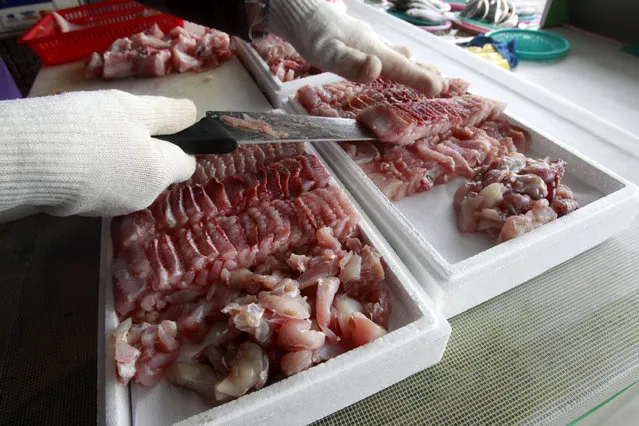
In this February 19, 2014 photo, a skate seller puts slices of skate into styrofoam boxes for shipment to customers around South Korea at a fish market in Mokpo, a port city on the southwestern tip of the Korean Peninsula. The aroma of one of southwestern South Korea's most popular delicacies regularly gets compared to rotting garbage and filthy bathrooms. (Photo by Ahn Young-joon/AP Photo)

In this February 19, 2014 photo, a skate seller puts slices of skate into styrofoam boxes for shipment to customers around South Korea at a fish market in Mokpo, a port city on the southwestern tip of the Korean Peninsula. The aroma of one of southwestern South Korea's most popular delicacies regularly gets compared to rotting garbage and filthy bathrooms. And that's by fans. The unusual dish is typically made by taking dozens of fresh skate, a cartilage-rich fish that looks like a stingray, stacking them up in a walk-in refrigerator and waiting. Up to a month in some cases. (Photo by Ahn Young-joon/AP Photo)
Details
11 Apr 2014 07:41:00
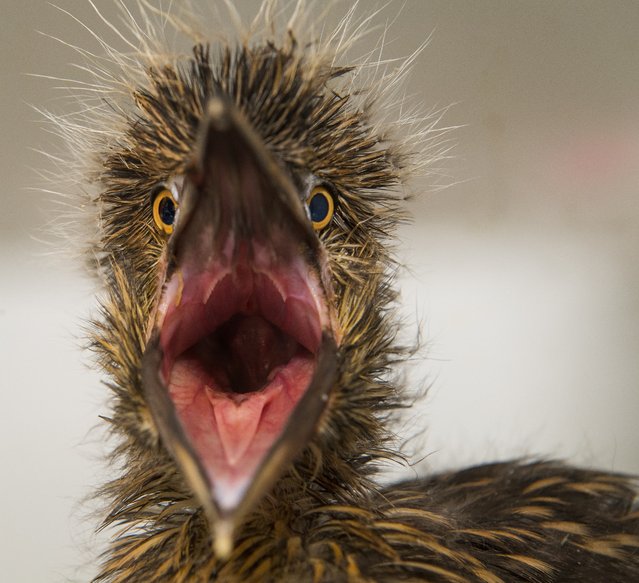
A baby Black-crowned Night Heron squawks in its incubator while being cared for at City Wildlife rescue and rehabilitation center in Washington, DC on May 31, 2017. The heron is one of several that have been brought to CW by the staff at The National Zoo over the past few years. The heron is a native bird and has made an established rookery inside the zoo grounds over a hundred years ago.  Every year at this time, some of the chicks get pushed or fall out of the nest and require human care.  Because the birds are native and not part of the Smithsonian collection, they partnered with CW to rehabilitate the herons for re-release back to the flock inside Zoo. They're reintroduced back to their flock so that they can migrate together in the Fall. The Black-crowned heron usually migrates from the DC area down to southeast North Carolina, some going as far as Jacksonville, FL in winter. The Black-crowned heron is the species of greatest conservation need in the District of Columbia because their numbers are in such rapid decline due to habitat loss. (Photo Linda Davidson/The Washington Post)

A baby Black-crowned Night Heron squawks in its incubator while being cared for at City Wildlife rescue and rehabilitation center in Washington, DC on May 31, 2017. The heron is one of several that have been brought to CW by the staff at The National Zoo over the past few years. (Photo Linda Davidson/The Washington Post)
Details
04 Jun 2017 08:04:00