Loading...
Done
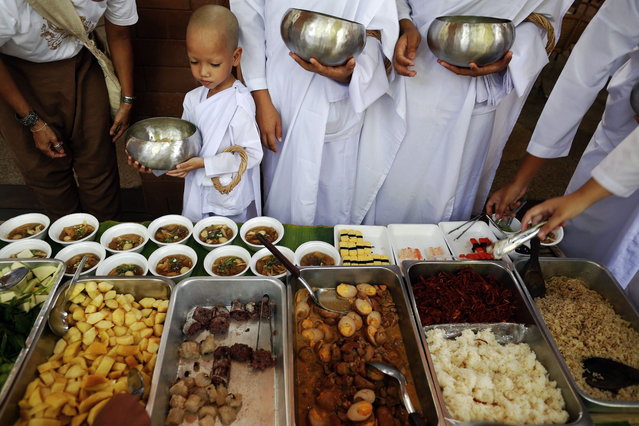
A girl joins other novice nuns for a lunch at the Sathira-Dhammasathan Buddhist meditation centre in Bangkok April 21, 2013. A group of Thai girls are choosing to spend part of their school holidays as Buddhist nuns, down to having their heads shaven at the meditation centre. The centre, founded in 1987, is a learning community for peace and harmony that has programs open to people regardless of age and gender. (Photo by Damir Sagolj/Reuters)

A girl joins other novice nuns for a lunch at the Sathira-Dhammasathan Buddhist meditation centre in Bangkok April 21, 2013. A group of Thai girls are choosing to spend part of their school holidays as Buddhist nuns, down to having their heads shaven at the meditation centre. The centre, founded in 1987, is a learning community for peace and harmony that has programs open to people regardless of age and gender. (Photo by Damir Sagolj/Reuters)
Details
25 Apr 2013 12:41:00
Guinness World Records World's Largest Nachos

“Nachos are a popular corn based food of Mexican origin associated with Tex-Mex cuisine that can be either made quickly to serve as a snack or prepared with more ingredients to make a full meal. In their simplest form, nachos are tortilla chips or totopos covered in melted cheese and salsa. First created circa 1943 by Ignacio "Nacho" Anaya, the original nachos consisted of fried corn tortillas covered with melted cheddar cheese and pickled jalapeño peppers”. – Wikipedia

Photo: Workers put the finishing touches on the nachos as Ninety Nine Restaurants in Billerica, Massachusetts set a new world record by creating the Guinness World Records World's Largest Nachos, weighing in at 3,999 lbs on October 1, 2011 in Billerica, Massachusetts. (Photo by Gail Oskin/Getty Images for Ninety Nine Restaurants)
Details
03 Oct 2011 09:31:00
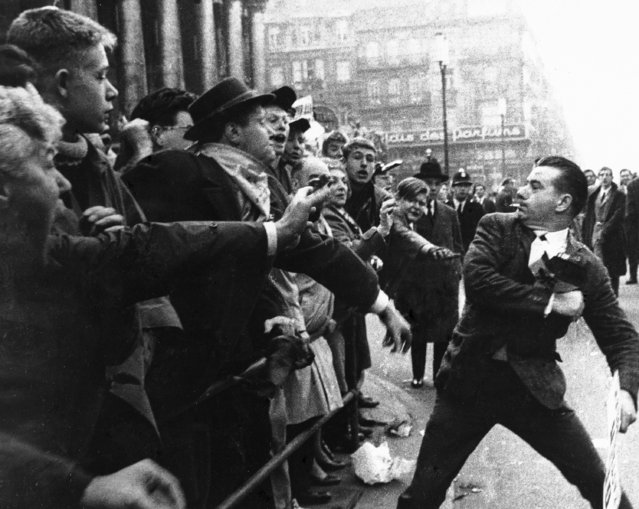
A Flemish demonstrator, one of thousands who gathered for a march through Brussels to protest against what the Flemings call their subjucation by the French-speaking Walloons, draws back as he is jeered by a crowd of Walloons on the pavement in a Brussels Street, on October 14, 1962. The Flemish demonstrators clashed with Walloon counter demonstrators as riot police sought to maintain order. (Photo by AP Photo)

A Flemish demonstrator, one of thousands who gathered for a march through Brussels to protest against what the Flemings call their subjucation by the French-speaking Walloons, draws back as he is jeered by a crowd of Walloons on the pavement in a Brussels Street, on October 14, 1962. The Flemish demonstrators clashed with Walloon counter demonstrators as riot police sought to maintain order. The Flemings claim that although they form 60% of the population in Belgium, they are inadequately represented in the government, and they say, the Walloons get most of the top jobs in the armed forces and the diplomatic service. (Photo by AP Photo)
Details
16 Oct 2015 08:05:00
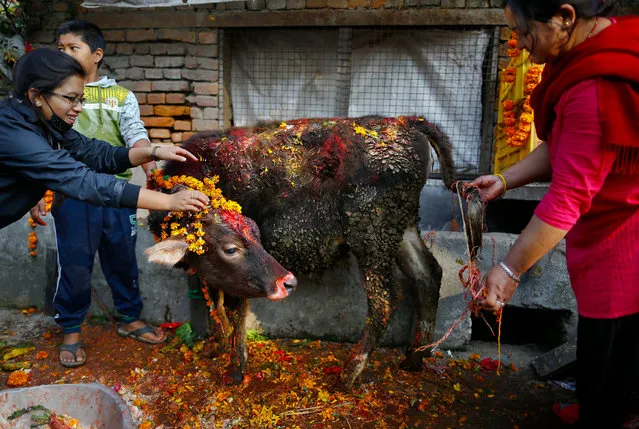
A Nepalese devotee bows in front of a cow during the 'Gai Puja', also known as the Cow Worship Day, as part of the Tihar festival in Kathmandu, Nepal, 11 November 2015. The Tihar festival is the second most important event for Nepalese Hindus. During the celebrations people worship cows, considered the incarnation of Lord Laxmi, the god of wealth. (Photo by Narendra Shrestha/EPA)

A Nepalese devotee bows in front of a cow during the 'Gai Puja', also known as the Cow Worship Day, as part of the Tihar festival in Kathmandu, Nepal, 11 November 2015. The Tihar festival is the second most important event for Nepalese Hindus. During the celebrations people worship cows, considered the incarnation of Lord Laxmi, the god of wealth. (Photo by Narendra Shrestha/EPA)
Details
14 Nov 2015 08:05:00
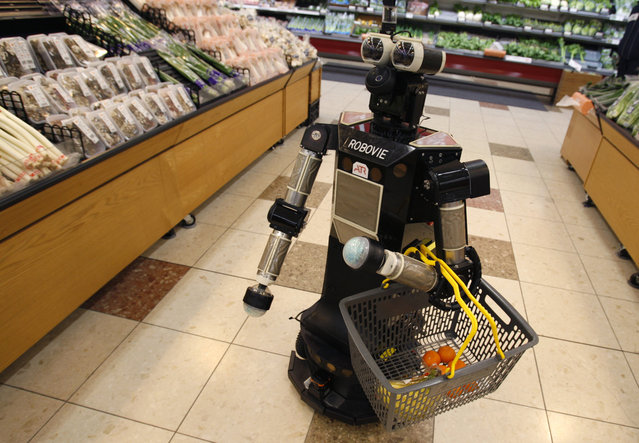
A robot named “Robovie-II”, developed by Japanese robotics research institution ATR, moves around at a grocery store during a shopping assisting experiment by utilizing the robot in an ubiquitous network technology platform in Kyoto, western Japan January 6, 2010. The robot greets the shopper at the entrance of the store, follows him to the shelves while holding a grocery basket and reminds him of the items on a shopping list, which the shopper would have entered beforehand in a specialized mobile device. The experiment is aimed to gather data in order to provide livelihood support for the elderly by using robots and network technologies, ATR's researcher Satoshi Koizumi said. (Photo by Yuriko Nakao/Reuters)

A robot named “Robovie-II”, developed by Japanese robotics research institution ATR, moves around at a grocery store during a shopping assisting experiment by utilizing the robot in an ubiquitous network technology platform in Kyoto, western Japan January 6, 2010. (Photo by Yuriko Nakao/Reuters)
Details
02 Feb 2018 06:54:00
A delegate poses for a photo at the end of the closing ceremony of the 20th National Congress of the Chinese Communist Party in front of the Great Hall of the People in Beijing, China, on Saturday, October 22, 2022. President Xi Jinping is officially set for a third term surrounded by allies, after key Communist Party officials without close ties to the Chinese leader exited the nation's top leadership body. (Photo by Bloomberg)

A delegate poses for a photo at the end of the closing ceremony of the 20th National Congress of the Chinese Communist Party in front of the Great Hall of the People in Beijing, China, on Saturday, October 22, 2022. President Xi Jinping is officially set for a third term surrounded by allies, after key Communist Party officials without close ties to the Chinese leader exited the nation's top leadership body. (Photo by Bloomberg)
Details
31 Oct 2022 04:22:00
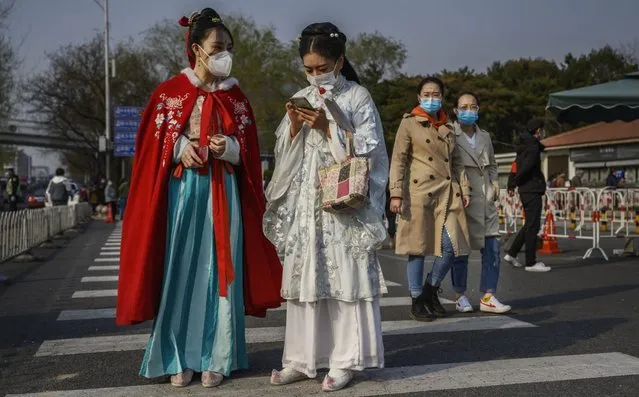
Chinese women wear protective masks as they are dressed in traditional clothing from the Qing Dynasty era outside a park on March 29, 2020 in Beijing, China. A limited section of the iconic tourist site was re-opened to the public this week allowing a smaller number of visitors to reserve tickets online in advance and to enter after passing health screening. With the pandemic hitting hard across the world, China recorded its first day with no new domestic cases of the coronavirus last week, since the government imposed sweeping measures to keep the disease from spreading. For two months, millions of people across China have been restricted in how they move from their homes, while other cities have been locked down in ways that appeared severe at the time but are now being replicated in other countries trying to contain the virus. Officials believe the worst appears to be over in China, though there are concerns of another wave of infections as the government attempts to reboot the worlds second largest economy. In Beijing, it is mandatory to wear masks outdoors, retail stores operate on reduced hours, restaurants employ social distancing among patrons, and tourist attractions at risk of drawing large crowds remain closed. Monitoring and enforcement of virus-related measures and the quarantine of anyone arriving to Beijing is carried out by neighborhood committees and a network of Communist Party volunteers who wear red arm bands. A primary concern for Chinese authorities remains the arrival of flights from Europe and elsewhere, given the exposure of passengers in regions now regarded as hotbeds for transmission. Since January, China has recorded more than 81,000 cases of COVID-19 and at least 3200 deaths, mostly in and around the city of Wuhan, in central Hubei province, where the outbreak first started. (Photo by Kevin Frayer/Getty Images)

Chinese women wear protective masks as they are dressed in traditional clothing from the Qing Dynasty era outside a park on March 29, 2020 in Beijing, China. A limited section of the iconic tourist site was re-opened to the public this week allowing a smaller number of visitors to reserve tickets online in advance and to enter after passing health screening. (Photo by Kevin Frayer/Getty Images)
Details
01 Apr 2020 00:05:00
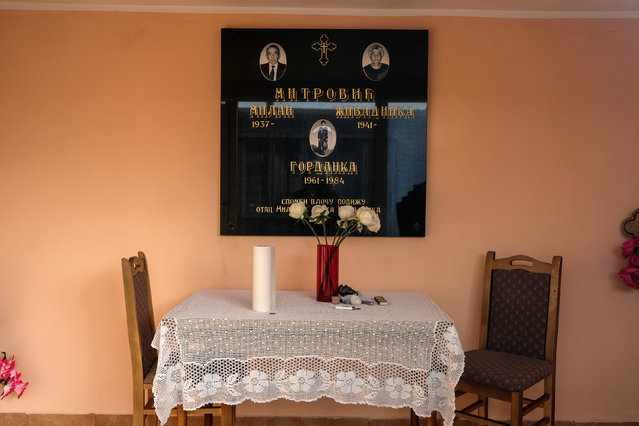
Pictures of deceased people are seen inside a chapel at a cemetery in the village of Smoljinac, Serbia, October 25, 2016. (Photo by Marko Djurica/Reuters)

Pictures of deceased people are seen inside a chapel at a cemetery in the village of Smoljinac, Serbia, October 25, 2016. From a distance, the cemetery in the eastern Serbian village of Smoljinac looks like a residential neighbourhood eerily placed among graves. But once inside the grounds, after passing a section with the usual stone slabs, visitors find rows of small bungalows painted in pastel colours. They have one or two rooms, large windows and ornate plaques – some inside, some outside – memorialising the deceased. These are the burial chapels of Smoljinac, cosy cabins with a furnished room inside, a storage place for wreaths and funeral paraphernalia, and the family crypt below. Some even have electric power inside. (Photo by Marko Djurica/Reuters)
Details
12 Nov 2016 10:37:00