Loading...
Done
A model presents a creation from The Blonds during New York Fashion Week Fall-Winter 2025 in New York City, U.S., February 8, 2025. (Photo by David Dee Delgado/Reuters)

A model presents a creation from The Blonds during New York Fashion Week Fall-Winter 2025 in New York City, U.S., February 8, 2025. (Photo by David Dee Delgado/Reuters)
Details
20 Feb 2025 04:24:00
A dancer plays with fire during Lunar New Year of the Dragon celebrations at Binondo, the Chinatown of Manila, Philippines, on February 10, 2024. (Photo by Eloisa Lopez/Reuters)

A dancer plays with fire during Lunar New Year of the Dragon celebrations at Binondo, the Chinatown of Manila, Philippines, on February 10, 2024. (Photo by Eloisa Lopez/Reuters)
Details
19 May 2025 02:52:00
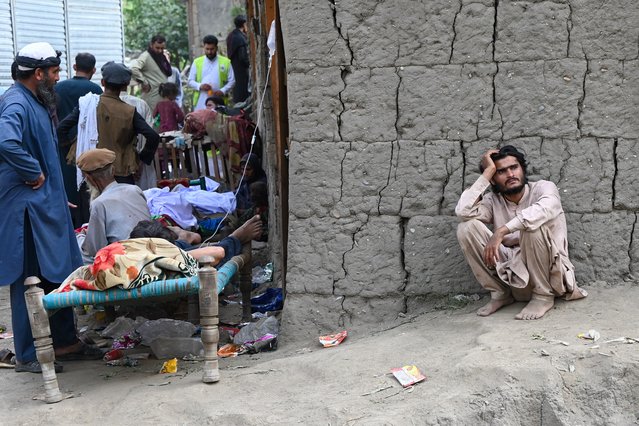
An Afghan man mourns outside a damaged house, after earthquakes at Mazar Dara village in Nurgal district, Kunar province, in Eastern Afghanistan, on September 1, 2025. (Photo by Wakil Kohsar/AFP Photo)

An Afghan man mourns outside a damaged house, after earthquakes at Mazar Dara village in Nurgal district, Kunar province, in Eastern Afghanistan, on September 1, 2025. (Photo by Wakil Kohsar/AFP Photo)
Details
11 Sep 2025 04:09:00
Ebiowei, 48, carries an empty oil container on his head to a place where it would be filled with refined fuel at an illegal refinery site near river Nun in Nigeria's oil state of Bayelsa November 27, 2012. (Photo by Akintunde Akinleye/Reuters)

Ebiowei, 48, carries an empty oil container on his head to a place where it would be filled with refined fuel at an illegal refinery site near river Nun in Nigeria's oil state of Bayelsa November 27, 2012. Locals in the industry say workers can earn $50 to $60 a day. Thousands of people in Nigeria engage in a practice known locally as “oil bunkering” – hacking into pipelines to steal crude then refining it or selling it abroad. The practice, which leaves oil spewing from pipelines for miles around, managed to lift around a fifth of Nigeria's two million barrel a day production last year according to the finance ministry. (Photo by Akintunde Akinleye/Reuters)

Details
18 Jan 2013 14:29:00
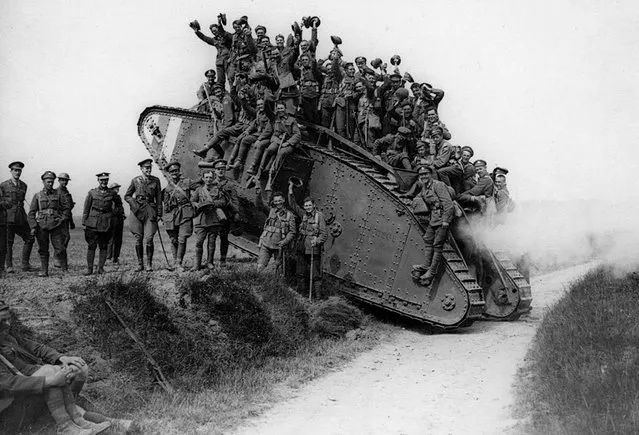
These black-and-white photos are taken from the new book “Armoured Warfare in the First World War 1916 – 1918” by Anthony Tucker-Jones and published by Pen & Sword Military. “Interestingly the British, French and Germans took completely different approaches with varying results”. The British military produced “Little Willie” in Autumn 1915 weighing 18 tonnes, which had a crew of two plus four gunners. “Inspired by a tracked artillery tractor “Little Willie” was referred to as a water tank – hence the name tank – to ensure secrecy”, said Anthony. “This led to the strange looking Mark I with its peculiar rhomboid shape, designed to cross trenches with guns in sponsons on either side. The Germans saw the tank as unchivalrous and were slow to grasp its utility. They favoured the Stormtrooper (specialist soldiers used to infiltrate enemy trenches) and artillery, not the tank”, said Anthony. “However, they didn’t hesitate to make use of captured British tanks. Although the tank helped secure victory and German soldiers dubbed it “Germany’s Downfall” the country was ultimately brought to its knees by the Allies blockade”. Here: British troops hitch a ride on a Mark IV after the massed tank fleet spearheading attack at Cambrai on November 20, 1917. (Photo by Anthony Tucker-Jones/Mediadrumworld.com)

These black-and-white photos are taken from the new book “Armoured Warfare in the First World War 1916 – 1918” by Anthony Tucker-Jones and published by Pen & Sword Military. Here: British troops hitch a ride on a Mark IV after the massed tank fleet spearheading attack at Cambrai on November 20, 1917. (Photo by Anthony Tucker-Jones/Mediadrumworld.com)
Details
23 Feb 2017 00:02:00
Fireplace for children, Trondheim, Norway, by Haugen/Zohar. The children of Trondheim come to sit around the fire and tell stories in this whimsical cone hut, made with materials recycled from a construction site. (Photo by Jason Havneraas/The Guardian)

Fireplace for children, Trondheim, Norway, by Haugen/Zohar. The children of Trondheim come to sit around the fire and tell stories in this whimsical cone hut, made with materials recycled from a construction site. (Photo by Jason Havneraas/The Guardian)
Details
17 Mar 2017 00:04:00
On Dale A. Browne’s first trip to Yellowstone, he “got the best shot” he’d ever taken after chasing this weasel for 30 minutes. The trip for the 58-year-old from Manassas, Va., was a gift from his wife and an opportunity to improve his photography skills with the help of guide and professional photographer Tom Murphy. (Murphy did not assist in the taking of this photo). (Photo by Dale A. Browne)

On Dale A. Browne’s first trip to Yellowstone, he “got the best shot” he’d ever taken after chasing this weasel for 30 minutes. The trip for the 58-year-old from Manassas, Va., was a gift from his wife and an opportunity to improve his photography skills with the help of guide and professional photographer Tom Murphy. (Murphy did not assist in the taking of this photo). (Photo by Dale A. Browne)
Details
26 Jul 2016 10:31:00
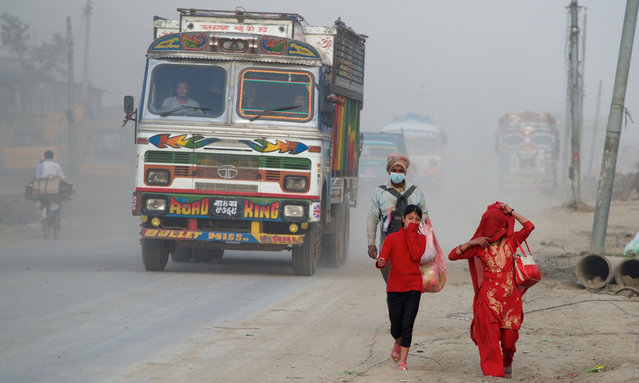
People in Kathmandu joke that the face mask has now become part of the national dress – an indispensable accessory in an effort to protect themselves from the dust. Nepal has the worst air quality in the world, according to the Environmental Performance Index. (Photo by Pete Pattisson/The Guardian)

People in Kathmandu joke that the face mask has now become part of the national dress – an indispensable accessory in an effort to protect themselves from the dust. Nepal has the worst air quality in the world, according to the Environmental Performance Index. (Photo by Pete Pattisson/The Guardian)
Details
22 Jun 2018 00:05:00