An armed police officer attends an explosive ordnance disposal training on April 12, 2022 in Nanning, Guangxi Zhuang Autonomous Region of China. (Photo by Yu Haiyang/VCG via Getty Images)
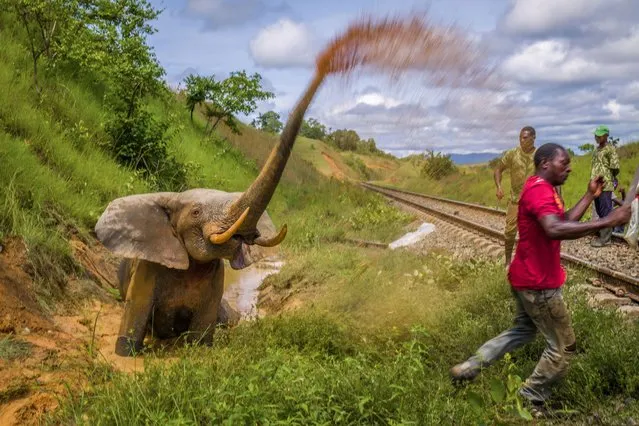
Grand prize winner: environmental photographer of the year 2023; also 1st place in the humanity v nature category; and winner of the 2023 public award. Lopé national park, Gabon, 2021. An angry elephant tries to defend itself after it was hit by a train that crosses paths the animals use within Lopé national park. Park officials decided the elephant was too severely injured to be saved. After it was killed, the park director distributed the meat to local people. As the forest loses its carrying capacity to sustain its megafauna, this kind of human-wildlife conflict is increasing. (Photo by Jasper Doest/Environmental Photography Award)
Female soldiers of Tigray Defence Force (TDF) celebrate while they sit on men's shoulders as people celebrate their return on a street in Mekele, the capital of Tigray region, Ethiopia, on June 29, 2021. Rebel fighters in Ethiopia's war-hit Tigray seized control of more territory on June 29, 2021, one day after retaking the local capital and vowing to drive all “enemies” out of the region. (Photo by Yasuyoshi Chiba/AFP Photo)
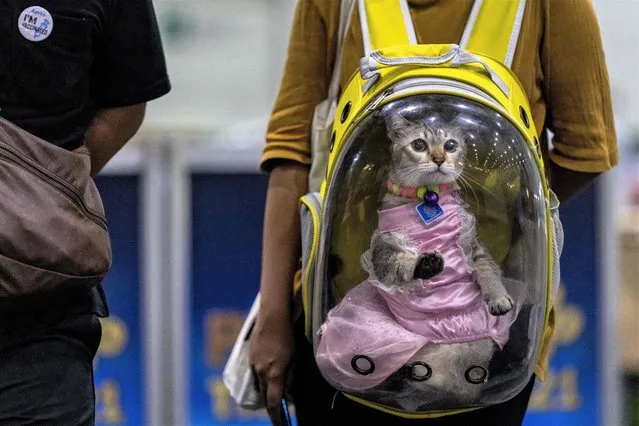
A cat wearing a dress is carried around in a transparent rucksack at the annual Pet Expo Thailand 2021 in Bangkok on November 25, 2021. (Photo by Jack Taylor/AFP Photo)
An NHS worker walks past a banner supporting NHS staff outside Salford Royal Hospital on March 22, 2020 in Manchester, UK. Coronavirus (COVID-19) has spread to at least 182 countries, claiming over 13,069 lives and infecting more than 308,592 people. There have now been 5,018 diagnosed cases in the UK and 233 deaths. (Photo by Anthony Devlin/Getty Images)
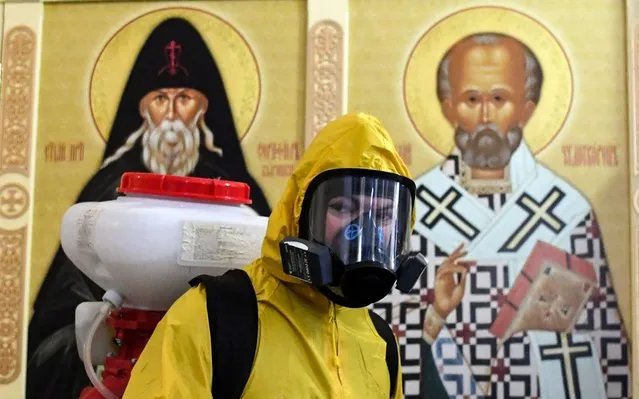
A serviceman of Russia's Emergencies Ministry wearing protective gear disinfects Moscow's Leningradsky railway station on May 19, 2020, amid the COVID-19 coronavirus pandemic. (Photo by Kirill Kudryavtsev/AFP Photo)
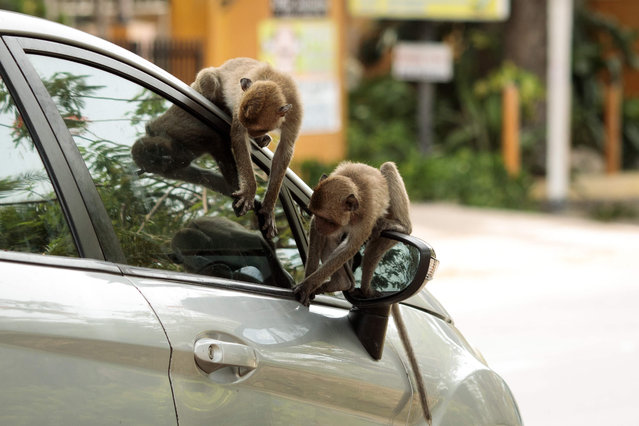
Macaque monkeys sit on a car in Hua Hin on May 29, 2020, as low tourist numbers due to the ongoing COVID-19 novel coronavirus situation have resulted in a decrease in the number of people feeding them. The monkeys in the town are going hungry as a consequence of the drop in tourism as a result of the COVID-19 coronavirus pandemic. (Photo by Jack Taylor/AFP Photo)