Loading...
Done
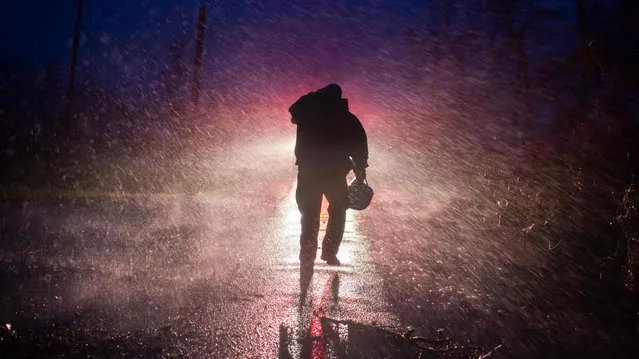
Montegut fire chief Toby Henry walks back to his fire truck in the rain as firefighters cut through trees on the road in Bourg, Louisiana as Hurricane Ida passes on August 29, 2021. Hurricane Ida struck the coast of Louisiana on August 29 as a powerful Category 4 storm, 16 years to the day after deadly Hurricane Katrina devastated the southern US city of New Orleans. “Extremely dangerous Category 4 Hurricane Ida makes landfall near Port Fourchon, Louisiana”, the National Hurricane Center wrote in an advisory. (Photo by Mark Felix/AFP Photo)

Montegut fire chief Toby Henry walks back to his fire truck in the rain as firefighters cut through trees on the road in Bourg, Louisiana as Hurricane Ida passes on August 29, 2021. Hurricane Ida struck the coast of Louisiana on August 29 as a powerful Category 4 storm, 16 years to the day after deadly Hurricane Katrina devastated the southern US city of New Orleans. “Extremely dangerous Category 4 Hurricane Ida makes landfall near Port Fourchon, Louisiana”, the National Hurricane Center wrote in an advisory. (Photo by Mark Felix/AFP Photo)
Details
28 Sep 2021 08:03:00
Birds behaviour winner: Land of the Eagle by Audun Rikardsen, Norway. High on a ledge, on the coast near his home in northern Norway, Rikardsen carefully positioned an old tree branch that he hoped would make a perfect golden eagle lookout. To this, he bolted a tripod head with a camera, flashes and motion sensor attached, and built himself a hide a short distance away. From time to time, he left road‑kill carrion nearby. Very gradually – over the next three years – a golden eagle got used to the camera and started to use the branch regularly to survey the coast below. (Photo by Audun Rikardsen/2019 Wildlife Photographer of the Year)

Birds behaviour winner: Land of the Eagle by Audun Rikardsen, Norway. High on a ledge, on the coast near his home in northern Norway, Rikardsen carefully positioned an old tree branch that he hoped would make a perfect golden eagle lookout. To this, he bolted a tripod head with a camera, flashes and motion sensor attached, and built himself a hide a short distance away. From time to time, he left road‑kill carrion nearby. Very gradually – over the next three years – a golden eagle got used to the camera and started to use the branch regularly to survey the coast below. (Photo by Audun Rikardsen/2019 Wildlife Photographer of the Year)
Details
17 Oct 2019 00:03:00
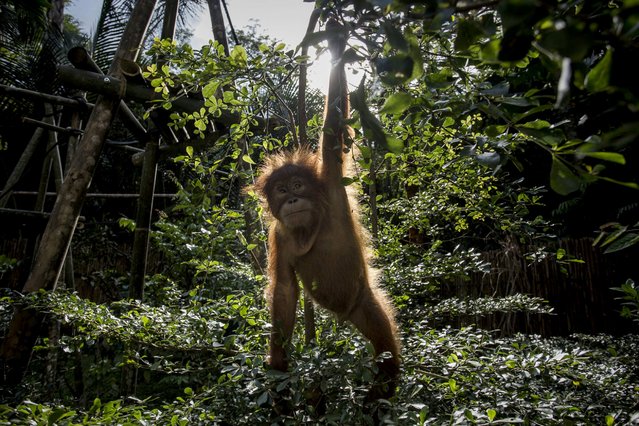
A Baby sumatran orangutan (Pongo abelii) plays around in a tree as they train at Sumatran Orangutan Conservation Programme's rehabilitation center on November 12, 2016 in Kuta Mbelin, North Sumatra, Indonesia. The Orangutans in Indonesia have been known to be on the verge of extinction as a result of deforestation and poaching. Found mostly in South-East Asia, where they live on the islands of Sumatra and Borneo, the endangered species continue to lose their habitat as a result of corporate expansion in a developing economy. Indonesia approved palm oil concessions on nearly 15 million acres of peatlands over the past years and thousands of square miles have been cleared for plantations, including the lowland areas that are the prime habitat for orangutans. (Photo by Ulet Ifansasti/Getty Images)

A Baby sumatran orangutan (Pongo abelii) plays around in a tree as they train at Sumatran Orangutan Conservation Programme's rehabilitation center on November 12, 2016 in Kuta Mbelin, North Sumatra, Indonesia. The Orangutans in Indonesia have been known to be on the verge of extinction as a result of deforestation and poaching. Found mostly in South-East Asia, where they live on the islands of Sumatra and Borneo, the endangered species continue to lose their habitat as a result of corporate expansion in a developing economy. Indonesia approved palm oil concessions on nearly 15 million acres of peatlands over the past years and thousands of square miles have been cleared for plantations, including the lowland areas that are the prime habitat for orangutans. (Photo by Ulet Ifansasti/Getty Images)
Details
16 Nov 2016 11:14:00
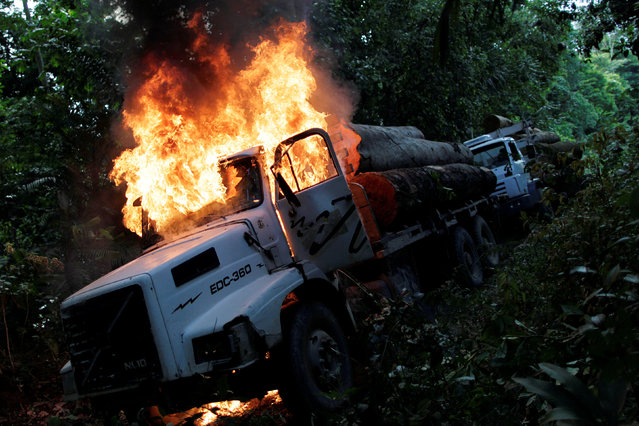
Trucks loaded with tree trunks are burned by agents of the Brazilian Institute for the Environment and Renewable Natural Resources, or Ibama, during an operation to combat illegal mining and logging, in the municipality of Novo Progresso, Para State, northern Brazil, November 11, 2016. When able to do their job, agents of the Brazilian Institute for the Environment and Renewable Natural Resources, or Ibama, are decisive, punishing illegal loggers on the spot. Nearly twice the size of India, the Amazon absorbs an estimated 2 billion tonnes of carbon dioxide per year, making its preservation vital in the fight to halt global warming. Ibama, responsible for preserving Brazil's 65 percent share of the world's largest rainforest, is one of the most important groups in that fight. But after years of surprising success, the rate of deforestation is on the rise again. Over the past four years it has risen 35 percent, as Ibama suffered from a lack of funding amid Brazil's worst recession in a century. (Photo by Ueslei Marcelino/Reuters)

Trucks loaded with tree trunks are burned by agents of the Brazilian Institute for the Environment and Renewable Natural Resources, or Ibama, during an operation to combat illegal mining and logging, in the municipality of Novo Progresso, Para State, northern Brazil, November 11, 2016. When able to do their job, agents of the Brazilian Institute for the Environment and Renewable Natural Resources, or Ibama, are decisive, punishing illegal loggers on the spot. Nearly twice the size of India, the Amazon absorbs an estimated 2 billion tonnes of carbon dioxide per year, making its preservation vital in the fight to halt global warming. (Photo by Ueslei Marcelino/Reuters)
Details
30 Nov 2016 12:36:00
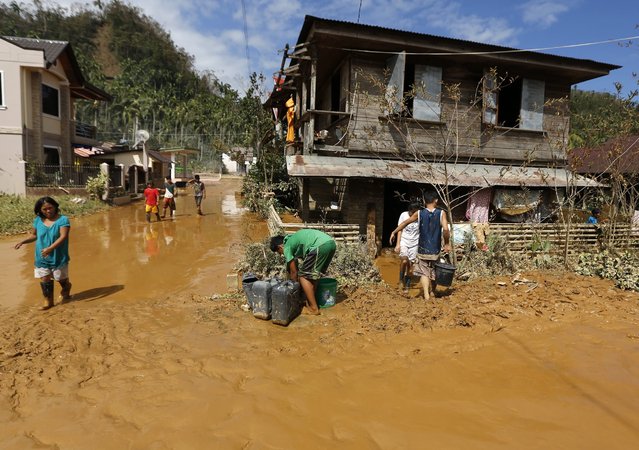
Filipino typhoon victims walk through heavy mud in the typhoon hit town of Taft, Samar island, Philippines, 08 December 2014. Typhoon Hagupit weakened into a tropical storm as it moved towards the Philippine capital after killing at least 27 people and displacing more than one million people in the eastern and central provinces. (Photo by Francis R. Malasig/EPA)

Filipino typhoon victims walk through heavy mud in the typhoon hit town of Taft, Samar island, Philippines, 08 December 2014. Typhoon Hagupit weakened into a tropical storm as it moved towards the Philippine capital after killing at least 27 people and displacing more than one million people in the eastern and central provinces. Hagupit slammed into the country's eastern coast on 06 December evening, bringing heavy rains and gale-force winds that flattened homes, ripped off roofs, and knocked out power and communications. (Photo by Francis R. Malasig/EPA)
Details
10 Dec 2014 11:37:00
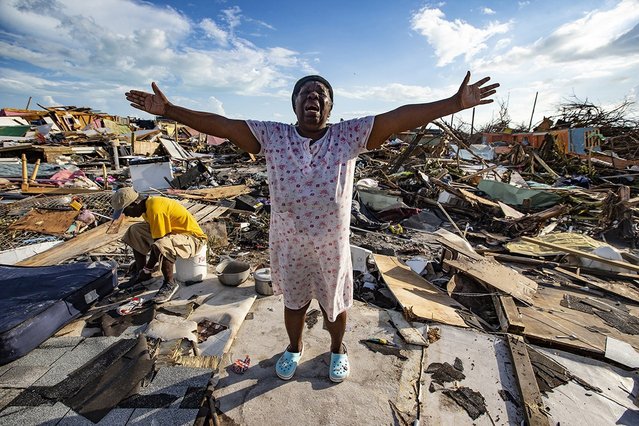
Aliana Alexis of Haiti stands on the concrete slab of what is left of her home after destruction from Hurricane Dorian in an area called “The Mud” at Marsh Harbour in Great Abaco Island, Bahamas on September 5, 2019. (Photo by Al Diaz/Zuma Press via AFP Photo)

Aliana Alexis of Haiti stands on the concrete slab of what is left of her home after destruction from Hurricane Dorian in an area called “The Mud” at Marsh Harbour in Great Abaco Island, Bahamas on September 5, 2019. Hurricane Dorian lashed the Carolinas with driving rain and fierce winds as it neared the US east coast Thursday after devastating the Bahamas and killing at least 20 people. (Photo by Al Diaz/Zuma Press via AFP Photo)
Details
07 Sep 2019 00:05:00
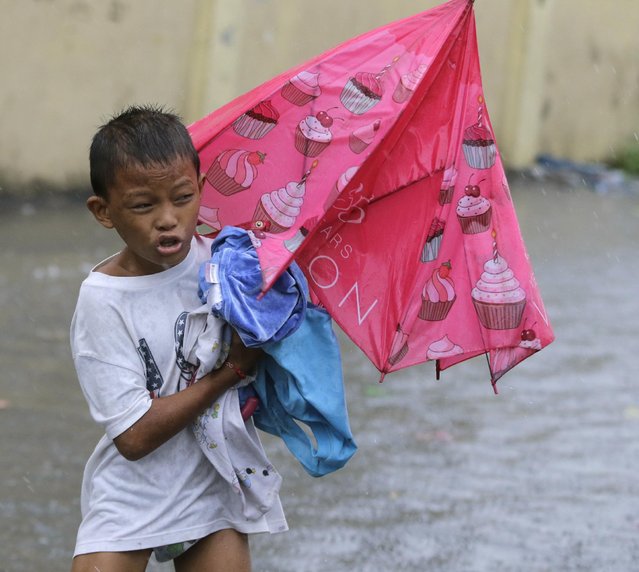
A boy evacuates to safer grounds at the onslaught of Typhoon Rammasun (locally known as Glenda) which battered the city Wednesday, July 16, 2014, in Manila, Philippines. (Photo by Bullit Marquez/AP Photo)

A boy evacuates to safer grounds at the onslaught of Typhoon Rammasun (locally known as Glenda) which battered the city Wednesday, July 16, 2014, in Manila, Philippines. (Photo by Bullit Marquez/AP Photo)
Details
17 Jul 2014 12:05:00
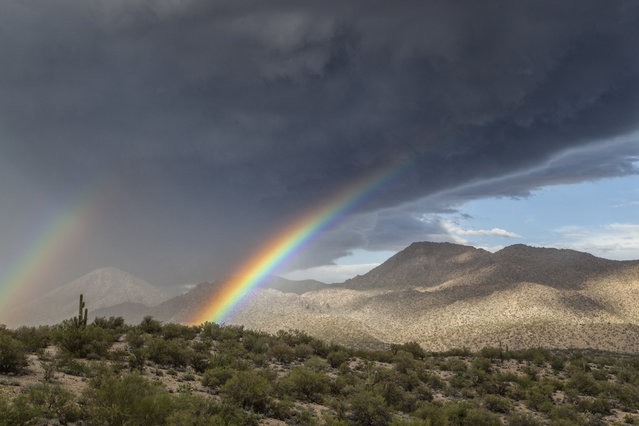
Two rainbows emerge from a black storm above the mountains, on August 19, 2014, in Kingman, Arizona.  Double tornadoes, lightning storms and rotating supercells – this is what it's like to chase storms for a year.(Photo by Roger Hill/Barcroft Media)

Two rainbows emerge from a black storm above the mountains, on August 19, 2014, in Kingman, Arizona. Double tornadoes, lightning storms and rotating supercells – this is what it's like to chase storms for a year. These dramatic images show apocalyptic weather throughout 2014 from a lightning storm to a pair of rainbows. Roger Hill, 57, has been chasing storms in the United States for thirty years and runs a tour operation with his wife Caryn. His favourite photograph of the year was also one of the most difficult to get – as two violent tornadoes tore through Pilger, Nebraska on June 16. The spiraling winds killed a five-year-old girl and injured at least 19 others, and as Roger tried to get the perfect shot debris began to rain down on his car. (Photo by Roger Hill/Barcroft Media)
Details
25 Feb 2015 09:27:00