Loading...
Done
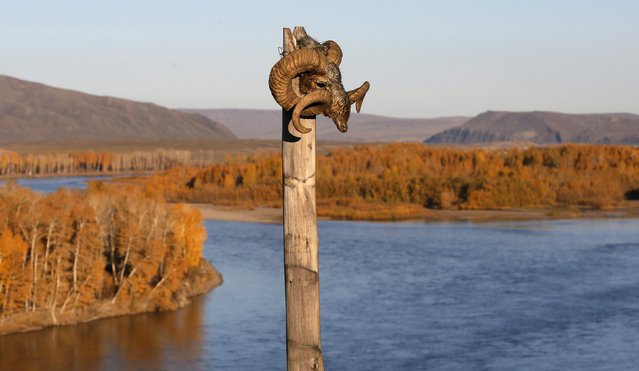
The head of a mountain ram is attached to a wooden column at the site used for shamans' rituals in the Aldyn Bulak area on the bank of the Yenisei River during sunset outside the village of Elegest, Tuva region, Southern Siberia, Russia, October 7, 2015. (Photo by Ilya Naymushin/Reuters)

The head of a mountain ram is attached to a wooden column at the site used for shamans' rituals in the Aldyn Bulak area on the bank of the Yenisei River during sunset outside the village of Elegest, Tuva region, Southern Siberia, Russia, October 7, 2015. The region is inhabited by Tuvans, historically cattle-herding nomads, who nowadays practise two main confessions – Buddhism and Shamanism. (Photo by Ilya Naymushin/Reuters)
Details
19 Oct 2015 08:05:00
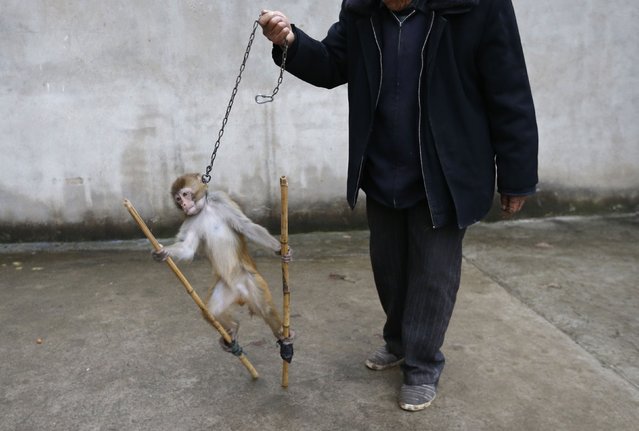
A monkey is led by its trainer Qi Defang during training for a circus in Suzhou, Anhui province, November 29, 2014. (Photo by William Hong/Reuters)

A monkey is led by its trainer Qi Defang during training for a circus in Suzhou, Anhui province, November 29, 2014. Suzhou is known as the hometown of circus troupes in China and has more than 300 circus troupes. (Photo by William Hong/Reuters)
Details
06 Dec 2014 12:21:00
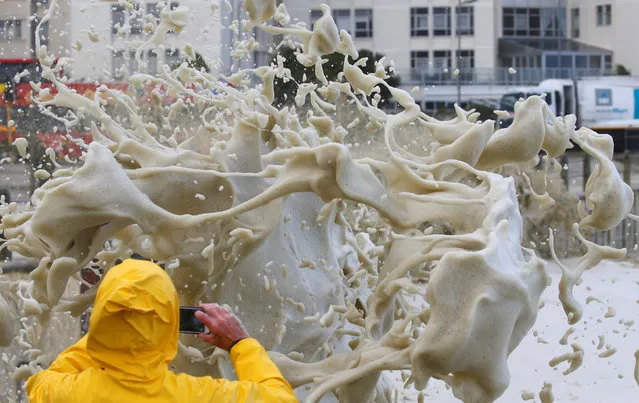
A man takes a picture of sea spray as storms hit Cape Town, South Africa, June 7, 2017. (Photo by Mike Hutchings/Reuters)

A man takes a picture of sea spray as storms hit Cape Town, South Africa, June 7, 2017. (Photo by Mike Hutchings/Reuters)
Details
10 Jun 2017 08:44:00
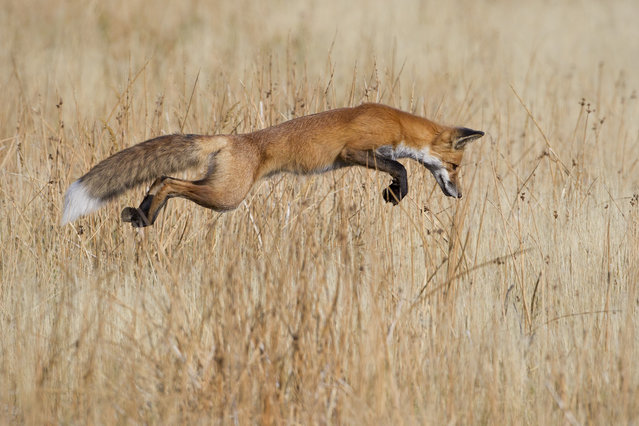
Canada: “Lucky pounce”. (Photo by Connor Stefanison/Wildlife Photographer of the Year 2013)

The winners of The London’s Natural History Museum's prestigious Wildlife Photographer of the Year for 2013 have finally been unveiled. Selected from almost 43,000 entries from 96 countries, the winners offer a glimpse of the stunning array of natural beauty on our planet. Photo: Canada: “Lucky pounce”. “Anticipating the pounce – that was the hardest part”, says Connor, who had come to Yellowstone National Park, Wyoming, USA, in search of wildlife as much as the spectacular landscape. He had found this fox, his first ever, on his last day in the park. It was so absorbed in hunting that Connor had plenty of time to get out of the car and settle behind a rock. It quartered the grassland, back and forth, and then started staring intently at a patch of ground, giving Connor just enough warning of the action to come. When it sprung up, Connor got his shot. And when it landed, the fox got his mouse. (Photo by Connor Stefanison/Wildlife Photographer of the Year 2013)

Details
17 Oct 2013 08:12:00
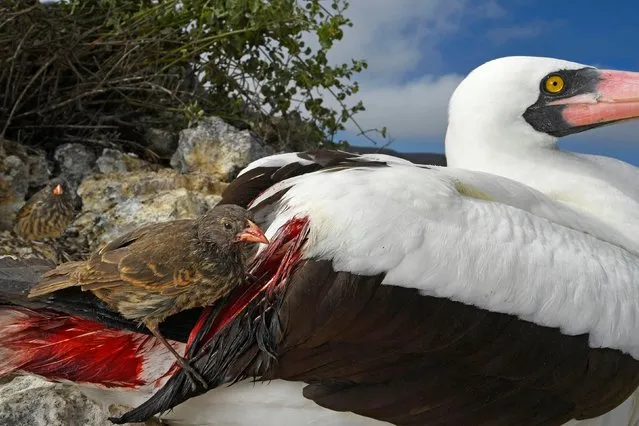
Bloodthirsty by Thomas P Peschak, Germany/South Africa — winner, Behaviour: birds. When rations run short on Wolf Island, in the remote northern Galápagos, the sharp-beaked ground finches become vampires. Their sitting targets are Nazca boobies and other large birds. The finches rely on a scant diet of seeds and insects, which regularly dries up, so they drink blood to survive. ‘I’ve seen more than half a dozen finches drinking from a single Nazca booby,’ says Tom. Rather than leave their nests the boobies tolerate the vampires, and the blood loss doesn’t seem to cause permanent harm. (Photo by Thomas P Peschak/2018 Wildlife Photographer of the Year)

Bloodthirsty by Thomas P. Peschak, Germany/South Africa — winner, Behaviour: birds. When rations run short on Wolf Island, in the remote northern Galápagos, the sharp-beaked ground finches become vampires. Their sitting targets are Nazca boobies and other large birds. The finches rely on a scant diet of seeds and insects, which regularly dries up, so they drink blood to survive. ‘I’ve seen more than half a dozen finches drinking from a single Nazca booby,’ says Tom. Rather than leave their nests the boobies tolerate the vampires, and the blood loss doesn’t seem to cause permanent harm. (Photo by Thomas P. Peschak/2018 Wildlife Photographer of the Year)
Details
19 Oct 2018 00:05:00


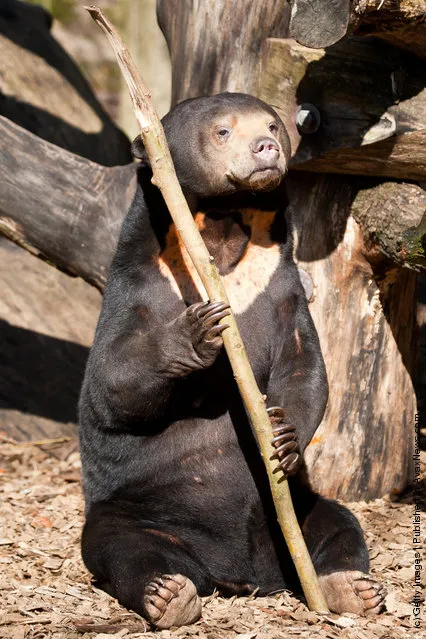
The sun bear (Ursus malayanus), also known as the honey bear, is a bear found primarily in the tropical rainforest (the dense lowland forests) in Southeast Asia; North-East India, Bangladesh, Myanmar, Thailand, Laos, Cambodia, Vietnam, Southern China, Peninsular Malaysia, and the islands of Sumatra and Borneo.
Details
03 May 2012 23:37:00
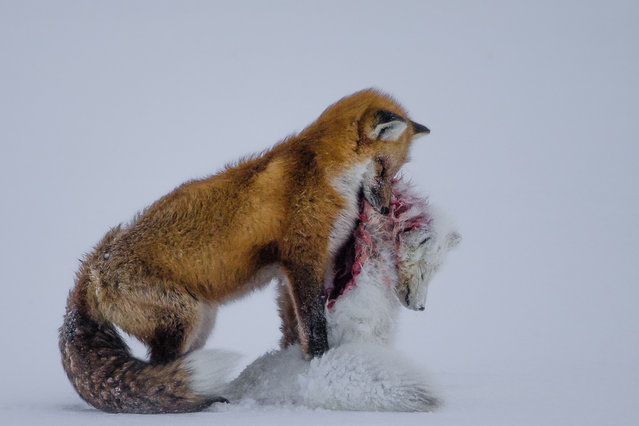
A tale of two foxes. Surprising behaviour, witnessed in Wapusk national park, on Hudson Bay, Canada, in early winter. Red foxes don’t actively hunt Arctic foxes, but where the ranges of two predators overlap, there can be conflict. Though the light was poor, the snow-covered tundra provided the backdrop for the moment that the red fox paused with the smaller fox in its mouth in a grim pose. (Photo by Don Gutoski/2015 Wildlife Photographer of the Year)

A tale of two foxes. Surprising behaviour, witnessed in Wapusk national park, on Hudson Bay, Canada, in early winter. Red foxes don’t actively hunt Arctic foxes, but where the ranges of two predators overlap, there can be conflict. Though the light was poor, the snow-covered tundra provided the backdrop for the moment that the red fox paused with the smaller fox in its mouth in a grim pose. (Photo by Don Gutoski/2015 Wildlife Photographer of the Year)
Details
20 Oct 2015 08:02:00
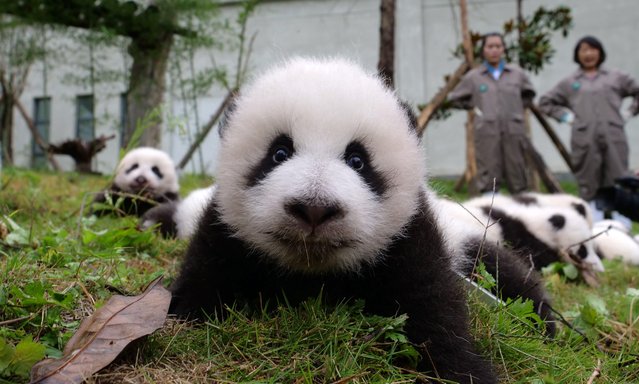
19 giant panda cubs, all born this year, meet the public at the Shenshuping Base of the China Conservation and Research Centre for the Giant Panda on October 13, 2017 in Ngawa Tibetan and Qiang Autonomous Prefecture, China. So far China Conservation and Research Centre for the Giant Panda has successfully bred 42 giant pandas this year. (Photo by VCG/VCG via Getty Images)

19 giant panda cubs, all born this year, meet the public at the Shenshuping Base of the China Conservation and Research Centre for the Giant Panda on October 13, 2017 in Ngawa Tibetan and Qiang Autonomous Prefecture, China. So far China Conservation and Research Centre for the Giant Panda has successfully bred 42 giant pandas this year. (Photo by VCG/VCG via Getty Images)
Details
15 Oct 2017 08:17:00