Loading...
Done
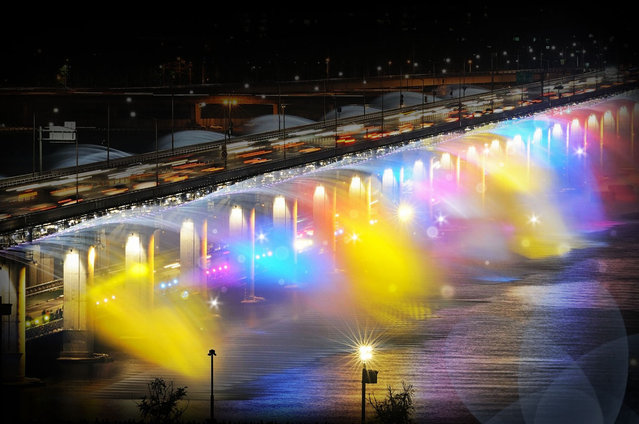
Moonlight Rainbow Fountain In Seoul South Korea

The Moonlight Rainbow Fountain is the world's longest bridge fountain that set a Guinness World Record with nearly 10,000 LED nozzles that run along both sides that is 1,140m long, shooting out 190 tons of water per minute. Installed in September 2009 on the Banpo Bridge, former mayor of Seoul Oh Se-hoon declared that the bridge will further beautify the city and showcase Seoul's eco-friendliness, as the water is pumped directly from the river itself and continuously recycled. The bridge has 38 water pumps and 380 nozzles on either side, which draw 190 tons of water per minute from the river 20 meters below the deck, and shoots as far as 43 meters horizontally.
Details
25 Jan 2014 18:48:00
Nicole Londraville works on aerial silks at Esh Circus Arts, a circus school and training center offering recreational circus instruction, in Somerville, Massachusetts May 7, 2014. (Photo by Brian Snyder/Reuters)

Movement is the essence and meaning of our life. We feel so much more alive when we are in motion, while people who spend hours motionless tend to have trouble connecting with the outside world. Whether you dive from a high cliff, play your favorite sport, dance at a rave party, or simply walk down a path with autumn leaves rustling under your feet with the love of your life by your side, all those things make your life richer, more beautiful, and more fulfilling. This set of pictures beautifully captures the joy of never-ending motion that enriches our life. (Photo by Brian Snyder/Reuters)
Details
16 Oct 2014 13:50:00
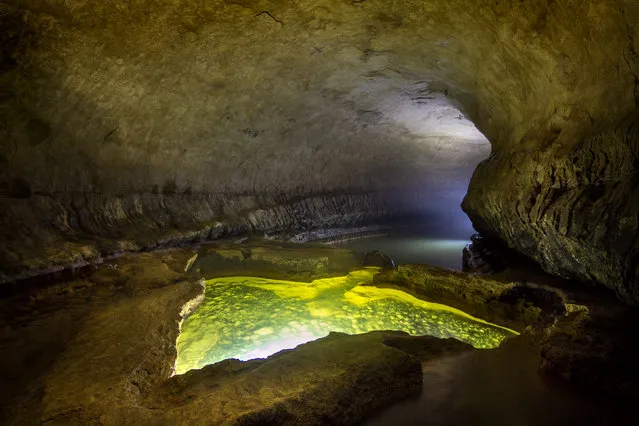
A large pool of water inside one of the tunnels. (Photo by Vladimir Mulde/Caters News)

These otherworldly images give a rare glimpse inside caves barely ever seen by the human eye. With its peculiar pools of water and strange colored sediments, the bizarre looking tunnels of the Shakuranskaya cave could be a set straight out of a science fiction film. Found in the disputed region of Abkhazia, around 75 miles outside of Sochi, Russia, it is rumored the incredible underground chambers were formed after a huge earthquake struck the area in 1892. After causing part of a nearby mountain to collapse into the Amtkel River, it is thought the dam-like affect has created a series of interconnecting underground tunnels. Here: a large pool of water inside one of the tunnels. (Photo by Vladimir Mulde/Caters News)
Details
07 Nov 2014 12:45:00
Magical Contamination By Antoine Bridier-Nahmias

Modern art is truly fascinating. Not in a way that it produces some novel things that will fascinate future generations for decades and even centuries to come. No, that is very far from the truth. On the contrary, modern art is essentially anything (yes, any little thing) that is a bit unusual and was created by a famous person. Let’s take the creation of Antoine Bridier-Nahmias for example. His brainchild is a set of pictures of petri dishes that were contaminated by various cultures of fungi. If this is art, I missed my chance of becoming famous when I accidentally left a piece of bread in a bag in a cupboard for about six months, and didn’t take a picture of the rather shocking results that awaited me when I finally discovered it. (Photo by Antoine Bridier-Nahmias)
Details
12 Dec 2014 13:03:00
Music Stores

A general view of the Vintage and Rare Guitars shop on Denmark Street on April 20, 2011 in London, England. Denmark Street, in the Soho area of central London, traces its musical connections back to the 1890s and is famous for its connection to contemporary British music after recording studios started setting up there in the 1960s. Many world-renowned recording artists, including: Jimi Hendrix, The s*x Pistols and Elton John have played and recorded in the street. The Rolling Stones recorded their first album in 1964 at the street's Regent Sounds Studio's. Known as London's 'Tin Pan Alley' Denmark Street is regarded as one of, if not the, best music streets in Europe and contains numerous specialist music shops, with many boasting of a long and prestigious musical history.
Details
24 Apr 2011 15:41:00
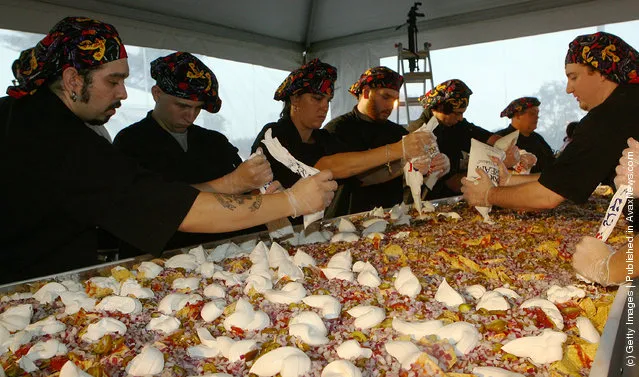
Guinness World Records World's Largest Nachos

“Nachos are a popular corn based food of Mexican origin associated with Tex-Mex cuisine that can be either made quickly to serve as a snack or prepared with more ingredients to make a full meal. In their simplest form, nachos are tortilla chips or totopos covered in melted cheese and salsa. First created circa 1943 by Ignacio "Nacho" Anaya, the original nachos consisted of fried corn tortillas covered with melted cheddar cheese and pickled jalapeño peppers”. – Wikipedia

Photo: Workers put the finishing touches on the nachos as Ninety Nine Restaurants in Billerica, Massachusetts set a new world record by creating the Guinness World Records World's Largest Nachos, weighing in at 3,999 lbs on October 1, 2011 in Billerica, Massachusetts. (Photo by Gail Oskin/Getty Images for Ninety Nine Restaurants)
Details
03 Oct 2011 09:31:00
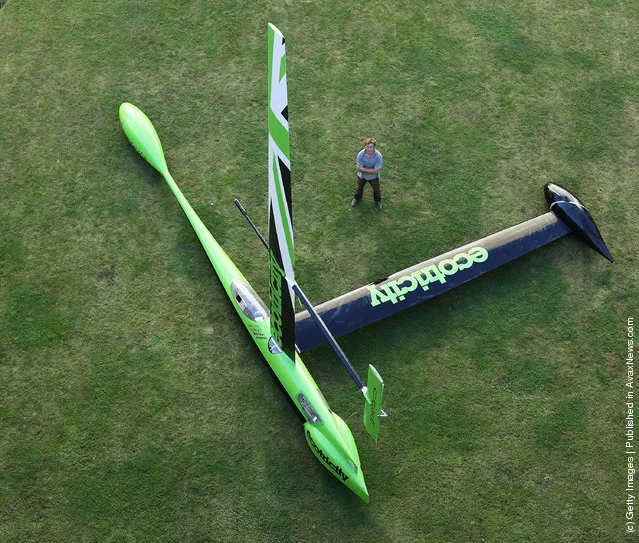
Ecotricity's Greenbird vehicle, designed and piloted by Richard Jenkins, broke the land speed world record for a wind-powered vehicle in 2009

“Ecotricity's Greenbird vehicle, designed and piloted by Richard Jenkins, broke the land speed world record for a wind-powered vehicle in 2009. Greenbird recorded a top speed of 126.4 mph (203.4 km/h), and sustained a speed of 126.2 mph (203.1 km/h) for the required time of three seconds, beating the previous, American held, record of 116 mph (186.7 km/h), set by Bob Schumacher in the Iron Duck in March 1999 at the same location”. – Wikipedia

Photo: Richard Jenkins poses for photographs with the world's fastest wind powered land Vehicle at Science Museum on August 3, 2009 in London, England. (Photo by Dan Kitwood/Getty Images)
Details
12 Dec 2011 12:30:00
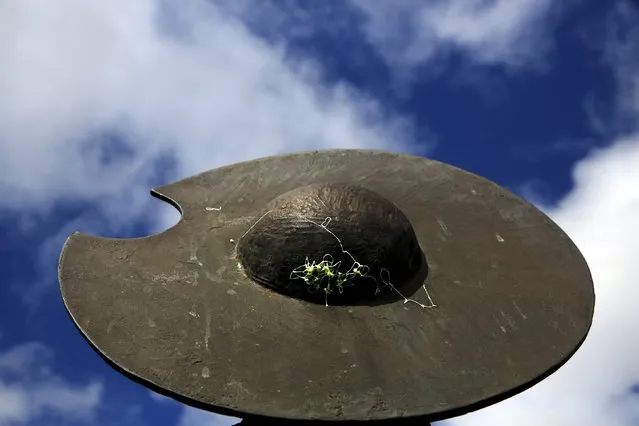
A sculpture of Don Quixote shows him wearing the basin he mistook for the enchanted helmet of the fictional Moorish king Mambrino in Alcazar de San Juan, Spain, April 5, 2016. (Photo by Susana Vera/Reuters)

A sculpture of Don Quixote shows him wearing the basin he mistook for the enchanted helmet of the fictional Moorish king Mambrino in Alcazar de San Juan, Spain, April 5, 2016. The arid central Spanish region of La Mancha is the setting for “Don Quixote”, the seventeenth-century novel by Miguel de Cervantes. Four hundred years after his death, references to the characters of Don Quixote, his loyal squire Sancho Panza and his beautiful lady Dulcinea abound in the surrounding villages from sweet treats to theatre productions involving livestock. Cervantes did not give away the name of the birthplace of Don Quixote, a middle-aged gentleman who becomes obsessed with chivalrous ideals. But many identify the village of Argamasilla de Alba as his hometown. The anniversary of Cervantes’ death is marked on the 23 April. (Photo by Susana Vera/Reuters)
Details
21 Apr 2016 12:32:00