Loading...
Done
epaselect epa05234254 A model presents a creation from the Beijing Institute of Fashion Technology Emerging Design Collection at the “BIFT ELLASSAY” Scholarship Awarding Ceremony during the Mercedes-Benz China Fashion Week at the Beijing Hotel, in Beijing, China, 29 March 2016. (Photo by Wu Hong/EPA)

epaselect epa05234254 A model presents a creation from the Beijing Institute of Fashion Technology Emerging Design Collection at the “BIFT ELLASSAY” Scholarship Awarding Ceremony during the Mercedes-Benz China Fashion Week at the Beijing Hotel, in Beijing, China, 29 March 2016. (Photo by Wu Hong/EPA)
Details
03 Apr 2016 12:03:00
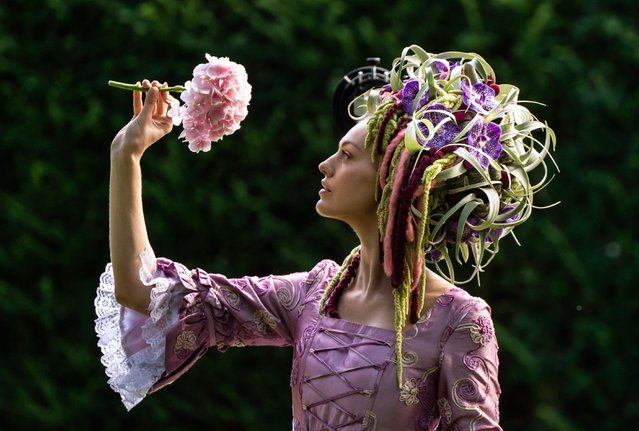
Gemma Sadler models a fabulous Georgian costume, including a wig made from flowers and foliage created by Florist of the Year Helen James, during the staging day for the 2021 Harrogate Autumn Flower Show at Newby Hall, near Ripon, United Kingdom on Thursday, September 16, 2021. (Photo by Danny Lawson/PA Images via Getty Images)

Gemma Sadler models a fabulous Georgian costume, including a wig made from flowers and foliage created by Florist of the Year Helen James, during the staging day for the 2021 Harrogate Autumn Flower Show at Newby Hall, near Ripon, United Kingdom on Thursday, September 16, 2021. (Photo by Danny Lawson/PA Images via Getty Images)
Details
17 Sep 2021 09:22:00
The Aurora Borealis (Northern Lights) is seen in the sky in Ivalo of Lapland, Finland on September 27, 2019. (Photo by Alexander Kuznetsov/Reuters)

The Aurora Borealis (Northern Lights) is seen in the sky in Ivalo of Lapland, Finland on September 27, 2019. (Photo by Alexander Kuznetsov/Reuters)
Details
18 Jun 2022 04:40:00
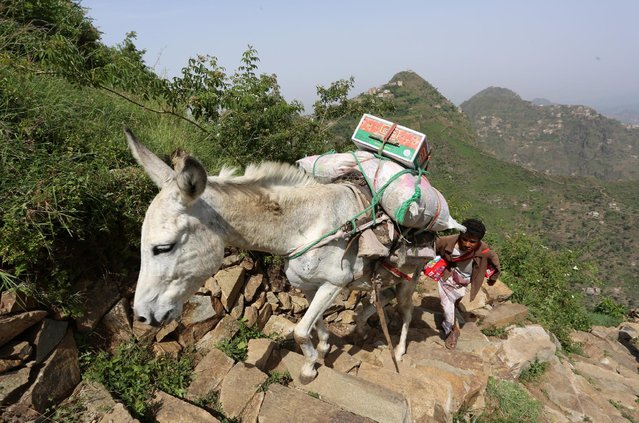
A man carries food supplies on a donkey to Dhalamlam Mountain in the Jafariya district of the western province of Raymah, Yemen June 2, 2016. (Photo by Abduljabbar Zeyad/Reuters)

A man carries food supplies on a donkey to Dhalamlam Mountain in the Jafariya district of the western province of Raymah, Yemen June 2, 2016. In villages perched high on a mountain in Western Yemen, residents are a safe distance from a conflict raging throughout most of the country but have had to turn the clock back on their lifestyles by centuries. (Photo by Abduljabbar Zeyad/Reuters)
Details
13 Sep 2016 09:23:00
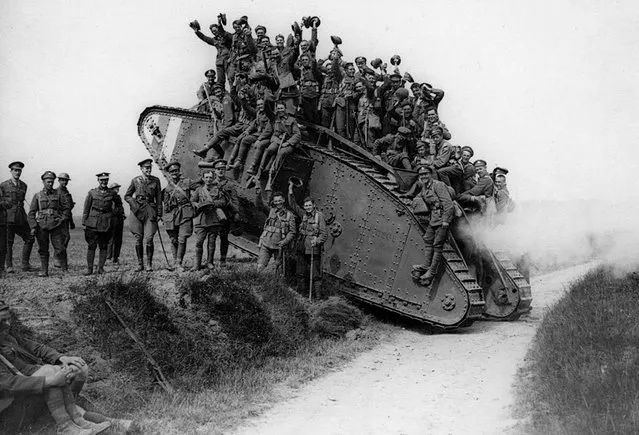
These black-and-white photos are taken from the new book “Armoured Warfare in the First World War 1916 – 1918” by Anthony Tucker-Jones and published by Pen & Sword Military. “Interestingly the British, French and Germans took completely different approaches with varying results”. The British military produced “Little Willie” in Autumn 1915 weighing 18 tonnes, which had a crew of two plus four gunners. “Inspired by a tracked artillery tractor “Little Willie” was referred to as a water tank – hence the name tank – to ensure secrecy”, said Anthony. “This led to the strange looking Mark I with its peculiar rhomboid shape, designed to cross trenches with guns in sponsons on either side. The Germans saw the tank as unchivalrous and were slow to grasp its utility. They favoured the Stormtrooper (specialist soldiers used to infiltrate enemy trenches) and artillery, not the tank”, said Anthony. “However, they didn’t hesitate to make use of captured British tanks. Although the tank helped secure victory and German soldiers dubbed it “Germany’s Downfall” the country was ultimately brought to its knees by the Allies blockade”. Here: British troops hitch a ride on a Mark IV after the massed tank fleet spearheading attack at Cambrai on November 20, 1917. (Photo by Anthony Tucker-Jones/Mediadrumworld.com)

These black-and-white photos are taken from the new book “Armoured Warfare in the First World War 1916 – 1918” by Anthony Tucker-Jones and published by Pen & Sword Military. Here: British troops hitch a ride on a Mark IV after the massed tank fleet spearheading attack at Cambrai on November 20, 1917. (Photo by Anthony Tucker-Jones/Mediadrumworld.com)
Details
23 Feb 2017 00:02:00
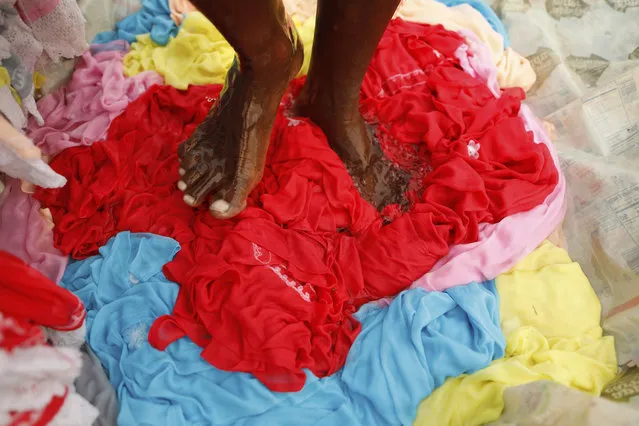
A dhobi, or a washerman washes cloths on the banks of the River Gomti in Lucknow, India, Saturday, September 12, 2020. Dhobis are traditional laundry workers who wash clothes by hand and dry them in the sun, an occupation which has been in existence for generations. Most cities in India have a Dhobi Ghat, or washermen's area, where the city's pile of clothes is laundered. This practice is still popular in India, despite of modern technology. Around 1,000 families work in Lucknow's Dhobi Ghat. However, in light of the novel coronavirus, their wages have decreased drastically. With each family earning around US$100-200 per month. (Photo by Rajesh Kumar Singh/AP Photo)

A dhobi, or a washerman washes cloths on the banks of the River Gomti in Lucknow, India, Saturday, September 12, 2020. Dhobis are traditional laundry workers who wash clothes by hand and dry them in the sun, an occupation which has been in existence for generations. Most cities in India have a Dhobi Ghat, or washermen's area, where the city's pile of clothes is laundered. This practice is still popular in India, despite of modern technology. Around 1,000 families work in Lucknow's Dhobi Ghat. However, in light of the novel coronavirus, their wages have decreased drastically. With each family earning around US$100-200 per month. (Photo by Rajesh Kumar Singh/AP Photo)
Details
25 Sep 2020 00:03:00
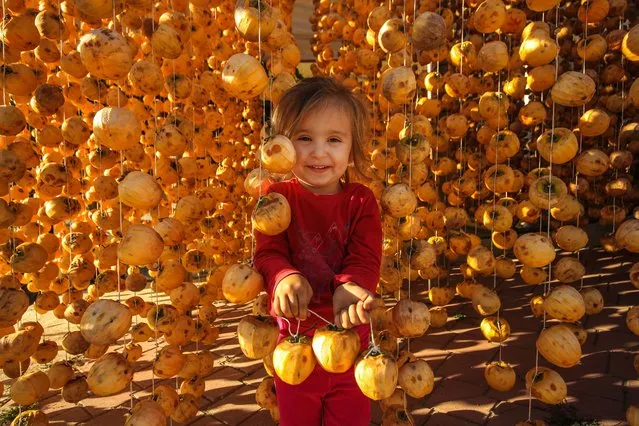
A child is seen with persimmons in Denizli, Turkiye on October 24, 2022. (Photo by Ummu Nisan Kandilcioglu/Anadolu Agency via Getty Images)

A child is seen with persimmons in Denizli, Turkiye on October 24, 2022. (Photo by Ummu Nisan Kandilcioglu/Anadolu Agency via Getty Images)
Details
09 Nov 2022 05:32:00
A couple poses for a joint photograph in a photo booth (photomaton) at a metro station in Paris on July 24, 2024. (Photo by Dimitar Dilkoff/AFP Photo)

A couple poses for a joint photograph in a photo booth (photomaton) at a metro station in Paris on July 24, 2024. (Photo by Dimitar Dilkoff/AFP Photo)
Details
04 Aug 2024 05:03:00