Loading...
Done
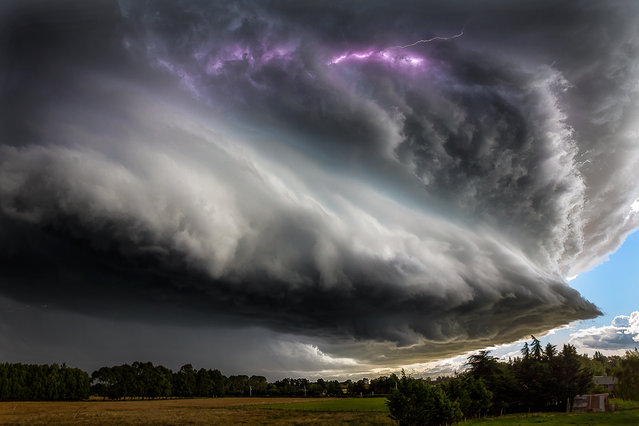
“Thunderstruck”. Summer stom. A super cell formed off the coast of New Zealand, intensified and swept across Christchurch and North Canterbury, February 23, 2014. Photo location: Christchurch, New Zealand. (Photo and caption by David Hardy/National Geographic Photo Contest)

“Thunderstruck”. Summer stom. A super cell formed off the coast of New Zealand, intensified and swept across Christchurch and North Canterbury, February 23, 2014. Photo location: Christchurch, New Zealand. (Photo and caption by David Hardy/National Geographic Photo Contest)
Details
15 Apr 2014 11:46:00
“Aurora over a glacier lagoon”. A vivid green overheaded aurrora pictured in Iceland's Vatnajokull National Park reflected almost symetrically in Jokulsrlon Glacier lagoon. A complete lack of wind and currrent combin in this sheltred lagoon scene to crete an arresting mirror effect giving the image a sensation of utter stillness. Despite theis there is motion on a suprising scale, as the loops and arcs of the aurora are shaped by the shifting forces of the Earth's magnetic field. (Photo by  James Woodend/The Astronomy Photographer of the Year 2014 Contest)

“Aurora over a glacier lagoon”. A vivid green overheaded aurrora pictured in Iceland's Vatnajokull National Park reflected almost symetrically in Jokulsrlon Glacier lagoon. A complete lack of wind and currrent combin in this sheltred lagoon scene to crete an arresting mirror effect giving the image a sensation of utter stillness. Despite theis there is motion on a suprising scale, as the loops and arcs of the aurora are shaped by the shifting forces of the Earth's magnetic field. James Woodend of Great Britain won the grand prize with the image, beating out more than 2,500 other entries. The Astronomy Photographer of the Year 2014 contest is judged by the Royal Observatory Greenwich and BBC Sky at Night magazine. (Photo by James Woodend/The Astronomy Photographer of the Year 2014 Contest)
Details
26 Sep 2014 13:39:00
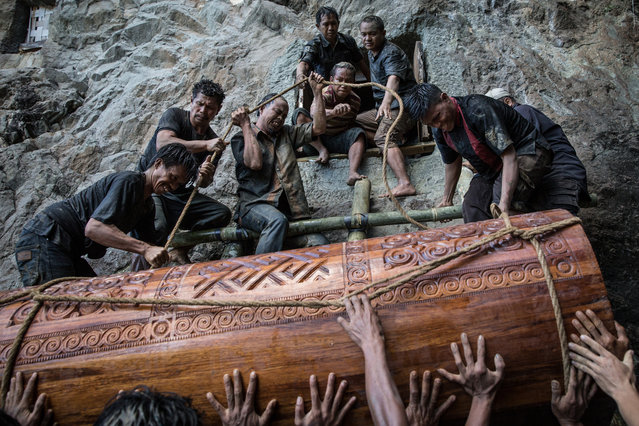
It is said that Torajans are people who “live to die”. For this Indonesian ethnic group, funerals are such extravagant events that they sometimes attract tourists. Families can postpone burials years (and the deceased are considered sick and hosted at home until the funeral) until the family can raise enough money and gather as many relatives as possible. And then it’s a jubilant multiday social event with a parade, dances and animal sacrifices. Agung Parameswara photographed these funerary practices when he traveled to South Sulawesi province, where the Torajans live. But often, their funeral isn’t the last time the dead are seen. In August, crypts are opened, coffins are slid back out and bodies delicately unsheathed. This tender ritual is known as Ma’Nene, which is customarily performed every few years. (Photo by Agung Parameswara/The Washington Post)

It is said that Torajans are people who “live to die”. For this Indonesian ethnic group, funerals are such extravagant events that they sometimes attract tourists. Families can postpone burials years (and the deceased are considered sick and hosted at home until the funeral) until the family can raise enough money and gather as many relatives as possible. And then it’s a jubilant multiday social event with a parade, dances and animal sacrifices. Agung Parameswara photographed these funerary practices when he traveled to South Sulawesi province, where the Torajans live. (Photo by Agung Parameswara/The Washington Post)
Details
06 Oct 2016 09:15:00
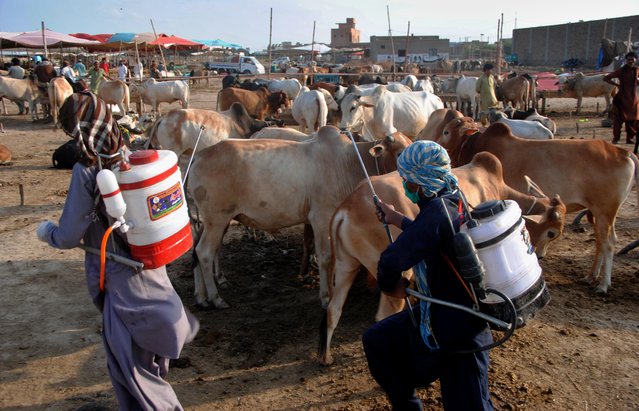
Health workers wearing face masks spray disinfectant liquid on sacrificial animals amid concerns over the spread of the SARS-CoV-2 coronavirus that causes the pandemic COVID-19 disease ahead of the Muslim festival of Eid al-Adha at an animal market in Hyderabad, southern Pakistan, 21 July 2020. Eid al-Adha, also known as the Festival of the Sacrifice, is the second and holiest of the two main Islamic holidays celebrated each year (the other one being Eid al-Fitr). Every year, on the 10th day of the Islamic lunar month of Dhu al-Hijjah, Muslims around the world ritually slaughter a sacrificial animal and split the meat into three parts: one is reserved for the family, another for friends and relatives, and the third is given to the poor and needy. The Saudi Supreme Court has declared that the first day of Eid al-Adha this year falls on 31 July. (Photo by Nadeem Khawar/EPA/EFE)

Health workers wearing face masks spray disinfectant liquid on sacrificial animals amid concerns over the spread of the SARS-CoV-2 coronavirus that causes the pandemic COVID-19 disease ahead of the Muslim festival of Eid al-Adha at an animal market in Hyderabad, southern Pakistan, 21 July 2020. (Photo by Nadeem Khawar/EPA/EFE)
Details
23 Jul 2020 00:07:00
A gibbon drinks from a soft drink bottle, given by a tourist, at a zoo in Kunming, Yunnan province, June 18, 2015. (Photo by Wong Campion/Reuters)

A gibbon drinks from a soft drink bottle, given by a tourist, at a zoo in Kunming, Yunnan province, June 18, 2015. (Photo by Wong Campion/Reuters)
Details
30 Jun 2015 11:48:00
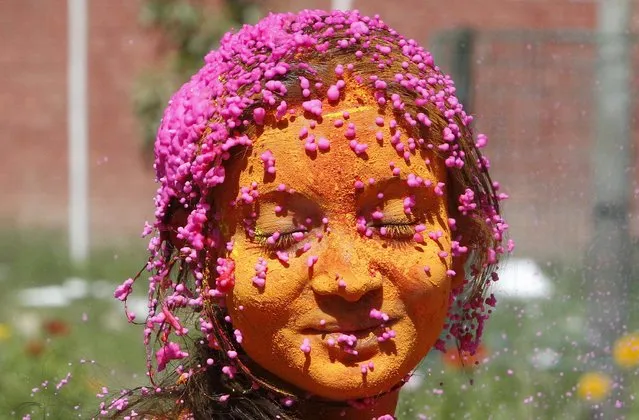
A students with her face smeared in coloured powder, celebrates Holi at a university campus in Chandigarh, India  March 23, 2016. (Photo by Ajay Verma/Reuters)

A students with her face smeared in coloured powder, celebrates Holi at a university campus in Chandigarh, India March 23, 2016. (Photo by Ajay Verma/Reuters)
Details
24 Mar 2016 12:08:00
A P-51 Mustang named “Charlotte's Chariot” from the Southern Heritage Air Foundation flies past a cloud of smoke and fire from a nearby battle reenactment during the Wings Over Houston Airshow in Houston, on Saturday, November 1, 2014. Battle reenactments are part of the yearly show held at Ellington Airport. (Photo by Kar Hlava/AP Photo/Bay Area Citizen)

A P-51 Mustang named “Charlotte's Chariot” from the Southern Heritage Air Foundation flies past a cloud of smoke and fire from a nearby battle reenactment during the Wings Over Houston Airshow in Houston, on Saturday, November 1, 2014. Battle reenactments are part of the yearly show held at Ellington Airport. (Photo by Kar Hlava/AP Photo/Bay Area Citizen)
Details
08 Nov 2014 12:47:00
Pedra da Gavea highline, 850 meters above the city, 100 meters direct exposure, March 24, 2013. Brian Mosbaugh on the line. Carefully tiptoeing almost 3000 metres above Rio de Janeiro on a thin wire got a bit too much for this adrenaline junkie – so he decided to have a LIE DOWN. Fearless Brian Mosbaugh is so used to the perilous heights he decided he deserved a short break and proceeded to kick back and relax over the famous Brazilian city. (Photo by Scott Rogers/Caters)

Pedra da Gavea highline, 850 meters above the city, 100 meters direct exposure, March 24, 2013. Brian Mosbaugh on the line. Carefully tiptoeing almost 3000 metres above Rio de Janeiro on a thin wire got a bit too much for this adrenaline junkie – so he decided to have a LIE DOWN. Fearless Brian Mosbaugh is so used to the perilous heights he decided he deserved a short break and proceeded to kick back and relax over the famous Brazilian city. (Photo by Scott Rogers/Caters)

P.S. All pictures are presented in high resolution. To see Hi-Res images – just TWICE click on any picture. In other words, click small picture – opens the BIG picture. Click BIG picture – opens VERY BIG picture (if available; this principle works anywhere on the site AvaxNews).

Details
30 Mar 2013 12:00:00