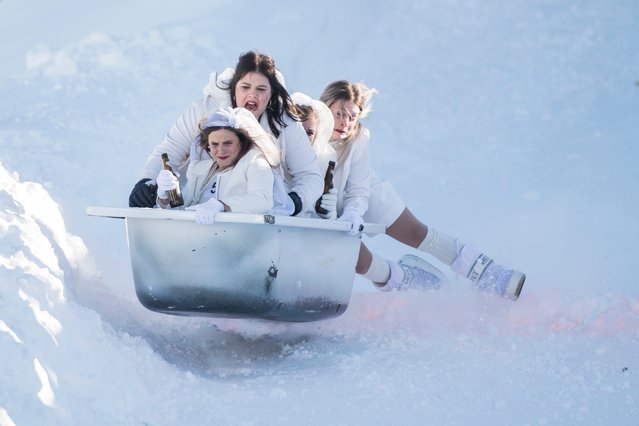
People in funny costumes race down the slope in bathtubs during the 7th Bathtub race at Stoos, Switzerland, on January 19, 2019. (Photo by Urs Flueeler/EPA/EFE/Rex Features/Shutterstock)
A mother raise her glass filled with 2017 Beaujolais Nouveau wine as she holds her child in a colored hot water “wine bath” at Hakone Kowakien Yunessun hot spring resort in Hakone, west of Tokyo, Japan, 16 November 2017, on the day of the Beaujolais Nouveau official release. With Germany and the United States, Japan is a major market for the Beaujolais Nouveau. (Photo by Franck Robichon/EPA/EFE)
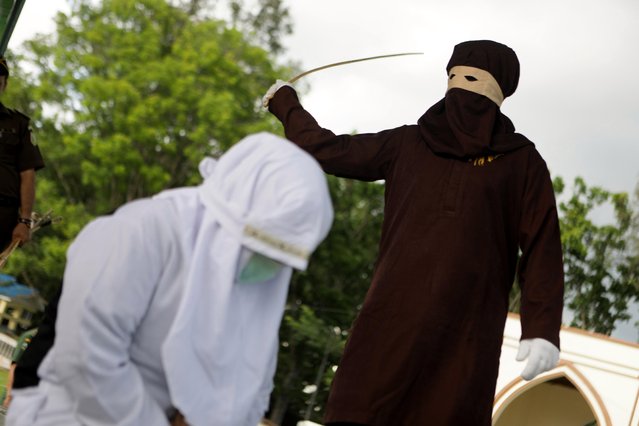
A sharia executor, know as algojo, during a public caning punishment in Jantho, Aceh Besar Regency, Indonesia, 17 November 2017. Ten people were sentenced to public caning for adultery in Aceh, the only province in Indonesia which implements sharia law. (Photo by Hotli Simanjuntak/EPA/EFE)
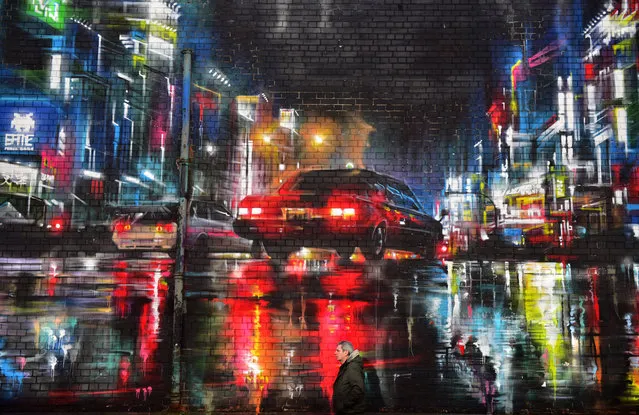
A man walks past a neon soaked street scene mural titled “Belfast – Blurry Eyed” by Dan Kitchener, also known as DANK on March 1, 2018 in Belfast, Northern Ireland. (Photo by Charles McQuillan/Getty Images)
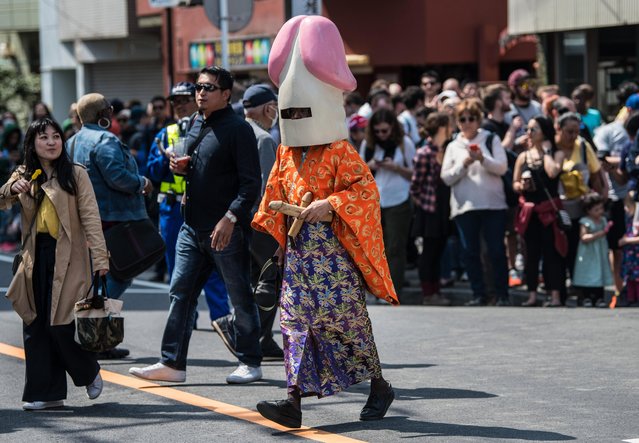
A man wear a phallic-shaped hat during Kanamara Matsuri (Festival of the Steel Phallus) on April 1, 2018 in Kawasaki, Japan. The Kanamara Festival is held annually on the first Sunday of April. The pen*s is the central theme of the festival, focused at the local pen*s-venerating shrine which was once frequented by prostitutes who came to pray for business prosperity and protection against sexually transmitted diseases. Today the festival has become a popular tourist attraction and is used to raise money for HIV awareness and research. (Photo by Carl Court/Getty Images)
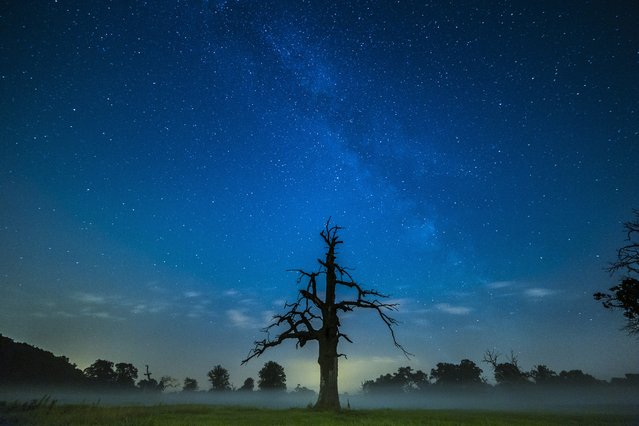
A picture made available on 17 July 2015 shows the bright line of the Milky Way above the old oaks at the Rogalin landscape Park in Rogalin village, near Poznan, on the night of 16 July 2015. (Photo by Lukasz Ogrodowczyk/EPA)
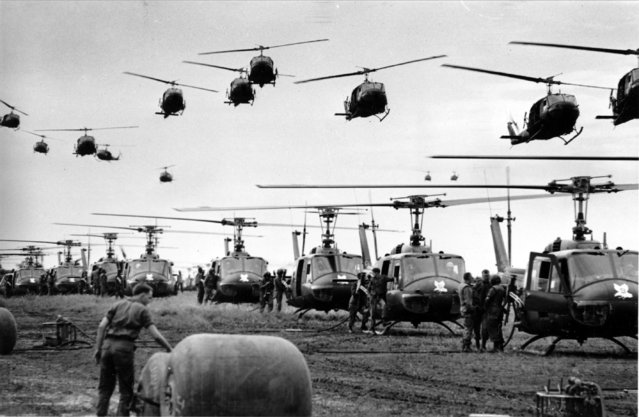
U.S. Army helicopters providing support for U.S. ground troops fly into a staging area fifty miles northeast of Saigon, Vietnam, August 28, 1966. Helicopter fuel is stored in the large rubber tanks, foreground. (Photo by Henri Huet/AP Photo)