Loading...
Done
Meet the world's smoothest cuddliest hedgehog. Names after brave hero, but Nelson is completely bald so when curled up he looks like an egg. Doesn't have a single prickle or strand of hair. Thought to be suffering a stress related alopecia following a trauma in the wild. Volunteers have been massaging him for half an hour a day for the last year to encourage spikes to grow. Now given up but he still gets daily massages because he enjoys them so much and to keep his cuddle skin soft and smooth. Unlike his namesake Nelson could not defend himself so will live out his days at the Foxy Lodge Wildlife Rescue in Hemsby, England. (Photo by Jeremy Durkin)

Meet the world's smoothest cuddliest hedgehog. Names after brave hero, but Nelson is completely bald so when curled up he looks like an egg. Doesn't have a single prickle or strand of hair. Thought to be suffering a stress related alopecia following a trauma in the wild. Volunteers have been massaging him for half an hour a day for the last year to encourage spikes to grow. Now given up but he still gets daily massages because he enjoys them so much and to keep his cuddle skin soft and smooth. Unlike his namesake Nelson could not defend himself so will live out his days at the Foxy Lodge Wildlife Rescue in Hemsby, England. (Photo by Jeremy Durkin)
Details
23 Oct 2016 11:33:00
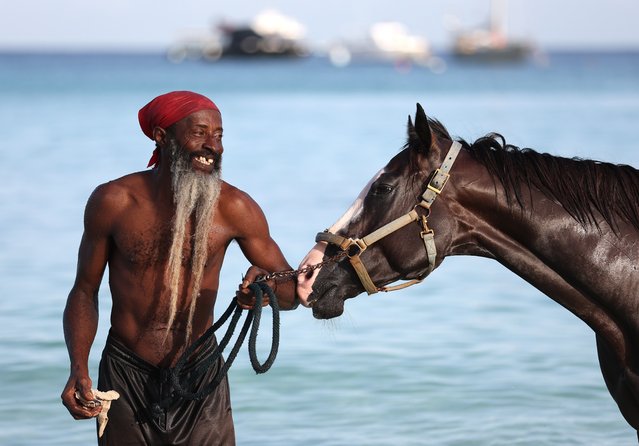
A horse trainer takes his horse into the water at Pebble Beach on June 28, 2024 in Bridgetown, Barbados. The swimming horses of Barbados offer a unique and remarkable experience at Pebbles Beach, where racehorses from the nearby Garrison Savannah enjoy their morning swim almost daily between 5:30 am and 7 am. During this ritual, horses swim out surprisingly far to the moored boats before returning to shore, with some staying longer in the water if recovering from injury or soreness after a race. Visitors can observe the horses' individual personalities as they swim and interact with the water, but are advised to respect the guidance of the grooms and maintain a safe distance, as horses can behave unpredictably, especially if frightened. (Photo by Robert Cianflone/Getty Images)

A horse trainer takes his horse into the water at Pebble Beach on June 28, 2024 in Bridgetown, Barbados. The swimming horses of Barbados offer a unique and remarkable experience at Pebbles Beach, where racehorses from the nearby Garrison Savannah enjoy their morning swim almost daily between 5:30 am and 7 am. During this ritual, horses swim out surprisingly far to the moored boats before returning to shore, with some staying longer in the water if recovering from injury or soreness after a race. Visitors can observe the horses' individual personalities as they swim and interact with the water, but are advised to respect the guidance of the grooms and maintain a safe distance, as horses can behave unpredictably, especially if frightened. (Photo by Robert Cianflone/Getty Images)
Details
07 Jul 2024 03:07:00
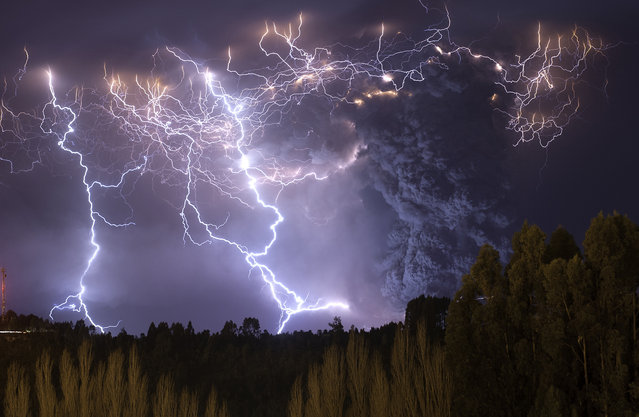
The eruption of Cordon Caulle began on June 4, 2011, located in the Region of Los Rios in Chile. For about 12 months, people and animals became accustomed to living with the daily fall of ash, which also caused problems in the air traffic in South America. The explosions and lightning during first days of the eruption could be seen from hundreds of miles around. This photograph was taken on the second night of eruption from the town of Lago Ranco. (Photo and caption by Francisco Negroni/National Geographic Traveler Photo Contest)

The eruption of Cordon Caulle began on June 4, 2011, located in the Region of Los Rios in Chile. For about 12 months, people and animals became accustomed to living with the daily fall of ash, which also caused problems in the air traffic in South America. The explosions and lightning during first days of the eruption could be seen from hundreds of miles around. This photograph was taken on the second night of eruption from the town of Lago Ranco. (Photo and caption by Francisco Negroni/National Geographic Traveler Photo Contest)

ATTENTION! All pictures are presented in high resolution. To see Hi-Res images – just TWICE click on any picture. In other words, click small picture – opens the BIG picture. Click BIG picture – opens VERY BIG picture.
Details
23 Jun 2013 11:24:00
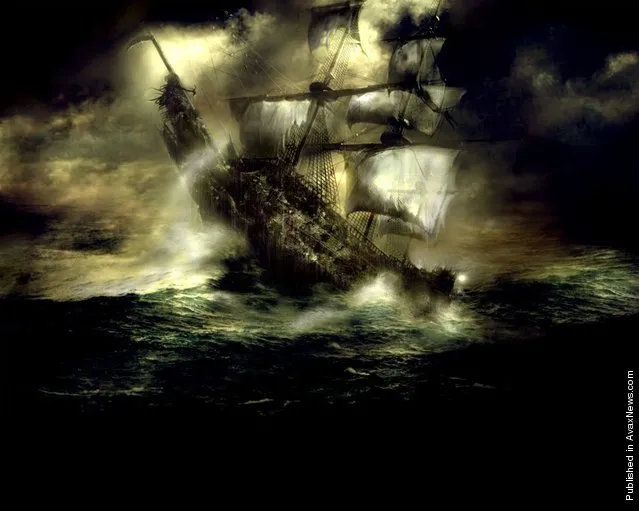
Ocean voyage

Do you think that history is a science? Well, not exactly. First, and foremost, history is the state's “legend of wars”, it’s official regalia. Of course, public historians are not interested in scientific truth – quite the opposite. In this respect, any attempt to present a state’s history as altruistic and benevolent as possible is welcomed and encouraged – as opposed to any revisionism attempts that may be more accurate. In this matter, Chinese have surpassed us all – they revised in highly creative manner (but rather shamelessly) the technology already invented by Europeans, a process that resulted in oldest state on the planet. Here is an interesting paradox: ask any sinologist about the Middle Kingdom during second century B.C., and he will describe it to you in such a vivid manner as if he has been living there all his life – but as soon as you will ask him to describe Chinese history in the 19-20th centuries… let's say, his eagerness will be greatly diminished. However, we will discuss China in a different article, and in the meantime we will try to understand how exactly historic “legend of wars” is formed and functions – based on a specific and well-known example. A great example is Ferdinand Magellan's first voyage around the world.
Details
14 Nov 2011 09:11:00
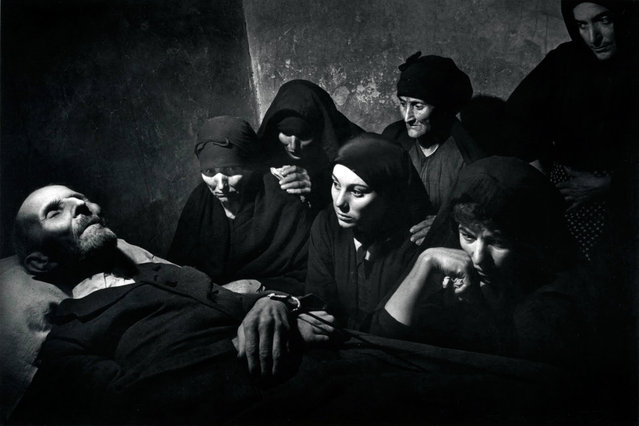
His wife, daughter, granddaughter and friends have their last earthly visit with a villager. (Photo by W. Eugene Smith/Time & Life Pictures)

“Originally published in the April 9, 1951, issue of LIFE magazine, W. Eugene Smith’s photo essay, «Spanish Village», has been lauded for more than six decades as the most moving photographic portrait ever made of daily life in rural Spain during the rule of dictator Francisco Franco”. – Time & Life Pictures. Photo: His wife, daughter, granddaughter and friends have their last earthly visit with a villager. (Photo by W. Eugene Smith/Time & Life Pictures)
Details
30 Apr 2013 10:11:00
Lenticular clouds hover of the mountains of the Kamchatka Peninsula in Russia. (Photo by Denis Budkov/Caters News)

“These eerie formations in the sky may look like alien ships. But as the Daily Mail points out, they’re actually a natural occurrence called lenticular clouds”. – Claudine Zap. Photo: Lenticular clouds hover of the mountains of the Kamchatka Peninsula in Russia. (Photos by Denis Budkov/Caters News)
Details
11 Jun 2013 09:26:00
How To Pass Time On Your Commute To Work

We all have our own ways of passing time on our daily commutes. Some people read, others try to sleep, and many listen to music or play on their phones. But one creative commuter has a simple and highly entertaining way that hopefully more people will embrace. By placing a face from a newspaper in front of a person at just the right angle, they transform other commuters into recognizable celebrities while keeping the unbeknownst participant obscured.
Details
02 Jul 2013 10:46:00
An animal rights activist from People for the Ethical Treatment of Animals (PETA) hands out bananas to motorists at an intersection in Bangkok, Thailand, 12 February 2015. (Photo by Diego Azubel/EPA)

An animal rights activist from People for the Ethical Treatment of Animals (PETA) hands out bananas to motorists at an intersection in Bangkok, Thailand, 12 February 2015. Activists called on people turn to vegetarian saying the cholesterol in meat, eggs and daily products can contribute to hardening of arteries and slow the flow of blood to all the body's vital organs. (Photo by Diego Azubel/EPA)
Details
17 Feb 2015 11:57:00