Loading...
Done
Ocean voyage

Do you think that history is a science? Well, not exactly. First, and foremost, history is the state's “legend of wars”, it’s official regalia. Of course, public historians are not interested in scientific truth – quite the opposite. In this respect, any attempt to present a state’s history as altruistic and benevolent as possible is welcomed and encouraged – as opposed to any revisionism attempts that may be more accurate. In this matter, Chinese have surpassed us all – they revised in highly creative manner (but rather shamelessly) the technology already invented by Europeans, a process that resulted in oldest state on the planet. Here is an interesting paradox: ask any sinologist about the Middle Kingdom during second century B.C., and he will describe it to you in such a vivid manner as if he has been living there all his life – but as soon as you will ask him to describe Chinese history in the 19-20th centuries… let's say, his eagerness will be greatly diminished. However, we will discuss China in a different article, and in the meantime we will try to understand how exactly historic “legend of wars” is formed and functions – based on a specific and well-known example. A great example is Ferdinand Magellan's first voyage around the world.
Details
14 Nov 2011 09:11:00
A girl plays kayagum, stringed Korean harp, at the Tongmun kindergarten No.1 in Taedonggang District of Pyongyang, North Korea Tuesday, May 16, 2023. (Photo by Cha Song Ho/AP Photo)

A girl plays kayagum, stringed Korean harp, at the Tongmun kindergarten No.1 in Taedonggang District of Pyongyang, North Korea Tuesday, May 16, 2023. (Photo by Cha Song Ho/AP Photo)
Details
31 Jul 2023 03:11:00
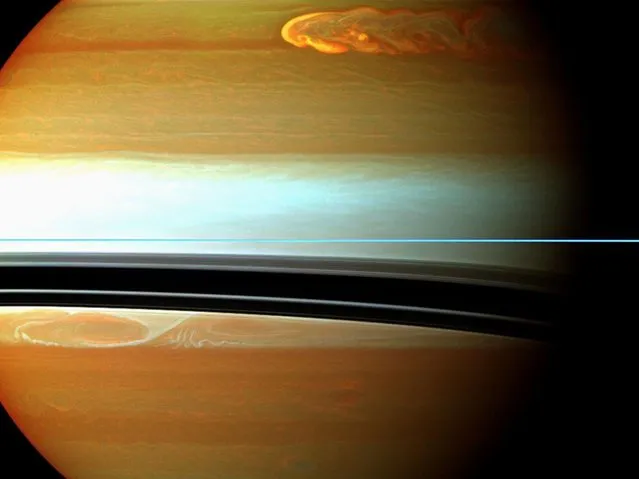
The huge storm which generated the lightning strike on Saturn can be seen in the top right of this image

An incredible view of daytime lightning on Saturn during one of the biggest storms the ringed planet has ever seen has been captured by a NASA spacecraft.

Photo: The huge storm which generated the lightning strike on Saturn can be seen in the top right of this image. (Photo by NASA)
Details
22 Jul 2012 08:43:00
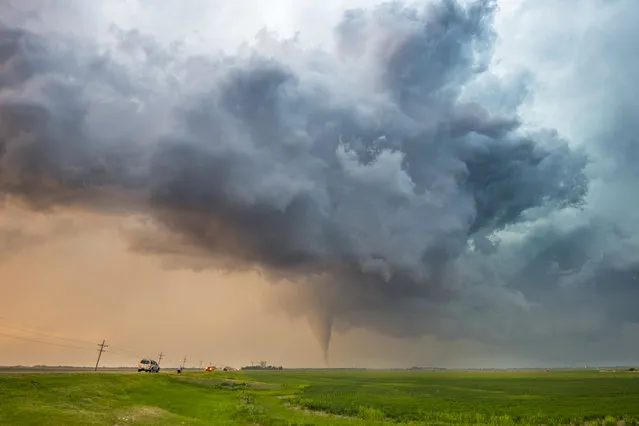
“The Sunsetter”. An EF-4 tornado rips through the open space of farmland near Rozel, Kansas. This tornado moves slowly but powerful towards the setting sun an gets its beautiful color right before sunset. Storm Chasers are spotting on the left side. Photo location: Rozel, Kansas. (Photo and caption by Dennis Oswald/National Geographic Photo Contest)

“The Sunsetter”. An EF-4 tornado rips through the open space of farmland near Rozel, Kansas. This tornado moves slowly but powerful towards the setting sun an gets its beautiful color right before sunset. Storm Chasers are spotting on the left side. Photo location: Rozel, Kansas. (Photo and caption by Dennis Oswald/National Geographic Photo Contest)

ATTENTION! All pictures are presented in high resolution. To see Hi-Res images – just TWICE click on any picture. In other words, click small picture – opens the BIG picture. Click BIG picture – opens VERY BIG picture.
Details
01 Dec 2013 11:03:00
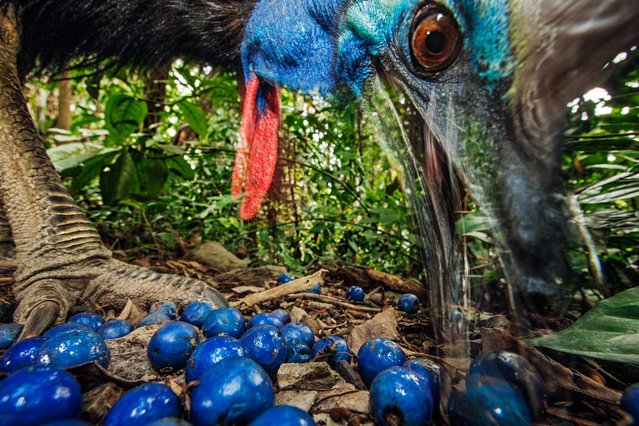
“Cassowaries are large, flightless birds related to emus and (more distantly) to ostriches, rheas, and kiwis”, writes Olivia Judson in the September issue of National Geographic magazine. (Photo by Christian Ziegler/National Geographic)

“Cassowaries are large, flightless birds related to emus and (more distantly) to ostriches, rheas, and kiwis”, writes Olivia Judson in the September issue of National Geographic magazine. How large? People-size: Adult males stand well over five foot five and top 110 pounds. Females are even taller, and can weigh more than 160 pounds. Dangerous when roused, they’re shy and peaceable when left alone. But even birds this big and tough are prey to habitat loss. The dense New Guinea and Australia rain forests where they live have dwindled. Today cassowaries might number 1,500 to 2,000. And because they help shape those same forests – by moving seeds from one place to another – “if they vanish”, Judson writes, “the structure of the forest would gradually change” too. (Photo by Christian Ziegler/National Geographic)
Details
06 Jan 2014 12:21:00
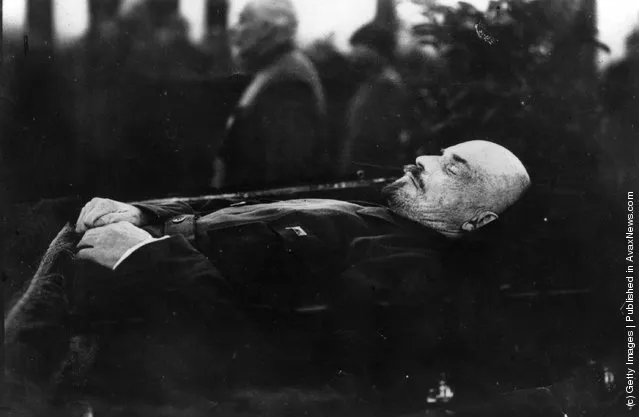
1924:  Vladimir Ilyich Lenin lying in state in the Kremlin

Photo: Vladimir Ilyich Lenin (1870 – 1924) lying in state in the Kremlin. (Photo by Hulton Archive/Getty Images). 1924

Important! For the same article in Russian language click here.

Something quite intriguing is happening within Russian-speaking internet during the last few – should you type a fully academic inquiry (at least, according to Russian academic requirements) in national search engines for "Lenin's mausoleum" – the first thing you get (even in top 10 searches) is website pages talking about black magic and occult. Website authors view this construction differently, but unconditionally agree on one thing: the mausoleum of the "leader of the world proletariat” – the essence of a magical artifact, a sort of “energy vampire”. It was built with a certain purpose: to drain the energy out of miserable Soviet citizens on one hand; and to poison the anthroposphere of one-sixth part of the earth with its vibes (the exact territory that was occupied by the former Soviet Union), depriving the Russian people of will to resist on the other hand. Complete nonsense? No doubt. Nevertheless, an intriguing one. Well, probably because some oddities do exist in mausoleum's history. These oddities are the thing we are going to discuss this time. First, let me refresh you memory on the subject.
Details
16 Oct 2011 11:27:00
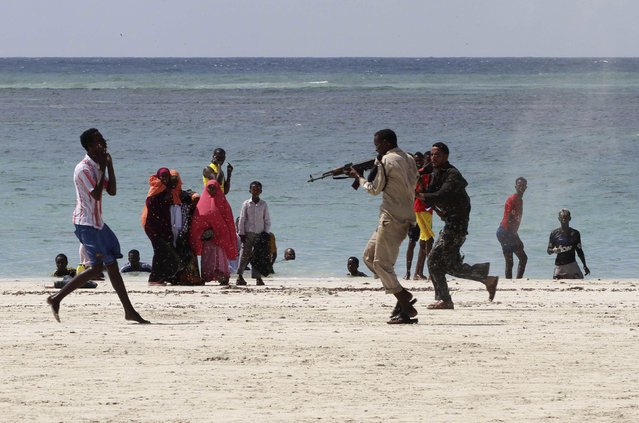
A Somali police officer arrests a suspected rebel member of the al Qaeda-affiliated al Shabaab among beach goers in Mogadishu. Al Shabaab claimed responsibility for today's pre-dawn attack on a Kenyan university campus near the Somali border.  (Photo by Feisal Omar/Reuters)

A Somali police officer arrests a suspected rebel member of the al Qaeda-affiliated al Shabaab among beach goers in Mogadishu. Al Shabaab claimed responsibility for today's pre-dawn attack on a Kenyan university campus near the Somali border. The following gallery examines who is al Shabaab. Here: Somali police officer (R) arrests a suspected rebel member (L) of the Al Qaeda-affiliated al Shabaab among beach goers at the Lido beach north of Somalia's capital Mogadishu March 23, 2012. (Photo by Feisal Omar/Reuters)
Details
03 Apr 2015 13:15:00
Anilson Costa, reveller of the annual block party “Ceu na Terra”, walks along the Santa Teresa neighborhood where the block party used to be celebrated, as Carnival celebrations have been canceled, amid the coronavirus disease (COVID-19) pandemic, in Rio de Janeiro, Brazil on February 12, 2021. (Photo by Pilar Olivares/Reuters)

Anilson Costa, reveller of the annual block party “Ceu na Terra”, walks along the Santa Teresa neighborhood where the block party used to be celebrated, as Carnival celebrations have been canceled, amid the coronavirus disease (COVID-19) pandemic, in Rio de Janeiro, Brazil on February 12, 2021. (Photo by Pilar Olivares/Reuters)
Details
13 Feb 2021 10:42:00