Loading...
Done
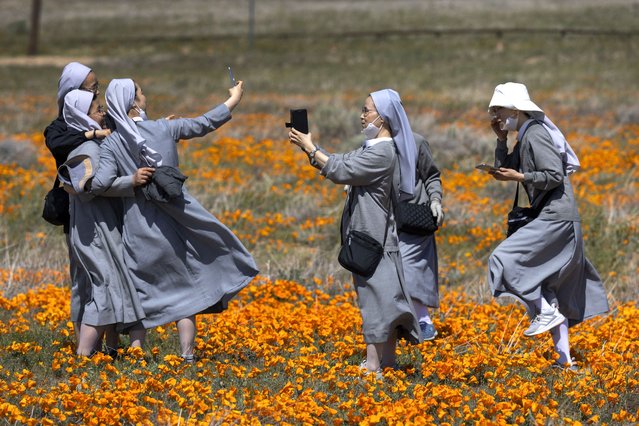
People walk in a field of California poppies and other wildflowers outside of the Antelope Valley California Poppy Reserve, after recent rains moved the region's second-driest winter on record up to its seventh-driest, near Lancaster, California, on April 2, 2022. The California Department of Water Resources reported that about one-third of the Sierra Nevada snowpack's water equivalency melted last week under higher-than-normal temperatures, leaving the statewide snow-water equivalent at 38% of normal for the date. (Photo by David Mcnew/AFP Photo)

People walk in a field of California poppies and other wildflowers outside of the Antelope Valley California Poppy Reserve, after recent rains moved the region's second-driest winter on record up to its seventh-driest, near Lancaster, California, on April 2, 2022. The California Department of Water Resources reported that about one-third of the Sierra Nevada snowpack's water equivalency melted last week under higher-than-normal temperatures, leaving the statewide snow-water equivalent at 38% of normal for the date. (Photo by David Mcnew/AFP Photo)
Details
12 Apr 2022 06:02:00
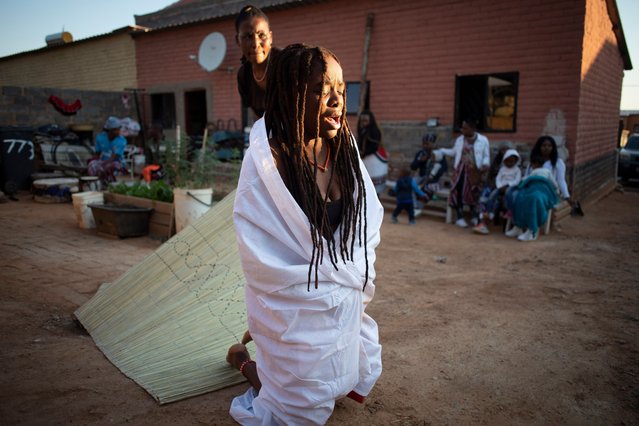
“Sangoma” initiate Dipuo Banda (C) is led out of her teachers shack while she remains in a trance like state prior to dancing during her 3 day initiation ceremony with her teacher, family, friends and students in the Alexandra Township in Johannesburg, South Africa, 14 May 2021. Sangomas, the Zulu term for Medicine Women or traditional healers, fulfill different social and political roles in the community, including divination, physical healing, emotional and spiritual illnesses, directing birth or death rituals and finding lost cattle. (Photo by Kim Ludbrook/EPA/EFE)

“Sangoma” initiate Dipuo Banda (C) is led out of her teachers shack while she remains in a trance like state prior to dancing during her 3 day initiation ceremony with her teacher, family, friends and students in the Alexandra Township in Johannesburg, South Africa, 14 May 2021. Sangomas, the Zulu term for Medicine Women or traditional healers, fulfill different social and political roles in the community, including divination, physical healing, emotional and spiritual illnesses, directing birth or death rituals and finding lost cattle. (Photo by Kim Ludbrook/EPA/EFE)
Details
28 May 2021 08:13:00
Jaison Vargas, crocodile tour guide, takes a picture of an American crocodile (Crocodylus acutus) during a tour at the Tarcoles river, in Tarcoles, Garabito municipality, Costa Rica, on March 31, 2022. Crocodile tours in the estuary of the Tarcoles River are a popular attraction for visitors to Costa Rica's Pacific coast, as the area gets back on its feet after being shaken by the pandemic. The river is home to nearly 500 species of birds and some 2,000 American crocodiles, many of which have been named after famous people. (Photo by Luis Acosta/AFP Photo)

Jaison Vargas, crocodile tour guide, takes a picture of an American crocodile (Crocodylus acutus) during a tour at the Tarcoles river, in Tarcoles, Garabito municipality, Costa Rica, on March 31, 2022. Crocodile tours in the estuary of the Tarcoles River are a popular attraction for visitors to Costa Rica's Pacific coast, as the area gets back on its feet after being shaken by the pandemic. The river is home to nearly 500 species of birds and some 2,000 American crocodiles, many of which have been named after famous people. (Photo by Luis Acosta/AFP Photo)
Details
10 Apr 2022 04:56:00
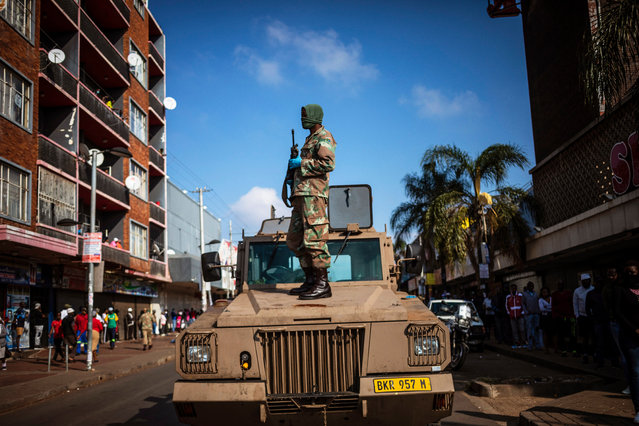
A member of the South African National Defense Force (SANDF) stands on a military vehicle during a joint South African Police Services (SAPS) and SANDF patrol on day 31 of the national lockdown as a result of the ongoing coronavirus COVID-19 pandemic in Johannesburg, South Africa, 26 April 2020. The patrol was in the high density areas of Hillbrow and Yoeville where civilians are still breaking the strict lockdown rules. Those that where breaking the rules where arrested. South Africa's Stage 5 lockdown is due to end 30 April 2020 when stage 4 will be implemented. (Photo by Kim Ludbrook/EPA/EFE)

A member of the South African National Defense Force (SANDF) stands on a military vehicle during a joint South African Police Services (SAPS) and SANDF patrol on day 31 of the national lockdown as a result of the ongoing coronavirus COVID-19 pandemic in Johannesburg, South Africa, 26 April 2020. The patrol was in the high density areas of Hillbrow and Yoeville where civilians are still breaking the strict lockdown rules. Those that where breaking the rules where arrested. South Africa's Stage 5 lockdown is due to end 30 April 2020 when stage 4 will be implemented. (Photo by Kim Ludbrook/EPA/EFE)
Details
06 May 2020 00:01:00
Ng Sin Nee (L) and Lee Shin May (R) from Malaysia take pictures with the panoramic view of the city from the Sky Box at KL Tower, the world's seventh tallest telecommunications tower, in Kuala Lumpur on May 24, 2016. Officially opened on May 20, the Sky Box has been the latest attraction for tourists arriving to the Malaysian capital. It stands 300 metres above ground and can fit six people at any one time, and offers spectacular views of the Kuala Lumpur skyline, including the iconic Petronas Twin Towers. (Photo by Mohd Rasfan/AFP Photo)

Ng Sin Nee (L) and Lee Shin May (R) from Malaysia take pictures with the panoramic view of the city from the Sky Box at KL Tower, the world's seventh tallest telecommunications tower, in Kuala Lumpur on May 24, 2016. Officially opened on May 20, the Sky Box has been the latest attraction for tourists arriving to the Malaysian capital. It stands 300 metres above ground and can fit six people at any one time, and offers spectacular views of the Kuala Lumpur skyline, including the iconic Petronas Twin Towers. (Photo by Mohd Rasfan/AFP Photo)
Details
25 May 2016 13:33:00
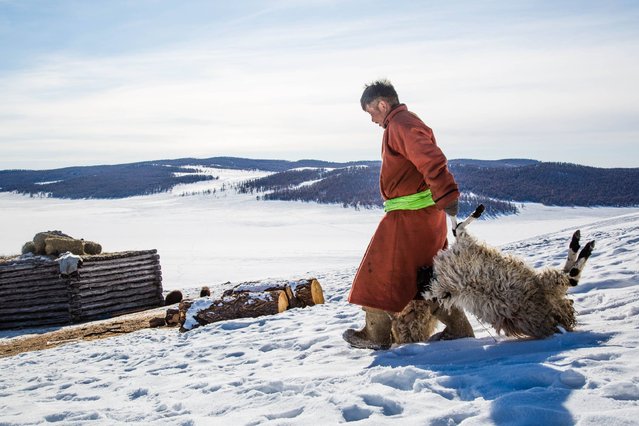
This handout photo taken on February 12, 2017 and released on February 16 by the International Federation of Red Cross and Red Crescent Societies (IFRC) shows Mongolian herder Munkhbat Bazarragchaa (C) dragging two sheep – which recently died due to the weather - to a pile of dead animals behind his “ger” in Khuvsgul province, northern Mongolia. Thousands of Mongolian herders face disastrous livestock losses from dreaded severe weather  known as the “dzud”, the Red Cross said on February 16, 2017 in launching an international emergency aid appeal. (Photo by Mirva Helenius/AFP Photo/IFRC)

This handout photo taken on February 12, 2017 and released on February 16 by the International Federation of Red Cross and Red Crescent Societies (IFRC) shows Mongolian herder Munkhbat Bazarragchaa (C) dragging two sheep – which recently died due to the weather - to a pile of dead animals behind his “ger” in Khuvsgul province, northern Mongolia. Thousands of Mongolian herders face disastrous livestock losses from dreaded severe weather known as the “dzud”, the Red Cross said on February 16, 2017 in launching an international emergency aid appeal. (Photo by Mirva Helenius/AFP Photo/IFRC)
Details
17 Feb 2017 11:40:00
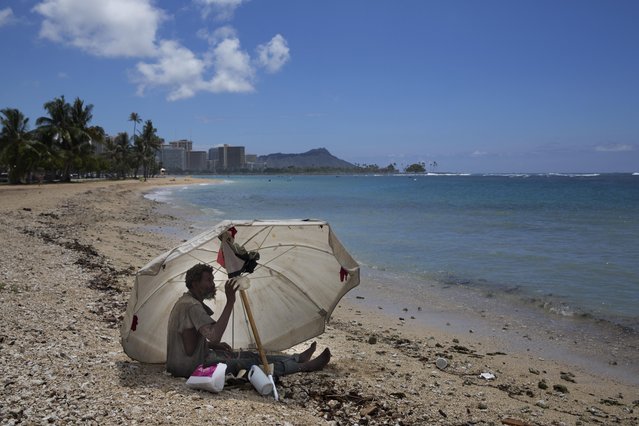
In this Thursday, August 27, 2015 photo, a homeless man drinks water while sitting on the beach at Ala Moana Beach Park located near Waikiki in Honolulu. Homelessness in Hawaii has grown steadily in recent years, leaving the state with the nation's highest rate of homeless people per capita. (Photo by Jae C. Hong/AP Photo)

Hawaii has long been known as a tropical paradise, but in recent years another image has intruded into the state's carefully crafted one of idyllic beaches and relaxing resorts: homelessness. The number of homeless people has grown in recent years, leaving the state with 487 homeless per 100,000 people, the nation's highest rate per capita, above New York and Nevada, according to federal statistics. Many of the homeless, however, defy the stereotype of the mentally ill or drug addicted. They are families, with men and women who work full-time jobs. They are struggling to get a foothold in a place with a high cost of living and low wages. Here: in this Thursday, August 27, 2015 photo, a homeless man drinks water while sitting on the beach at Ala Moana Beach Park located near Waikiki in Honolulu. (Photo by Jae C. Hong/AP Photo)
Details
11 Nov 2015 08:03:00
Mayu adjusts Koiku’s kimono, as Koiku wears a protective face mask while posing for a photograph, before they work at a party where they will entertain with other geisha at Japanese luxury restaurant Asada in Tokyo, Japan, June 23, 2020. The coronavirus pandemic has made Tokyo's geisha fear for their centuries-old profession as never before. Though the number of geisha - famed for their witty conversation, beauty and skill at traditional arts - has been falling for years, they were without work for months due to Japan's state of emergency and now operate under awkward social distancing rules. Engagements are down 95 percent, and come with new rules: no pouring drinks for customers or touching them even to shake hands, and sitting 2 meters apart. Masks are hard to wear with their elaborate wigs, so they mostly don't. “I was just full of anxiety”, said Mayu, 47. “I went through my photos, sorted my kimonos ... The thought of a second wave is terrifying”. (Photo by Kim Kyung-Hoon/Reuters)

Mayu adjusts Koiku’s kimono, as Koiku wears a protective face mask while posing for a photograph, before they work at a party where they will entertain with other geisha at Japanese luxury restaurant Asada in Tokyo, Japan, June 23, 2020. (Photo by Kim Kyung-Hoon/Reuters)
Details
23 Jul 2020 00:03:00