Loading...
Done
Models of Cold War-era Allied (L) and Soviet Bloc weaponry

Models of Cold War-era Allied (L) and Soviet Bloc weaponry face one another at the new Bundeswehr Military History Museum (Militaerhistorisches Museum der Bundeswehr, or MHM) on October 11, 2011 in Dresden, Germany. The museum, redesigned by star architect Daniel Libeskind, traces Germany military history from 1300 to the present, including during the Nazi period and the Cold War, and also examines the influence of the military on popular culture. (Photo by Sean Gallup/Getty Images)
Details
12 Oct 2011 11:55:00
Murad Khydyrov, horse and monkey trainer at the Great Moscow State Circus, and chimpanzee named Micky get ready for a rehearsal of the show called “History” as the circus prepares for its new season, which is to begin on September 19, in Moscow on September 17, 2020. (Photo by Natalia Kolesnikova/AFP Photo)

Murad Khydyrov, horse and monkey trainer at the Great Moscow State Circus, and chimpanzee named Micky get ready for a rehearsal of the show called “History” as the circus prepares for its new season, which is to begin on September 19, in Moscow on September 17, 2020. (Photo by Natalia Kolesnikova/AFP Photo)
Details
27 Sep 2020 00:01:00
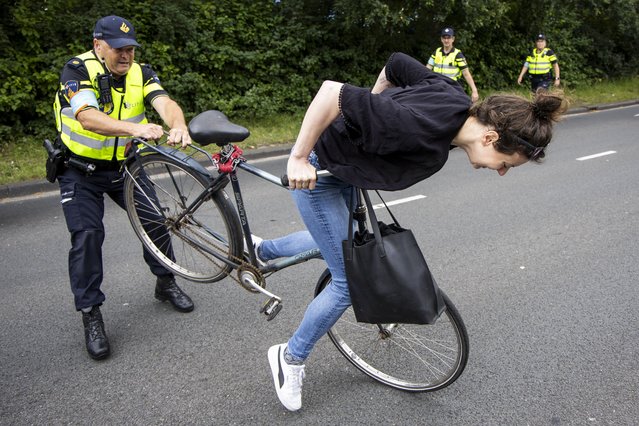
A policeman stops a cyclist as demonstrators from Extinction Rebellion (XR) protest during the NATO Summit by blocking the A12 highway in The Hague, The Netherlands, 25 June 2025. The Netherlands, for the first time in NATO's history of existence, is hosting a NATO summit. (Photo by Sebastiaan Barel/EPA)

A policeman stops a cyclist as demonstrators from Extinction Rebellion (XR) protest during the NATO Summit by blocking the A12 highway in The Hague, The Netherlands, 25 June 2025. The Netherlands, for the first time in NATO's history of existence, is hosting a NATO summit. (Photo by Sebastiaan Barel/EPA)
Details
13 Jul 2025 00:39:00


Orange Caramel (오렌지 캬라멜) – 까탈레나 (Catallena) – Korean. Is it worth eating live beings? This is a philosophical question: the history of our species and the ontology of being are saying that it's more likely yes, and on the other hand your mind and empathy are more likely to be against this idea. Or at least like in this Korean clip – eat, but with tears in your eyes.
Details
12 Sep 2017 09:18:00
The workers begin to search for gold at 10 am and work until sunset, often working second jobs in the day in order to survive. (Photo by Borja Sanchez-Trillo/Getty Images)

Two workers shovel mud from the river as they look for gold on March 25, 2014 in Lampang, Thailand. Thai villagers from Wang Nuea, North of Thailand, look for gold in the river every year during the drought season. They are able to make an average around USD 15 per day, however two years ago they reached USD 200 in one day due to the river level dropping so much. The workers begin to search for gold at 10 AM and work until sunset, often working second jobs in the day in order to survive. (Photo by Borja Sanchez-Trillo/Getty Images)
Details
27 Mar 2014 06:09:00


“Snowflake (c. 1964 – November 24, 2003) was an albino gorilla. He was the only known albino gorilla so far, and the most popular resident of the Barcelona Zoo in Catalonia, Spain. Originally named Nfumu Ngui in Fang language ("white gorilla") by his captor, he was then nicknamed Floquet de Neu (Catalan for little snowflake) by his keeper Jordi Sabater Pi. On his arrival to Barcelona where he was given an official reception by the then Mayor of Barcelona, Josep Maria de Porcioles, in November 1966, he was called Blancanieves (“Snow White”) in the newspaper Tele/Exprés. But he became famous with the name given to him by Sabater when National Geographic Magazine featured him on the main page in March 1967, with the English name Snowflake. This name spread among the press (Stern, Life, Paris-Match) and was later translated to Spanish as Copito de Nieve. Sabater himself called the gorilla Floquet or Copi, and in the later years Nfumu. The asteroid 95962 Copito, discovered by Catalan astronomer J. Manteca, is named in his honour”.
Details
07 Mar 2011 15:50:00
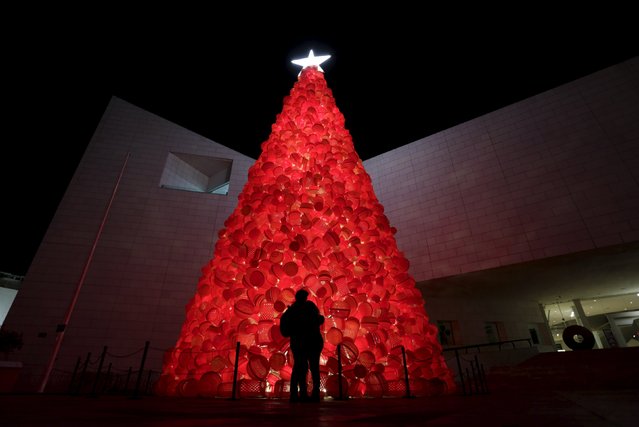
A couple hugs while standing near a Christmas tree made out of plastic bins and plastic hampers outside the Museum of History in Monterrey, Mexico, December 4, 2015. (Photo by Daniel Becerril/Reuters)

A couple hugs while standing near a Christmas tree made out of plastic bins and plastic hampers outside the Museum of History in Monterrey, Mexico, December 4, 2015. The humble Christmas tree has a rich history, from evergreen trees used to symbolise eternal life in Ancient Egypt to tree worship among pagan Europeans. The modern version has its origins in Germany, where the song “O Tannenbaum” is still a festive favourite. Today the traditional tree with lights and decorations appears in cities including Washington, Moscow and Beirut. Alternative constructions range from recycled rubbish in Mexico City to old window frames in Rakvere, Estonia. Whatever the shape or size, the message is the same: Merry Christmas. (Photo by Neil Hall/Reuters)
Details
23 Dec 2015 08:01:00


Is it worth eating live beings? This is a philosophical question: the history of our species and the ontology of being are saying that it's more likely yes, and on the other hand your mind and empathy are more likely to be against this idea. Or at least like in this Korean clip – eat, but with tears in your eyes.
Details
05 Jan 2019 13:13:00